

The best food container for an RV is the one that stops taking up space when the food is gone. That sounds obvious, but it took me two seasons of digging through the overhead galley cabinet in our 25-foot Class C motorhome to understand it. Ray and I bought the Annaklin 8-pack collapsible silicone containers in spring 2025, and they have been in the cabinet ever since. I still keep a couple of rigid plastic containers because they do one job better. This is the comparison I wish I had before I filled that cabinet with boxes that only worked when they were full.
Short answer: for our galley, the Annaklin set wins on empty storage, weight and microwave use. Rigid plastic wins on stacking full containers and protecting soft food from being crushed. If you have one narrow drawer and one overhead cabinet, as we do, the collapsible set earns its place. If you pack full containers shoulder to shoulder in a fridge or stack heavy gear on top of your food box, keep some rigid pieces. The rest of this is how I got to that answer, including the parts of the Annaklin set that are not perfect.
How the Two Types Compare in a Small Galley
Before I bought either type, I measured the overhead cabinet above the sink with a tape measure: about 22 inches wide, 11 inches deep, and 9 inches of usable height. Then I stacked the rigid plastic containers we already owned, a set of square boxes I had brought from the house in Salem, and set them inside. Six boxes took the entire cabinet and pushed against the ceiling trim when I closed the door. That was the afternoon I started looking at collapsible containers. What follows is what I have found after two seasons of using both types side by side, not what the packaging claims.
| Annaklin Collapsible Containers | Rigid Plastic Containers | |
|---|---|---|
| Empty cabinet space | Collapses to roughly half height, so the empty pieces nest in the overhead galley cabinet | Holds full height empty or full, so every piece claims shelf space all the time |
| Stacking in the fridge | Flexible walls need a flat spot and do not stack as squarely when full | Rigid walls stack straight and stay put on a crowded shelf |
| Crush protection in a packed bay | Silicone walls can flex and squash if something heavy rides on top | Rigid walls keep soft food from being crushed under a cast iron lid or a bag of gear |
| Microwave and hot food | Rated microwave safe and tolerant from -4F to 428F | Many rigid plastic containers are not rated for high heat, and repeated hot use can warp them |
| Lid closure | Four snap buckles and a silicone seal ring, but all four need a firm press | A simple press or screw lid is quicker to close |
| Long-term staining | Tomato sauce can leave a faint stain in the silicone | Rigid plastic scratches and can hold tomato sauce and grease in those scratches |
| Weight in a tote | Light enough to carry to the picnic table with one hand | Also light, but bulkier when empty |
| Shapes and sizes | Rectangular and round pieces in four sizes from 11.8 to 40.5 ounces | Usually one shape per set, and the sizes are fixed |
| Freezer use | Freezer safe, but leave headroom for food to expand | Freezer safe, but a dropped frozen block can crack the plastic |
| Cleaning the seal | The silicone seal ring can trap crumbs and needs to be checked | No separate seal ring to clean on a simple lid |
| Warping over time | Silicone can stain but does not crack like rigid plastic | Rigid plastic can crack or warp after repeated hot washes |
| Packing odd leftovers | The four sizes fit around odd shapes and collapse as food is used | Fixed boxes waste space around odd shapes |
One note on that table. The winners are not evenly split, and three rows are a genuine tie. I gave rigid plastic the stacking, the crush protection, the lid speed and the seal cleaning. I gave Annaklin the empty space, the heat, the weight, the shapes and the warping. That is roughly how it shakes out in our rig after two seasons. Your mix will depend on whether your real problem is an overstuffed cabinet or an overstuffed fridge shelf. Ours was the cabinet, which is why the collapsible set is the one that stayed.
Where Annaklin Wins
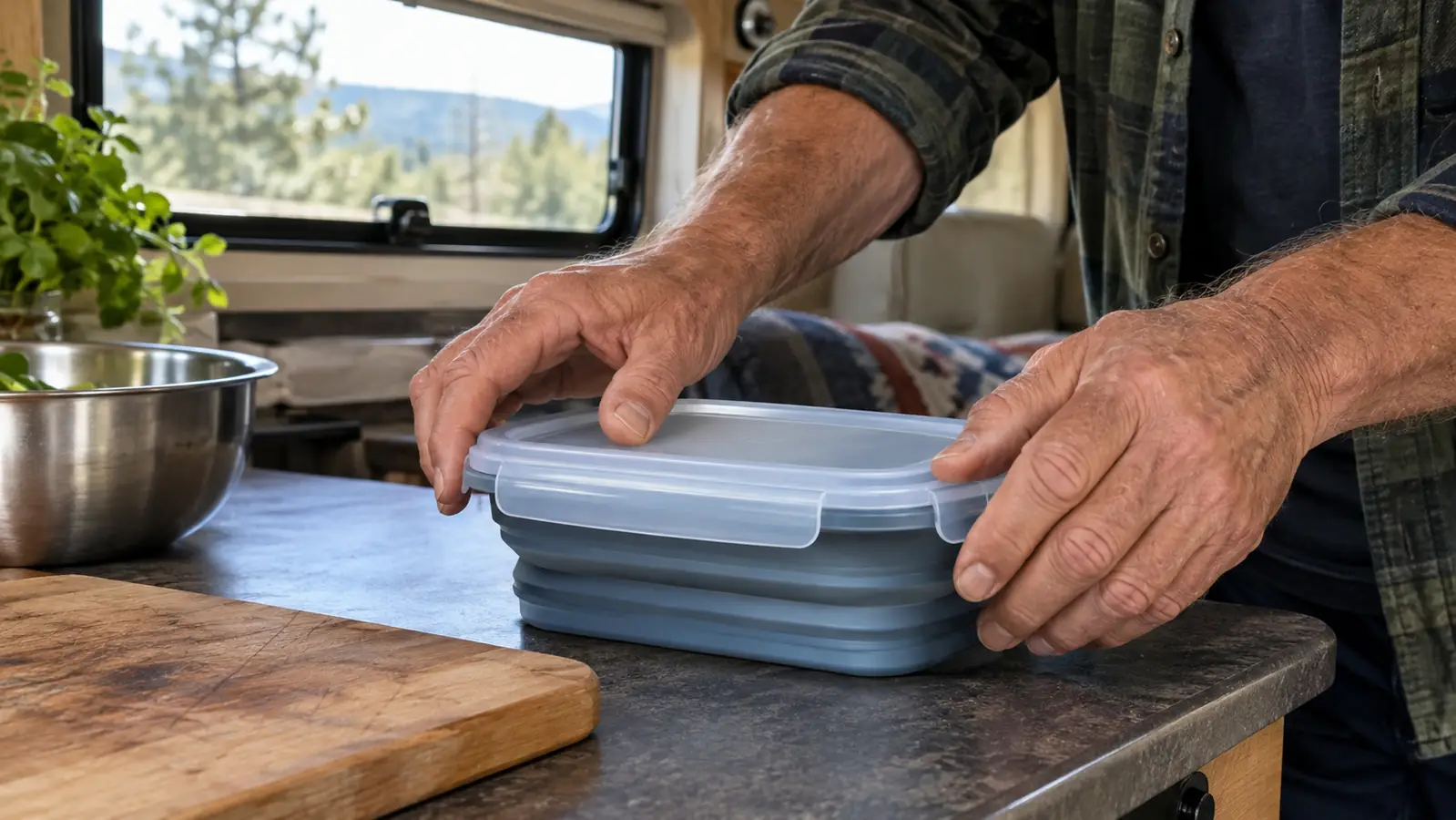
The first win is empty space. The Annaklin set is eight pieces, four sizes from 11.8 to 40.5 ounces, and the empty containers collapse to roughly half height. In our rig, that means the whole set nests in the overhead cabinet above the sink, with room left for a stack of paper plates. The rigid plastic containers I used before kept their full height whether they held chili or air. When you have one overhead cabinet for cookware and storage, that difference is the whole argument. The set holds 192.4 fluid ounces total, and the listed dimensions are 11.02 by 8.46 by 4.53 inches, so it fits a small cabinet without a fight.
Here is the demonstration that convinced Ray. Set the largest rectangular piece on the counter and it stands at full height. Press it down and it drops to about half, which is the space saving the listing claims. Eight pieces at full height would not fit in our overhead cabinet. Eight pieces collapsed fit with room left for the paper plates and a box of tea. Ray spent his working life as a machinist and does not get excited about kitchen gear, and even he did the arithmetic on the back of a receipt and said the set was the right call. That was spring 2025, and I have not had to rearrange that cabinet since.
The second win is heat. The Annaklin containers are microwave safe and rated from -4F to 428F. I reheat soup in the 27-ounce piece at the campground, and I do not have to move it to another bowl. Many rigid plastic containers are not rated for that kind of heat, and the ones that are can warp after a few hot cycles. The Annaklin set is also BPA free and dishwasher safe, which matters when we are washing dishes in a small sink and trying to use less water. The silicone flexes, so a quick hand wash reaches the corners.
Where Rigid Plastic Containers Wins
I am not going to pretend the collapsible set is better at everything. A full silicone container does not stack as squarely as a rigid box. The walls flex, so if I fill the 40.5-ounce piece with chili and try to put a second container on top, it leans. Rigid plastic holds its shape and stacks flat in the 6 cubic foot fridge. When I am packing for a long weekend and every shelf is full, the rigid containers are easier to organize.
The other concession is crush protection. In the outside storage bay, we carry a 5-quart cast iron Dutch oven and a 17-inch griddle. I would not put either one on top of a full silicone container. Rigid plastic walls protect soft food from being squashed by a bag of gear or a heavy lid. The Annaklin set is best kept in the cabinet or the fridge, where nothing heavy rides on top. I also find the four snap buckles slower to close than a simple press lid, especially when my hands are cold at the picnic table.
If your cabinet is full of empty containers, start with the set that folds down
The Annaklin 8-pack gives you four sizes, rectangular and round pieces, and a collapse that saves about half the height when the containers are empty. It is the set that made our overhead galley cabinet usable again.
Amazon Check Today's Price on Amazon →What the Annaklin Set Actually Does in Our Galley
We bought the set in spring 2025, at the same time I switched to detachable-handle cookware. The rectangular pieces fit the one narrow drawer beside the stove, and the round pieces go in the overhead cabinet. I use the 11.8-ounce and 16.9-ounce sizes for cut fruit, cheese and crackers. The 27-ounce and 40.5-ounce sizes hold soup, chili and leftover cobbler. On day trips to a lake, I pack sandwiches and grapes in the smaller pieces and put the whole thing in a tote. They are light enough that I do not think about the weight.
A Tuesday in September is a fair example. We were at a state park outside Bend, and I had cooked a pot of chili on the two-burner cooktop the night before. Tuesday morning I filled two 27-ounce pieces with the cold chili, packed celery and carrot sticks in an 11.8-ounce piece, and set the whole stack in a tote with a loaf of bread on top. Nothing leaked on the drive to the lake. At the picnic table I collapsed the empty pieces and they took up the corner of the tote the bread had been using. Back at the rig I washed them in a basin with about two cups of water and set them upside down on the dish towel. That is the entire cycle, and it is why the set stays in the rig while the rigid boxes stay home in Salem.
In the fridge, the set is most useful after a meal. A half-full container of stew can be collapsed down as we eat through it, which frees a little shelf space in a 6 cubic foot fridge. That sounds small until you are trying to fit a carton of milk and a bag of coffee in the same door. The rectangular pieces fit around odd shapes better than the rigid boxes I used to carry. The round pieces are better for soup because the lid goes on with four snaps and I can see the seal ring all the way around.
I do not use the Annaklin pieces for raw meat on a long trip. The silicone is easy to clean, but I would rather have a rigid container with a hard corner for that job. I also do not fill the largest piece to the rim before freezing. Food expands, and the flexible walls will bulge. Leave an inch of headroom and set the container on a flat shelf. Those are small habits, but they keep the set working.

The Lid, the Seal, and the Cleanup
The lid has four snap buckles and a silicone seal ring. When all four are pressed down, the lid sits tight and the container keeps food fresh. When I am in a hurry, I can get three snaps and miss the fourth. Then the lid lifts at one corner. I have learned to run my thumb around the rim before I put the container in the fridge. Ray does the same check after he packs his lunch. It is not hard, but it is not a one-hand job either.
One warning about that seal ring. In the fall of 2025 I pulled a ring out to rinse it, set it on the counter, and it slid behind the sink. I did not notice until the next morning, when I filled that container with soup and the lid would not sit flat. A missing ring is not obvious by eye when you are hurrying. Now I either rinse the ring while it is still on the lid, or I set it in a small bowl so it cannot wander off. That two-minute habit has saved me one messy fridge shelf and a long cleanup.
Cleaning is where the set earns my trust. The silicone is dishwasher safe, and at home in Salem I run the pieces through the dishwasher. At the campsite, I wash them by hand in a small basin with a little water. The silicone flexes, so I can turn the container inside out and reach the bottom corners without a bottle brush. The seal ring is the one fussy spot. Crumbs and grease can hide under it, so I pull it out and rinse it every few days. Tomato sauce can leave a faint stain in the silicone, but it does not affect the way the lid fits.
Eight containers, four sizes, 192.4 fluid ounces total. When they are empty, the Annaklin set takes up about half the height of the rigid boxes I used to carry in the same cabinet.
What I Would Not Pretend
I would not pretend the Annaklin set is a full replacement for rigid plastic. It is not. If you stack full containers in a tight fridge, or if you pack heavy gear on top of your food, rigid plastic is the better tool. The collapsible set also takes a few seconds longer to close because of the four snaps. And the silicone can stain. Those are real tradeoffs, not small print.
What I would say is that the tradeoffs are worth it in a 25-foot rig with one overhead cabinet. Space is the thing we do not have. The Annaklin set gives us eight containers that fold down when they are empty, and that is the reason they stay in the cabinet while the rigid boxes live in the house in Salem. If your rig has more storage, you may not need the collapsible set as much as we do.
Who Should Buy Which
Buy the Annaklin collapsible set if your galley storage is tight, if you reheat food in the container, and if you want containers that pack down when the leftovers are gone. Buy rigid plastic containers if you stack full containers, if you need hard corners for raw meat or soft fruit, or if you pack heavy items against your food box. Many RVers will do what we do: keep the Annaklin set for the cabinet and the fridge, and keep two or three rigid pieces for the jobs that need a hard wall. That is not a compromise. It is using each container for what it does best.
The set that earns its cabinet space when the trip is over
If you are tired of empty containers taking up the same room as full ones, the Annaklin 8-pack is the practical fix for a small galley. Four sizes, rectangular and round pieces, and a lid that snaps down with four buckles and a silicone seal ring.
Amazon Check Today's Price on Amazon →