
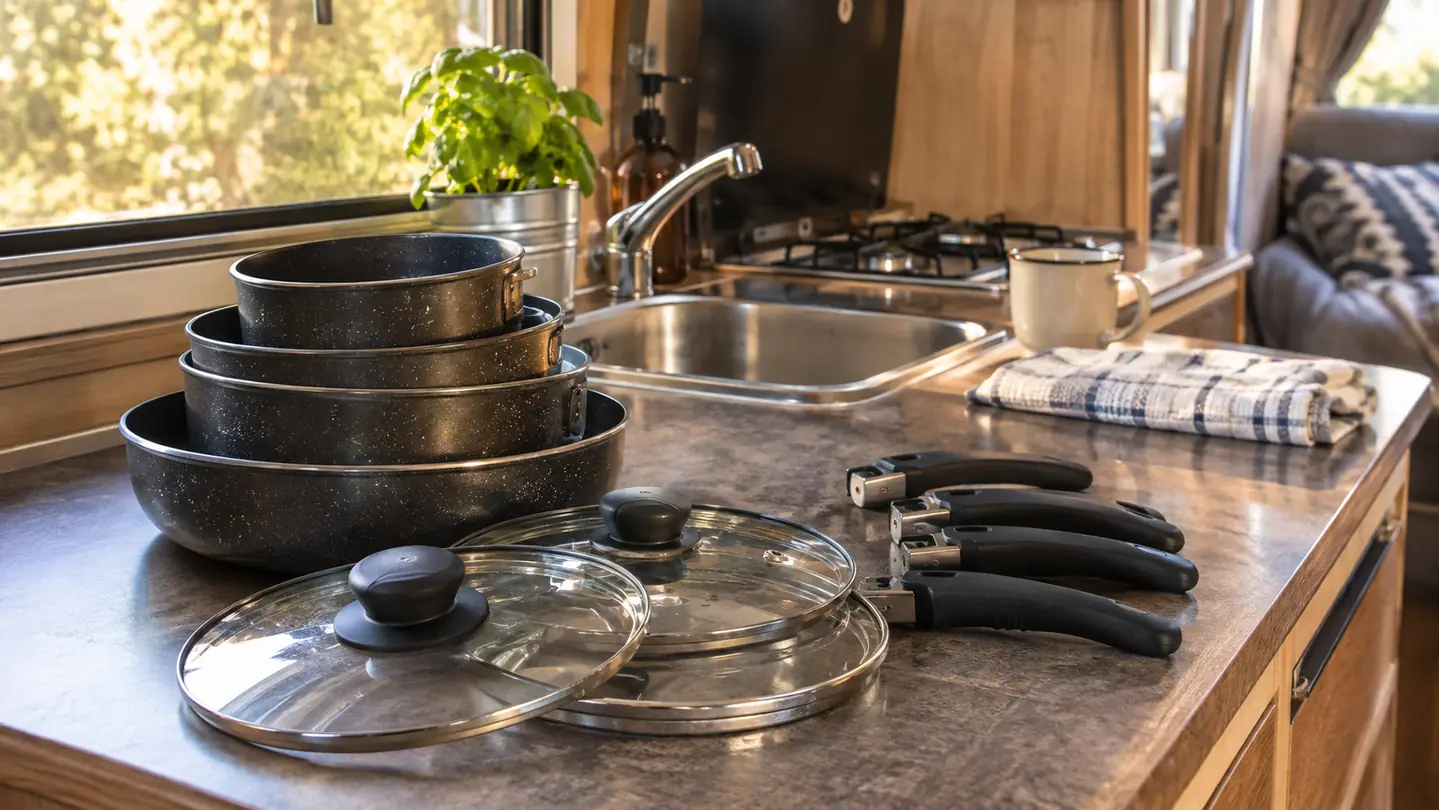
The drawer under our counter is twenty-two inches wide and about six inches deep. That is the entire cookware budget in our 25-foot Class C motorhome. For the first three years we traveled, I treated that drawer like a puzzle I kept losing. Long handles stuck out past the lip. Lids slid under everything else. I would open it at a rest stop, find the same two frying pans wedged sideways with a spatula jammed between them, and close it again and tell myself I would sort it out at the next campground. I did not sort it out at the next campground.
In spring 2025 I bought the CAROTE 19-piece detachable handle cookware set. The number of pieces is not what sold me. The two handles did. Take the handle off and a frying pan becomes a flat disc with a small socket on one side, and flat discs stack. That is the whole idea, and after about eighteen months of trips, from the Oregon coast to a winter in Arizona and back through every state park in between, that one idea has held up better than anything else I have bought for this galley.
The Quick Verdict
The detachable handles are not a gimmick. They are the reason five pans fit in a drawer meant for two, and the nonstick still releases eggs after eighteen months of near-daily cooking on a two-burner propane stove.
Amazon Check Today's Price →Five pans in a drawer built for two
Handles off, the set nests into a stack about a hand tall. Today's price and the full 19-piece breakdown are on the listing.
Amazon Check Today's Price on Amazon →How I've Used It
Ray and I bought this set in spring 2025, in the same week as a stack of collapsible silicone storage containers, because both purchases solved the same problem: a six cubic foot fridge and one narrow galley drawer. Our rig is a 2019 Class C, twenty-five feet, with a two-burner propane cooktop, a small microwave and one overhead cabinet for cookware. I cook in it most days when we are on the road. Ray handles the grill and the campfire. I handle the galley, which means I am the one who opens that drawer forty times a day.
Not all nineteen pieces travel with us, and that is the part I did not understand before I bought it. The core stays in the rig: the 8-inch frying pan, the 10-inch frying pan, the 1.5-quart saucepan, the 3-quart saucepan, the 4-quart saute pan, both detachable handles and the lids. The extra utensils and one of the storage lid sets stayed in the kitchen at our house in Salem. Nineteen pieces sounds like too much for twenty-five feet of motorhome. It works because you do not have to take all nineteen.
A normal dinner is chicken thighs or a stir fry in the 10-inch pan with rice going in the 1.5-quart saucepan beside it, both burners running, both pans on the counter five minutes later with the handles off. Breakfast is eggs in the 8-inch pan. The saute pan gets the one-pot meals, the ones where I brown meat, add liquid and let it sit, and the 4-quart size is right for two people with leftovers for the next day. The whole set is listed at about 4 kilograms, close to nine pounds, so weight was never the argument. The argument was whether the drawer would close. It closes.
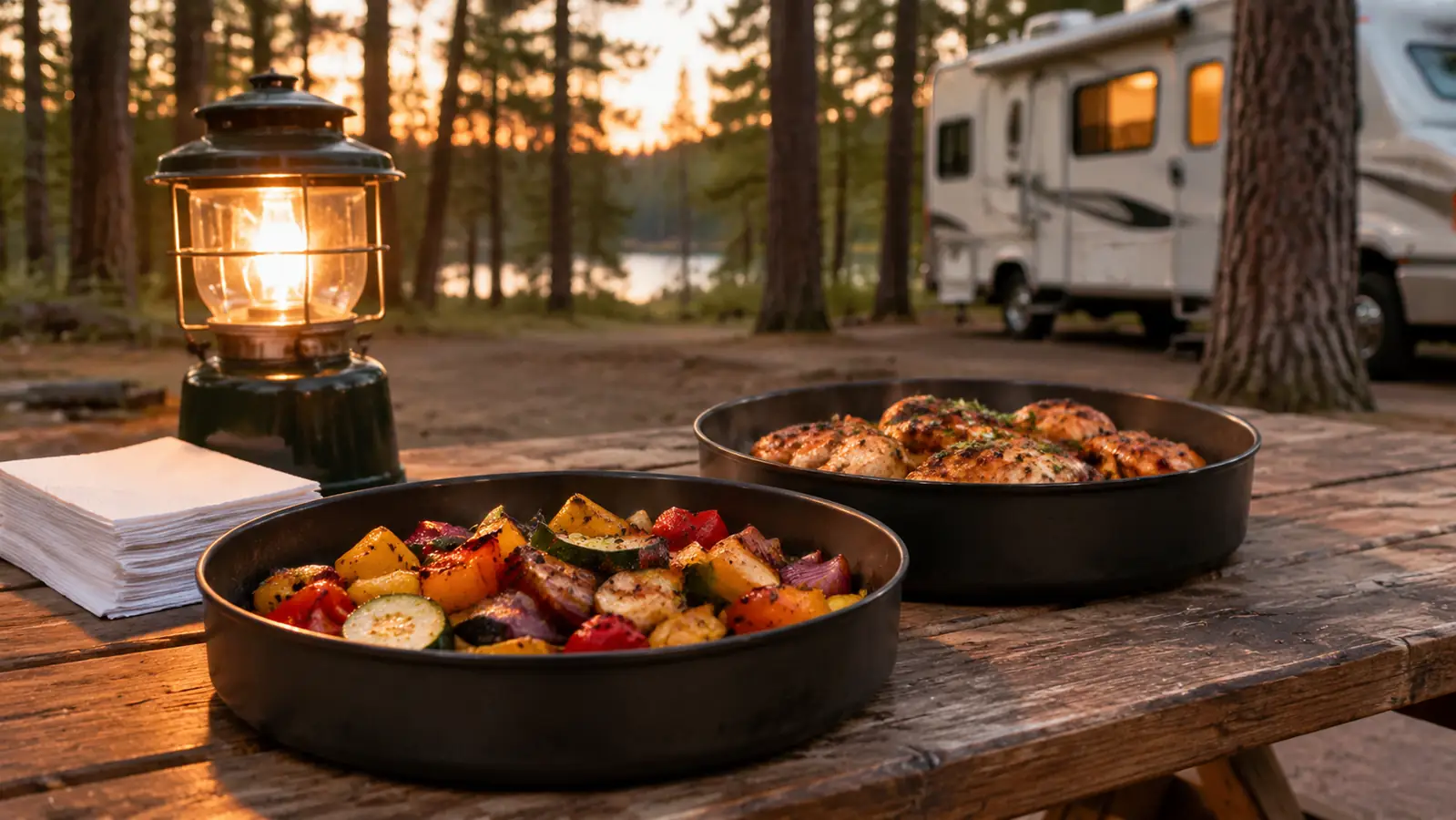
One evening last October, camped at a state park outside Bend, the wind came up hard enough that I did not want to be outside at the picnic table at all. I did the whole meal on the two inside burners: sausage and peppers in the 10-inch pan, couscous in the 1.5-quart saucepan, both lids on between stirs to keep the heat in. When it was done I took both handles off and we carried the pans to the table and ate out of them. Two pans, two forks, and about two cups of water to wash up afterward. On a night when the stove outside would have struggled to stay lit, that is the sort of thing I notice more than any line on the box.

What the 19 Pieces Actually Are
Here is what is in the CAROTE box, because nineteen pieces hides a lot. Five cooking vessels: a 1.5-quart saucepan, a 3-quart saucepan, an 8-inch frying pan, a 10-inch frying pan and a 4-quart saute pan. Two detachable handles, which is the part that matters. Tempered glass lids for the vessels that take them, storage lids that let a pan go straight into the fridge, and a set of utensils. The bodies are aluminum and the handles are Bakelite. The set is listed as oven compatible, which in practice means with the handles off.
The second thing the listing says is that it works as cookware and as dinnerware. That sounded like marketing until I started doing it. The 10-inch pan goes from the burner to the picnic table with the handle off, and we eat out of it. One pan to wash instead of a pan and two plates. When your dishwashing water comes out of a jug or a campground spigot, you feel that difference every single night. It also means fewer dishes stacked in a sink the size of a shoebox.
The claim that handles off saves up to 70% more space is the number I was most skeptical about. I cannot verify a percentage in a drawer with a kink in the runner, but I can tell you the practical result. The 10-inch pan, the 8-inch pan, both saucepans and the saute pan nest into a stack roughly a hand tall. Lids lie flat between them. The two handles go in the cutlery drawer. Nothing in that stack sticks up past the lip.
The lids are the piece I had to work out for myself. Tempered glass does not nest the way the pans do, so they get laid flat between the vessels, biggest at the bottom of the stack and smallest near the top, which keeps the whole thing level. I keep a couple of glass lids in the rig and left the rest at the house. The storage lids are a different animal: they press on and let a pan go into the fridge with leftovers still in it, which is how the saute pan spends a good share of its non-cooking life, half a meatloaf in it and a lid on top.
Living With Two Detachable Handles
The handle seats into a socket on the side of the pan and clicks when it is locked. There are two of them, so the 4-quart saute pan full of chili gets lifted with two hands, left and right, like a roasting pan. That is steadier than one long handle, and it is the arrangement I use for anything heavy. The grip is Bakelite, which is the reason the handle is not the hot part after ten minutes over a flame.
The one habit the set forced on me is checking the click before I lift. In eighteen months there has been one moment where I picked up a 3-quart saucepan of pasta water and felt the handle shift under my thumb, because I had set it in the socket without pushing it all the way home. Nothing spilled. But now I press down and listen for the click every time, the way you check a hitch before pulling out of a site. It takes half a second and it is not optional.
Ray is a retired machinist, and his one contribution to this review was to point out that anything that clicks can stop clicking cleanly if grit gets into it. So I wipe the socket out with a dry cloth every few days, more often after a windy week at a picnic table where the sand moves in. A little grit in the wrong place and the handle does not seat all the way down, and you can feel it before you lift anything heavy.
Because the handles come off, the pans can go in an oven. I use that more than I expected, though not in the rig, which has a microwave and the cooktop and nothing else. At the house in Salem I have a full oven, and a frittata in the 10-inch pan starts on a burner and finishes in there, with no handle sticking out to catch on the rack or the door. The lids stay on the counter when the pan goes in.
Cooking, Cleaning, and Rationing Water
Nonstick on a two-burner propane stove is not the same as nonstick on a home range, because the flame is harder to modulate. Even so, eggs slide in the 8-inch pan, pancakes release, and a piece of salmon comes off the 10-inch pan with a spatula and leaves nothing behind. The pans heat quickly and evenly enough that I have stopped preheating as long as I used to. I keep the flame at medium or below, which is what the coating wants anyway.
Cleaning is where the set earns its place in an RV. I wipe the pan while it is still warm with a paper towel, then use a soft sponge with a drop of soap, then rinse. That is maybe a cup of water per pan. No soaking, no scrubbing, no filling the sink. I cook with silicone and wooden utensils now, I do not own a metal spatula anymore, and I do not stack anything sharp on top of the pans in the drawer.
One pot of rice left a starch ring around the 1.5-quart saucepan on a night I had the flame higher than I meant to. I let it cool, wiped it with a damp paper towel, and the ring lifted without any soaking at all. That is the test I judge a nonstick pan by in a rig, because soaking means leaving a sink full of water standing overnight, and that water has to come from our fresh tank and go into the grey tank. A pan that needs soaking is a pan that costs us something.
Details that matter to me: the coating is listed as free of BPA, cadmium, lead and PFOS, which is the sort of thing I check now that I cook on it twice a day. CAROTE lists a 12-month warranty from the date of purchase. We are well past that and nothing has delaminated, chipped or bubbled, though I am careful with heat and utensils, so read that as one careful owner rather than proof the coating is indestructible.
Where It Falls Short
This is not a set for high heat. A nonstick pan will not give you the crust a cast iron skillet gives you, and I do not ask it to. When Ray wants a steak with a real sear, it goes into the 5-quart Lodge over the campfire, not into the CAROTE. If you are the kind of cook who wants one pan to do everything at any temperature, this is the wrong purchase, and you probably already know it.
Nineteen pieces is also more than most people need in a rig this size. I left pieces at home and I would leave them at home again. The storage lids are genuinely useful in the fridge, but they take up room, and the utensils are the least essential part of the set. If you have less cabinet space than we do, count what you will actually carry before you count what you are buying.
And the honest one: a coated aluminum pan is not a buy-it-for-life pan. Eighteen months in, mine look good, but cast iron will outlive them and so will good stainless. What you are paying for here is the flat stack and the light weight, not permanence. Set your expectations there and you will be pleased. Expect it to be the last cookware you buy and you will be disappointed.
What I Liked
- Handles off, the five vessels nest into a stack that fits a drawer about six inches deep
- The set is listed at roughly 4 kilograms, light enough that loading the drawer is a one-hand job
- Nonstick still releases eggs and fish after about eighteen months of near-daily cooking
- Two handles let you lift the 4-quart saute pan from both sides instead of wrestling one long handle
- Pans go from burner to picnic table as serving dishes, which cuts washing up when water is limited
- Oven compatible with the handles off, so a handle is never in the way of a small oven rack
Where It Falls Short
- The handle must be seated and clicked every time, and a half-seated handle will shift under a full pan
- Nonstick means no metal utensils and no high heat, so real searing still needs cast iron
- Nineteen pieces is more than a small galley needs, and the extras still take up room somewhere
- It is a coated aluminum set, not a lifetime purchase, and it should not be priced in your head as one
Handles off, the 10-inch pan, the 8-inch pan, both saucepans and the saute pan nest into one stack that slides into a drawer six inches deep. That is most of the review, honestly.
Who This Is For
This set suits someone cooking in a small space where the drawer is the hard limit: a Class B or Class C motorhome, a truck camper, a trailer with a galley the width of a hallway. It suits a couple who cooks most nights rather than eating out, who washes dishes by hand, and who wants the pan to double as the serving dish. If you have ever pulled every pan out of a drawer to reach the one at the back, this is aimed at you.
It also suits anyone who has moved from a house kitchen into a rig and wants the familiar shape of a saucepan and a frying pan rather than a nesting backpacking set. The 3-quart saucepan holds a pound of pasta. The 10-inch pan fits two chicken breasts. These are home-sized pans that happen to store flat.
Who Should Skip It
Skip it if you cook over high heat, if you like a metal spatula and a stiff brush, or if the sight of a scratched nonstick pan will bother you. Skip it if you want one heavy pan that does everything and will outlast the motorhome, because that is a different product made of a different material.
Skip it too if storage is not your problem. If you have a deep drawer or a cabinet with vertical slots, a fixed-handle set will cost less and last longer, and the detachable handle is a solution to a constraint you do not have.
The narrow-drawer problem, solved by taking the handle off
Five vessels, two handles, tempered glass lids and storage lids, and a stack that clears a six-inch drawer. Current price and the full piece count are on the listing.
Amazon Check Today's Price on Amazon →