
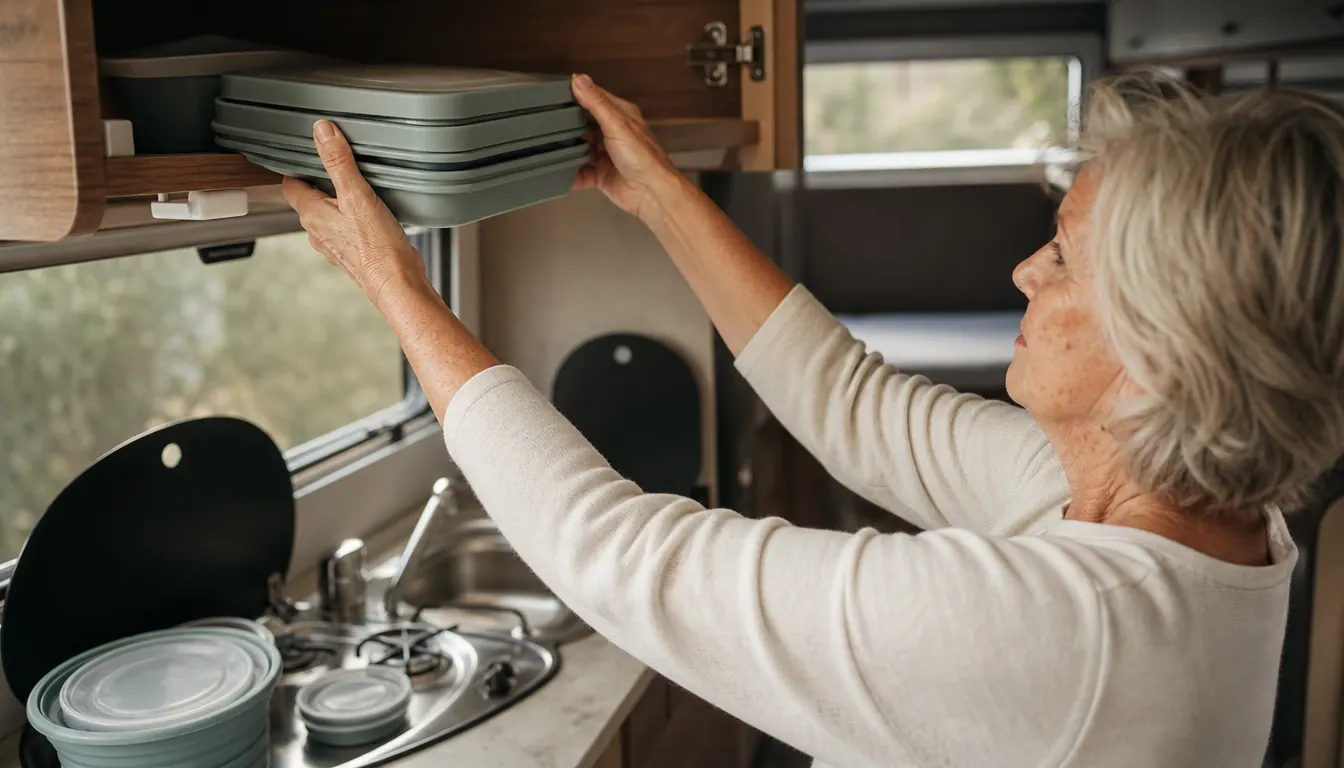
I bought the Annaklin collapsible containers in spring 2025 because I had reached the end of my patience with a cabinet. Not with cooking, and not with the motorhome itself. With one overhead cabinet in the galley that held four rigid plastic containers and nothing else, and every time I wanted the middle one I had to take out the other three and set them on the counter.
Two seasons later, most of those rigid containers are back at the house in Salem, holding screws in Ray's garage. The Annaklin set lives in the rig. But this is not a straight endorsement, because there are three specific things about these containers that the product photos never show you, and one of them nearly made me give up on them in the first month. If you are retired, cooking most days in a small galley or at a picnic table, and thinking about whether these are worth the cabinet space, here is the honest version.
The Quick Verdict
Genuinely saves cabinet space and handles camp cooking well, but the lids demand real attention and the silicone holds onto tomato sauce. Buy them for the flat-pack trick, not for leakproof travel.
Amazon Check Today's Price →Want to see the current Annaklin sizes and price before reading the rest?
The 8-pack comes in four sizes from 11.8 oz to 40.5 oz, rectangular and round, with snap lids. That is the set I have been using since spring 2025.
Amazon Check Today's Price on Amazon →How I Have Actually Used These for Two Seasons
Our rig is a 2019 Class C, 25 feet, with a two-burner propane cooktop, a small microwave, and a 6 cubic foot fridge. The galley has one narrow drawer and one overhead cabinet for cookware and storage. That is the whole inventory. When I say space matters, I am not being dramatic about it. I am describing a cabinet that is roughly the size of a microwave.
The Annaklin set went into that overhead cabinet, and this is the part that sold me: collapsed, all eight nest down to something close to the height of a hardback book. I stack the flattened ones on the left side and I can still reach everything behind them without unloading the cabinet. The listing claims the collapsible design saves up to 50 percent of space. In my cabinet the honest number is closer to a third, because the lids do not collapse and they need somewhere to live. Still a third, in a 25-foot motorhome, is the difference between a usable cabinet and a daily argument.
Before these, I tried a wire rack that was meant to hold four rigid containers upright so I could slide them out like files. It lasted one trip. The rack ate two inches of cabinet depth, the containers still had to be lifted over the lip, and on a rough stretch of Highway 101 north of Lincoln City the whole contents slid forward on a turn and took the rack with them. I measured the cabinet the week after we got home: 22 inches wide, 11 inches deep, and 9 inches of usable height under the shelf above. The largest container is listed at 11.02 by 8.46 by 4.53 inches, and the flattened set stacks to barely more than that. That leaves the top half of the cabinet for the lids, a tin of tea and the coffee filters.
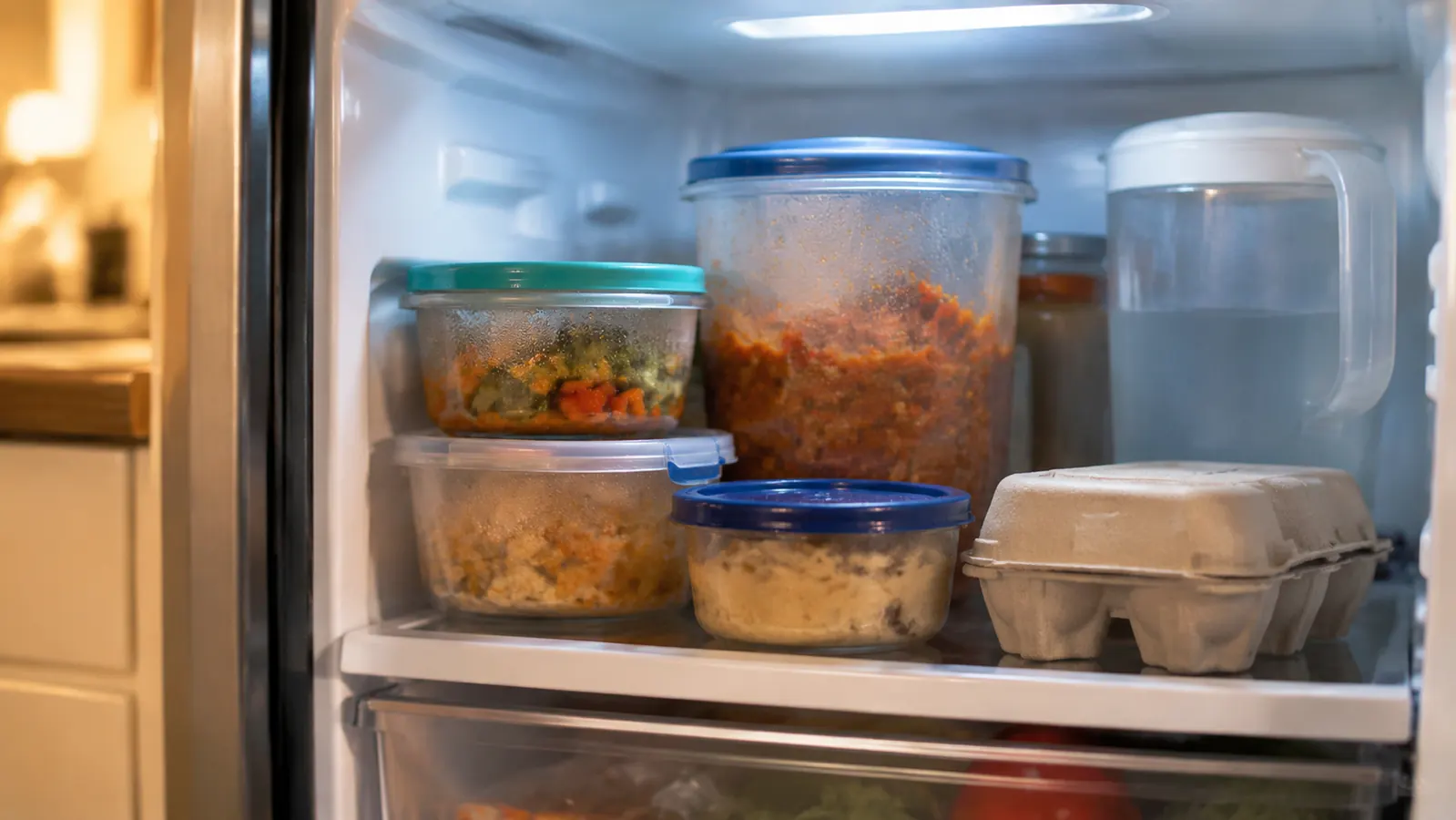
The second job is the fridge. I use the small ones for leftovers and the tall ones for prepped ingredients, and the rectangular shape is what makes it work, because rectangles pack against each other in a fridge the way round containers never do. A 6 cubic foot fridge has no wasted corner to spare. When I have half an onion, three spears of asparagus and a cup of rice left over, they go in three containers, and those three containers stack in the space one dinner plate would take.
The third job is day trips. When we drive to a lake for the afternoon, lunch goes in the 16.9 oz and 27 oz sizes, and they ride in a tote bag without complaint. This is where the containers are at their best and where the snap lids are genuinely useful.
The Three Things Nobody Tells You
Let me start with the one that nearly ended the relationship.
The lids are not casual. There are four snap buckles plus a silicone seal ring on each lid, and they work, but they work only when all four buckles are pressed down properly. In my first week I filled a 27 oz container with soup, pressed two buckles, got distracted by the kettle, and put it in the fridge. I found out about it later when I picked it up by the lid. That was my mistake, not a design flaw, but it is a real behavior change if you are used to a lid that just sits there. Ray, who is 70 and has hands that have spent forty years around machinery, has no trouble with them. I have arthritis in my thumbs and I notice the pressure required, especially on the largest size.
I have a routine now. Fill, set the lid, then work around the rim pressing each buckle until I hear the snap, then press the centre of the lid down with the flat of my hand to seat the seal ring. Four buckles, four snaps, every time, about eight seconds. What I stopped doing is filling a container to the brim. The walls bulge when they are full, the lid sits proud of the rim, and one buckle will not catch. Leave a finger of headroom and it goes on clean. Ray watched me lose a fight with a 40.5 oz container of beef barley soup on a Tuesday in October before I worked that out, and he said what he always says, which is that I was overfilling it.
Second: tomato sauce tints the silicone. Not badly, and not permanently in a way that affects the food, but if you make chili or a tomato-based stew once a week the way we do, the containers will gradually take on a faint warm tone. I have one 40.5 oz container that has held maybe thirty batches of chili and it is visibly different from the ones that have only held rice and vegetables. Dishwasher safe does not mean stain proof. If a uniform matching set matters to you aesthetically, this will bother you. If you are like me and you care about whether the food stays fresh, it will not.
Third, and this is the one I would want a friend to tell me: the sizes are not what you expect from reading 8 pack. You get four sizes across two shapes, not eight matching containers. Some people read that listing and assume eight identical pieces. There are small ones, medium ones, large ones and extra large ones, and you will find that two of the sizes do almost all the work in your kitchen while one sits idle. I use the 27 oz constantly. The 11.8 oz ones get used for salad dressing, cut fruit and small amounts of leftovers, but if I were buying again I would want a set of six in the middle sizes rather than the full spread.
Collapsed, all eight nest down to something close to the height of a hardback book, and I can still reach everything behind them without unloading the cabinet.
Temperature, Cleaning and the Water Question
The silicone is rated from -4°F to 428°F, which covers everything I have asked of it. I have microwaved soup in the 40.5 oz size in the RV microwave many times. I have put the smaller ones in the freezer with leftover stew. Neither has warped or cracked anything. I have not put them near a campfire and I would not, because silicone and open flame are not a combination worth testing in a campground.
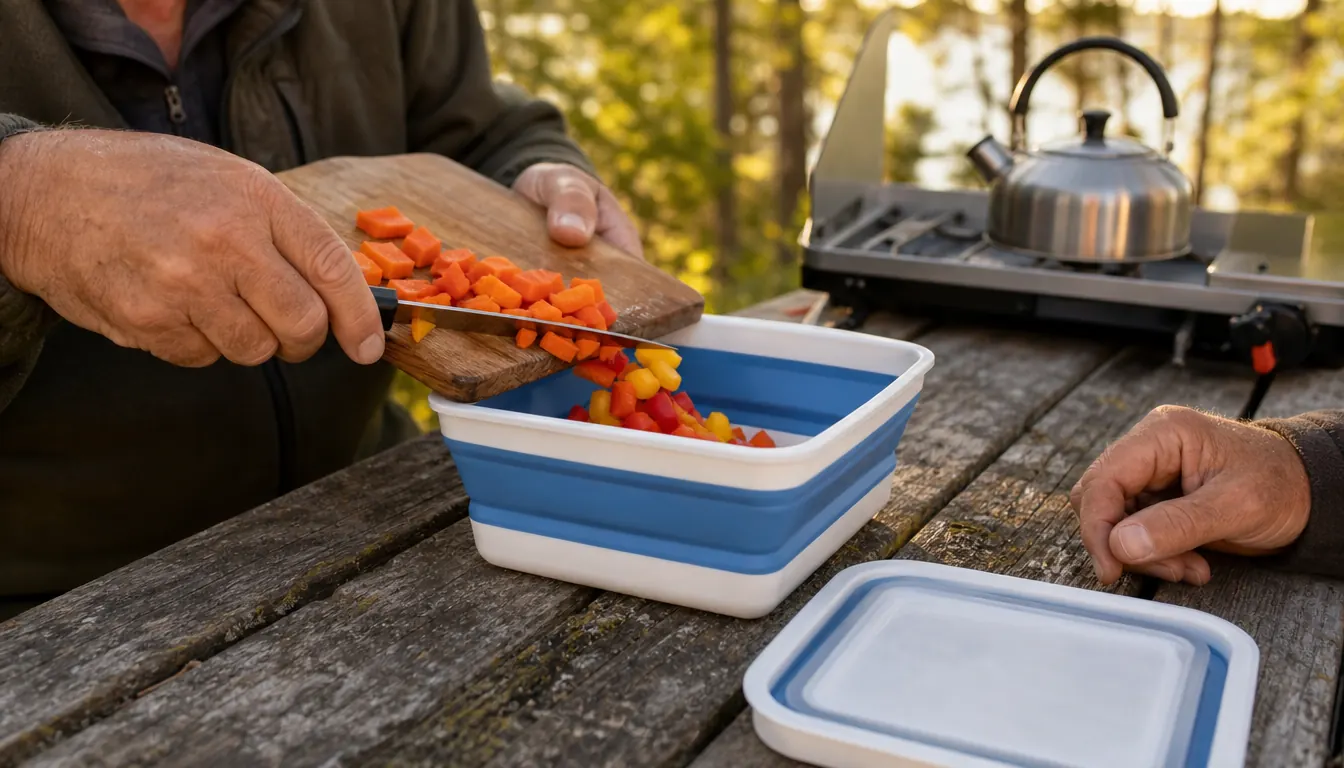
Cleaning is where the RV context matters most. We have limited water and limited tank space, so dishwashing water is a resource, not an unlimited tap. Silicone has one real advantage here: it does not hold onto grease the way plastic does. A quick wipe with a soapy cloth and a rinse gets most of the way there. Rigid plastic containers with corners and ridges take more scrubbing and more water. When I am washing up at a picnic table with a basin and a kettle of hot water, that difference is worth something real.
We wash up in a plastic basin at the picnic table most evenings. Two quarts of hot water from the kettle, a squirt of soap, and everything gets done in that one basin in order: glasses first, then containers, then the greasy pan last. Rigid plastic used to force me to change the water halfway through, because grease came off it slowly and the water went grey before I was done. The silicone wipes clean in a couple of passes. On a stretch through eastern Oregon last September we went four days between dump stations, and one basin of water per evening instead of two is the kind of saving that adds up when every quart has to be pumped or carried.
They are dishwasher safe, and at home in Salem I run them through. In the rig I hand wash, because running the dishwasher for four containers is not a thing we do. One caution: because the sides are flexible, they need to be dried open or they will hold moisture in the folds. I leave them collapsed but not sealed, sitting on a dish towel on the counter overnight. If you snap a damp container shut, you will know it the next time you open it.
Where These Fit With the Rest of My Galley
It took me a season to understand that the Annaklin containers are not competing with my cookware. They are competing with air. My CAROTE set nests in the one narrow drawer and I do not have room to add anything there. The Lodge Dutch oven lives in a padded bag on the floor of the outside storage bay at 13 pounds, deliberately low and centered. The Gas One stove and Ray's Blackstone griddle both live in that same bay in their cases. Nothing in that arrangement changes based on what I store leftovers in.
The containers are the one piece of the kitchen that solves a galley problem rather than a cooking problem. When I prep vegetables in the afternoon for a dinner I will cook at the picnic table, the prepped pieces go into containers and into the fridge, and the counter is clear. When I cook too much chili in the Dutch oven, which is most weeks, the leftovers go into the 40.5 oz containers and stack in the fridge instead of colonizing three shelves with a pot.
When the Lodge comes out and I make a five quart batch of chili, which happens about once a week, roughly half of it goes into containers the same evening. Two of the 40.5 oz size hold the surplus, and they go into the fridge flat and stackable instead of leaving me with a heavy pot and a lid that eats an entire shelf. Before the containers, that pot sat in the fridge overnight and I lost the shelf until Thursday. I would rather wash two containers than lose a shelf in a six cubic foot fridge.
That is the actual value. It is not that these containers are remarkable objects. It is that they let a small kitchen behave like a slightly larger one.
Who This Is For
If you are retired and traveling in a rig where cabinet space is measured in inches, this set earns its keep. It is especially good for anyone who preps ingredients ahead, anyone who cooks in batches and deals with leftovers, and anyone who packs lunches for day trips to a lake or a trailhead. The 4.3 star average across more than three thousand ratings is consistent with what I have found: most people get real use out of these.
It is also a good fit if you have limited hand strength and want containers that are light when empty. Silicone weighs almost nothing collapsed, which matters when you are lifting a stack out of an overhead cabinet at shoulder height.
Who Should Skip It
Skip these if you need a container that is genuinely leakproof in a bag. The snap buckles and the seal ring do a good job of keeping food fresh inside a fridge, and I have carried soup in the 27 oz size in a tote without incident, but I would not trust one on its side in a backpack or in a cooler full of ice. For that job, a screw-top rigid bottle is the right tool and these are not.
Skip them if you cook a lot of tomato-based food and a uniform-looking set matters to you. And skip them if you want eight containers of the same size, because you are not getting that. You are getting four sizes in two shapes, and if your cooking leans toward one kind of portion, you will have sizes that sit idle.
One more honest note for anyone with hand or thumb issues: the lids require firm, even pressure on all four buckles. If gripping and pressing is painful for you, look at a set with fewer, larger latches. I managed fine, but I noticed it every single time in the first month.
What I Liked
- Collapses flat enough to free real cabinet space in a small galley
- Rectangular shape stacks efficiently in a compact RV fridge
- Silicone releases grease with less water than rigid plastic, which matters when tank space is limited
- Rated -4°F to 428°F, and it handled microwave and freezer use without warping
- Light when empty, easy to lift out of an overhead cabinet
- Four sizes across two shapes cover leftovers, prep and packed lunches
Where It Falls Short
- The lids need all four snap buckles pressed firmly or they will not hold
- Tomato sauce gradually tints the silicone
- You get four sizes in two shapes, not eight matching containers
- Flexible walls must be dried open or they hold moisture in the folds
- Not the right choice for leakproof transport in a bag or cooler
The Bottom Line After Two Seasons
I would buy the Annaklin collapsible containers again, and I have already told two women at a campground in Oregon to get a set. But I would buy them knowing what I know now: they are a space solution, not a travel container, the lids need your attention every time, and the silicone will not stay looking new if you cook the way we cook.
In a 25-foot motorhome with one overhead cabinet for this kind of thing, they have earned their spot. In a big kitchen with endless cabinet space, they would be a nice-to-have rather than a fix. That is the honest summary. If your galley is small and your patience for digging through stacked plastic is gone, these solve that problem for a reasonable amount of money, and two seasons in, mine are still doing it.
Still deciding? Look at the size breakdown before you buy
Four sizes from 11.8 oz to 40.5 oz, rectangular and round, plastic snap lids, rated -4°F to 428°F. Check the current listing for today's price and the exact size mix.
Amazon See the Annaklin 8-Pack on Amazon →