
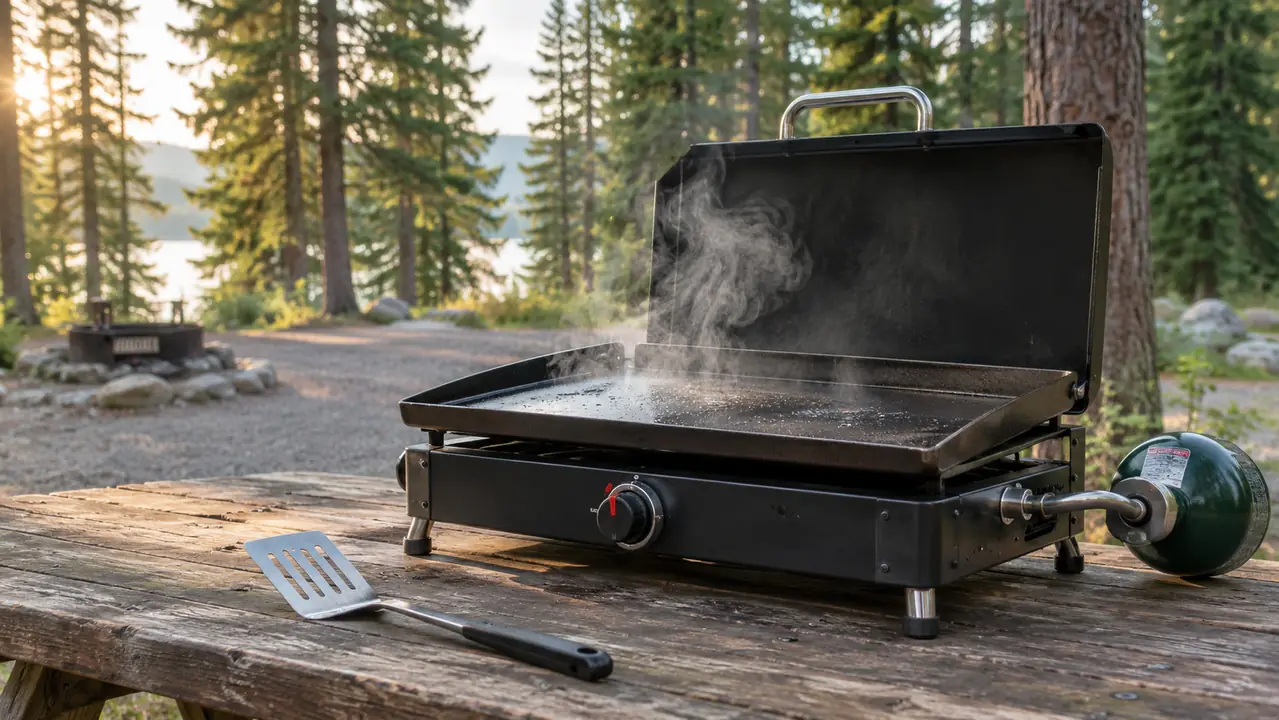
The first thing Ray cooked on the BLACKSTONE was a pound of bacon, and the smell pulled two neighbors over from three sites down before the pancakes even hit the surface. We bought the 17 inch tabletop model in spring 2026. It has been out on a picnic table at nearly every campsite since, somewhere past eighty breakfasts by my rough count, plus a summer of smash burgers and one memorable batch of fried rice. We pull one rig, a 25 foot Class C, and anything that comes with us has to earn its space in a single outside storage bay.
Here is what I am not going to tell you: that a griddle makes good pancakes. It does, and you already knew that. What I want to tell you is what seven months of steady use does to the thing, where it lives in a motorhome this small, how it behaves when the wind picks up at four in the afternoon, and the two parts of owning it that still annoy me. If you are standing in a campground trying to decide whether a griddle earns the space a two-burner camp stove already takes up, that is the question I can actually answer.
The Quick Verdict
268 square inches of honest cooking surface, a grease tray that holds a whole pound of bacon, and a footprint that slides into a shallow storage bay. The scrape and the oil after every use is a real job, not a footnote.
Amazon Check Today's Price →The griddle that has cooked every breakfast on our trip since April
17 inches of flat surface, about twenty pounds, and it fits in the bay behind the rear wheels. Check today's price and the current rating before you decide.
Amazon Check Today's Price on Amazon →How I've Used It
Ray runs the griddle. I run everything else in the galley, and that division has held since we started traveling in 2021. He sets it up on the picnic table, hooks up a 1 lb propane cylinder or the adapter hose depending on how long we are staying, and cooks breakfast outside so the inside of the rig does not smell like bacon fat for three days. In summer that matters more than you would think. A 25 foot motorhome holds heat, and two burners going inside at eight in the morning turns the whole thing into an oven.
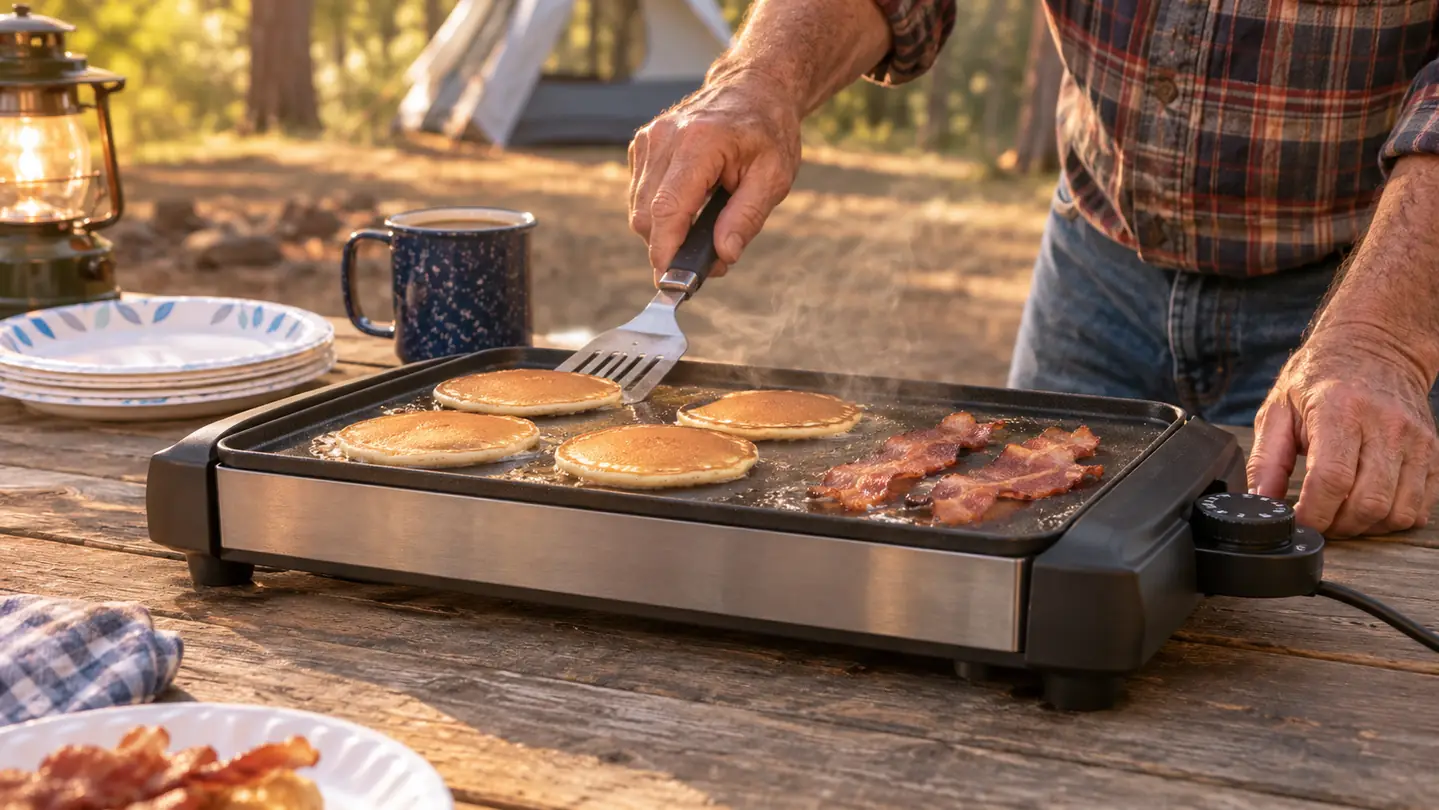
Breakfast is the main event: pancakes, eggs, bacon, hash browns, and toast done on the flat surface when the toaster is being temperamental. Suppers are smash burgers, onions, and whatever vegetables need using up. The BLACKSTONE has also cooked for other people. When neighbors wander over, which they do, we have fed six without anyone waiting long. That is the whole case for it, really. It is a second cooking surface that lives outdoors and does not heat up the rig.
Getting it out takes about three minutes. It lives in the outside storage bay in its own cover, and the bay is the low, wide compartment behind the rear wheels, so it comes out at waist height. The hood and the stainless front plate make it heavier than it looks, but Ray carries it the fifteen feet to the table himself and he is seventy. I have carried it too. I would not want to carry it a quarter mile to a beach.
What 268 Square Inches Actually Cooks
The cooking surface is 17 inches across, which the listing puts at 268 square inches, and I have never found that number to be optimistic. Nine burgers fit with a little room to work a spatula between them. So do eight pancakes at a time, which means a batch for two people is done in one pass instead of three. Hash browns for two spread out thin enough to actually crisp rather than steam.
Where it runs out is a full breakfast for eight. Not because the surface cannot take it, but because you are cooking in waves by then and the first batch is going cold while the last one cooks. For two people, or four, it is more surface than we need, and I have never once wished we had bought the bigger version. That is a sentence I do not get to write often about anything we have purchased for this rig.
One thing to be clear about: it is a flat griddle, not a stove. You cannot put a pot on it. We still use the two-burner cooktop inside for pasta and rice, and the Gas One single burner outside when we want a flame under a pot at the picnic table. The griddle is a third surface, not a replacement for the other two.
The Grease Tray, Which Is the Whole Story
Grease management is where tabletop griddles either work or they do not, and this is the part that surprised me. The tray underneath has real capacity. The listing says it does not need frequent emptying while you are busy cooking, and after a pound of bacon and a package of sausage I believe it. Nothing overflowed. Nothing ran off the edge onto the picnic table. That sounds like a low bar until you have watched a cheaper griddle do exactly that at somebody else's campsite.
I still empty it every single time, and I want to be honest about why. Not because it fills up, but because carrying a tray of warm grease across a campground to a disposal point is a job I would rather do once, immediately, while I am already standing there, than discover two hundred miles later when the griddle has been riding in the storage bay. Set it on a flat rock, let it cool, wipe it out with a paper towel, done. Two minutes. That is the difference between a griddle that stays usable and one that smells.
The cooking surface itself needs scraping after every use and a thin coat of oil before it goes away. This is not optional and it is not a design flaw. It is how a flat steel surface works. If you are the kind of person who wants to cook, eat, and walk away, this is not the appliance for you, and I would rather tell you that now than have you find out at seven in the morning.
Nine burgers on a picnic table, a pound of bacon before that, and the grease tray never came close to running over. The cleanup is the price, and it is a real one.
What It Weighs, and Why That Decides Things
The shipping weight is 9 kilograms, a hair under twenty pounds, and the overall footprint is 21.7 inches deep by 20.5 wide by 14.7 tall. That last number is the one that matters in a motorhome, because height is what determines whether something slides into a compartment or has to ride on the floor.
It slides in. Ours goes in the outside bay with the cover on, next to the cast iron Dutch oven in its padded bag. Those two are the heaviest things we carry for cooking, and we keep them both low and over the rear axle. Ray is careful about weight in this rig and I have learned to be too. Twenty pounds is not nothing when you are already close to your limit, and it is the main argument against the bigger models. The two of us can lift this one without arguing about it.
Set up, it takes a corner of a standard picnic table and leaves the rest for plates and coffee. That sounds like a small thing. On a rainy morning when everyone is crowded under one shelter, it is not small at all.

The Igniter, the Burner, and Cooking in Wind
It lights from a built in igniter. No match, no long lighter fumbling in the breeze. The burner underneath is an H shape, which is what the listing credits for even heat, and I can tell you what that looks like in practice: the pancakes at the far left corner brown at roughly the same rate as the ones in the middle. Not identical. Roughly. On a griddle this size, that is good enough that I stopped shuffling food around to compensate.
Heat runs from light to high, and most of our cooking happens in the lower half of that range. High is for getting a crust on a burger or driving off water after cleaning. Eggs on high will punish you.
Wind is the real limitation, and it is true of every propane griddle I have ever stood next to. On an exposed site with a breeze coming across the table, the flame struggles and the surface cools at the edge nearest the wind. We carry a simple folding windscreen and set it on the upwind side. With that in place it has cooked through mornings I would not have wanted to be outside for. Without it, you will be standing there with a spatula watching your pancakes take forever.
How It Has Held Up Over Seven Months
The stainless front plate and the hood have come through a season of being loaded, unloaded, and bounced down washboard forest service roads without a dent or a rattle. The hinge on the hood is the part I expected to go soft first, and it has not. The BLACKSTONE still sits flat on a table that is not quite flat, which matters more than I expected on older picnic tables that have been repainted six times.
The cooking surface no longer looks new, and it should not. It has taken on the look of a well used skillet, and it cooks better now than it did in the first week when everything stuck. That first week was genuinely frustrating. I want to say that plainly, because reviews that skip it set people up badly. Season it properly before the first cook, and again after the first few, and it settles down into something you stop thinking about.
It carries a limited warranty, which I have not had to use, so I cannot tell you how that side of the company behaves. What I can tell you is that nothing has failed. Seven months is not ten years and I will not pretend to know how it looks at year five. But nothing has loosened, nothing has rusted through, and the grease tray still slides out the way it did in April.
What I Liked
- 268 square inches is honest surface: nine burgers or eight pancakes at once
- The grease tray holds a full pound of bacon without overflowing onto the table
- Built in igniter and an H style burner give roughly even heat corner to corner
- About twenty pounds and 14.7 inches tall, so it fits a shallow outside storage bay
- Stainless front plate and hood have survived a season of rough roads with no rattle
Where It Falls Short
- The cooking surface has to be scraped and oiled after every single use
- Wind throws off the flame, so you need a folding screen on exposed sites
- The first week of seasoning is a slog and food sticks until it is done
- It is a griddle only. No pots, no kettle, no pasta water
Who This Is For
If you travel in a motorhome or a trailer and you cook breakfast outside more often than you cook it in, this earns its space. Two people, four people, the neighbors who wander over when the bacon starts. It is also a good fit for anyone who has been cooking on a two-burner camp stove and is tired of one pan at a time. A griddle gives you a whole surface instead of two circles.
Retirees in particular, I think. We are not in a hurry in the morning. Ray likes being outside with a spatula and a cup of coffee while the campground wakes up around him. That is half of why we bought the BLACKSTONE and I am not going to pretend otherwise.
Who Should Skip It
Skip it if you are solo and mostly boil water. A single burner stove and a small pot will do everything you need and weigh a fraction as much. Skip it if your outside storage is shallow or already full, because twenty pounds of griddle living on the floor of the rig becomes a trip hazard by the second night.
Skip it if you want to cook and walk away. The scrape and the oil are not a weekly chore, they are every time, and if you skip them the surface will tell you about it at the next breakfast. And skip it if your outdoor cooking is mostly one pot meals like chili, stew or pasta. The cast iron Dutch oven does that better and the griddle cannot do it at all.
Eighty breakfasts in, it still comes out of the bay every morning
17 inches, 268 square inches of surface, about twenty pounds with the hood. If your galley is small and your picnic table is doing the real work, this is the one we keep.
Amazon Check Today's Price on Amazon →