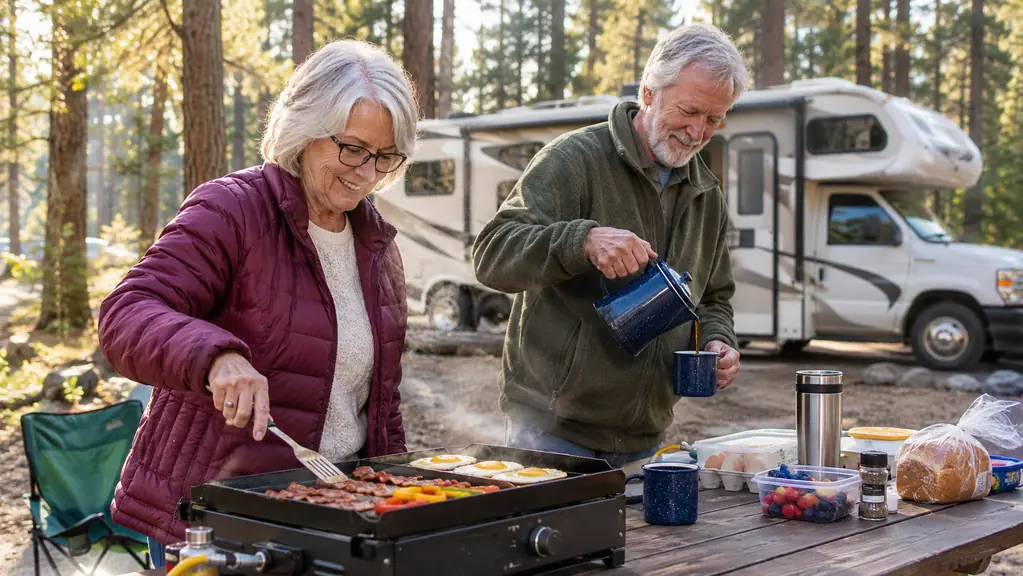
Short answer: for the way Ray and I cook in a 25 foot Class C, the BLACKSTONE 1814 17 inch griddle earns the picnic table more often than a two-burner camp stove. It gives us one wide cooking surface for pancakes, eggs, bacon and smash burgers, and it packs into the outside storage bay without stealing the galley. I would not tell a friend to buy it as their only outdoor cooker, though. A two-burner camp stove still does coffee, soup and a kettle of water better because it has two separate burners and pot grates. The choice comes down to what you actually cook outside.
We bought the BLACKSTONE in spring 2026, so it has about seven months of campsite use behind it. Ray runs it for breakfast and burgers. I run the galley inside on the motorhome's two-burner propane cooktop, and we both care about weight, water and where a thing lives when it is not being used. This is not a lab test. It is a report from a retired couple who cooks every day in a small rig and has to put everything away before the slides come in.
| BLACKSTONE 17 Inch Griddle | Coleman Classic Two-Burner Camp Stove | |
|---|---|---|
| Cooking surface | 268 sq in flat griddle, listed for about 9 burgers at once | Two open burners with pot grates, no wide flat cooking field |
| Burner setup | One H-style burner under the plate, built-in igniter | Two independent burners with separate valves |
| Breakfast for four | Pancakes, eggs and bacon can share the surface and finish together | You cook in batches with one or two pans and juggle the burners |
| Coffee, soup and pasta | The cooking surface is not set up for a kettle or a saucepan | Pot grates take a kettle, saucepan or coffee pot directly |
| Heat zones | One heat zone across the plate, light to high | Two burners can run two different heats at once |
| Wind | Hood and side plates help, but the open front can lose heat in a stiff breeze | Folding wind panels and burners close under the pot |
| Footprint and storage | 21.7 by 20.5 by 14.7 inches and 9 kg, with a flat shelf profile | Folds down, but legs, grates and hose make a less tidy package |
| Cleanup | Scrape the plate, empty the grease tray, wipe while warm | Burner grates and pans need washing; grease can drip into the stove body |
| Fuel | Propane | Propane |
| Best for | Flat food for a crowd: breakfast, burgers, pancakes | Pot-based meals and drinks: coffee, soup, pasta, rice |
How I Compared Them in a 25 Foot Class C
I compared them by cooking the same meals on both, not by reading boxes. The griddle lives in our outside storage bay and goes onto the picnic table. The Coleman Classic style two-burner camp stove is the stove I have used at campgrounds for years, the kind with two burners, pot grates and folding side panels. I paid attention to setup time, how much counter space each one took, how hard it was to clean with limited dishwater, and whether I could put it away without moving three other things first.
Our rig is a 2019 Class C, 25 feet long, with a two-burner propane cooktop inside, a small microwave, a 6 cubic foot fridge, one narrow drawer and one overhead cabinet for cookware. That is the whole galley. When I say a cooker fits, I mean it fits in the outside bay and does not crowd the drawer where the pots live. A griddle that is wonderful on a patio can still be wrong for a motorhome if it is too tall for the shelf or too heavy to lift after a long day.
I also watched the weather. Campground mornings are often cool and breezy, and an open flame is only as good as its shelter. I noted how each cooker handled wind, how evenly it cooked, and what it did to the air around the picnic table. Neither one is a kitchen range. Both have a job they do well and a job they do poorly, and the honest answer depends on which job you have more often.
What the Numbers Mean in a Small Galley
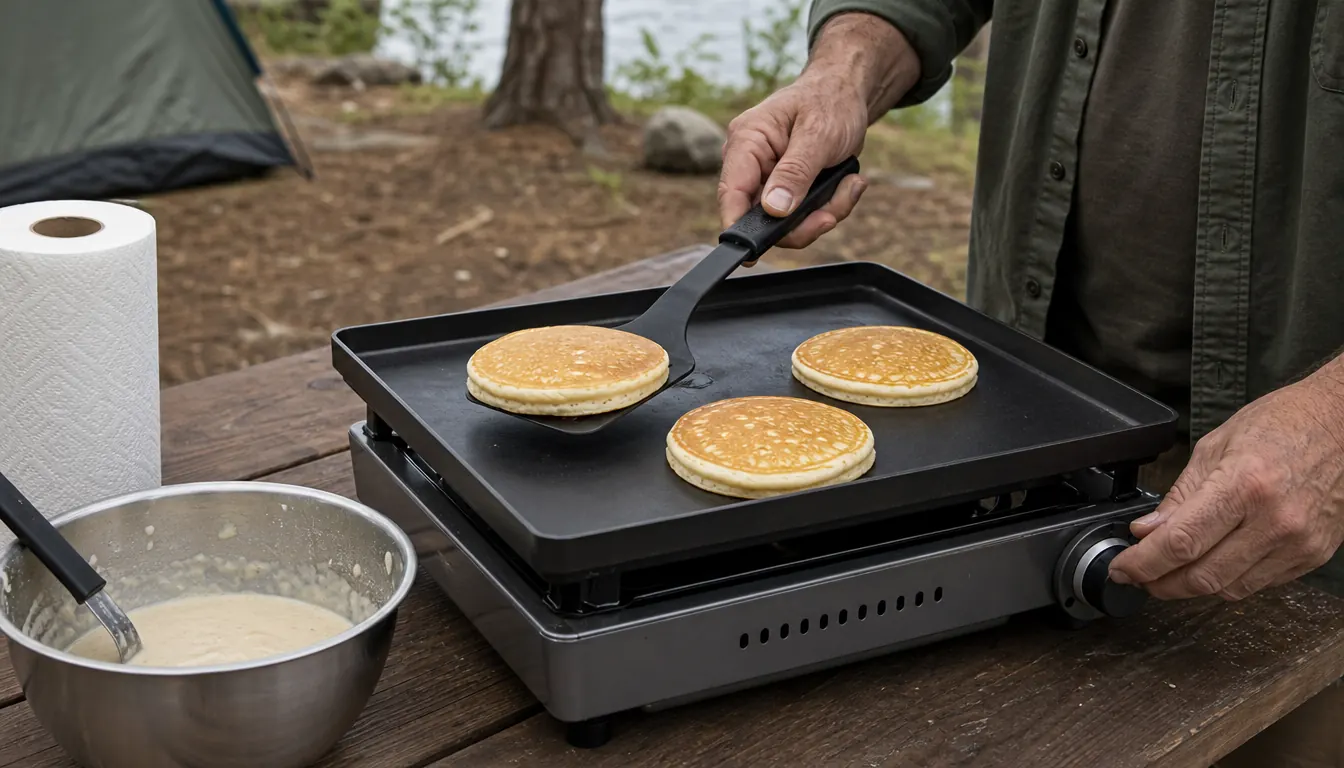
The BLACKSTONE listing gives a cooking surface of 268 square inches and a weight of 9 kg. For a motorhome, those two numbers pull in opposite directions. The surface is generous enough to cook for four, but the weight is still light enough for me to lift from the bay to the picnic table without asking Ray. I can carry it with two hands, set it down, and have the hood open while the coffee is still brewing. That matters more as I get older. A cooker that is too heavy to move is a cooker that stays in storage.
The listed footprint is 21.7 inches deep by 20.5 inches wide by 14.7 inches high. In a 25 foot Class C, that is not a small thing. It takes a real shelf in the outside bay, and the hood adds a little clearance. Before we bought it, I measured the bay opening and the shelf height with a tape measure. I would do that again. A griddle that fits on paper can still fail at the hatch if the hood has to open before you slide it in.
The two-burner camp stove is a different shape of problem. It folds, but the legs and grates do not disappear, and the hose has to go somewhere. It may pack smaller in one direction and taller in another. Neither cooker is a clear winner on storage until you measure your own bay. That is why I put storage as a tie in the table. The right answer depends on the shelf you actually have, not the one in the catalog photo.
Where the BLACKSTONE 17 Inch Griddle Wins
The first win is surface area. The BLACKSTONE lists 268 square inches of cooking space and a capacity of about nine burgers. That number matters at a campsite because it turns breakfast into one pass instead of three. I can put pancakes on one end, eggs in the middle and bacon on the other, and everything reaches the table warm. On a two-burner camp stove I am working with two pans and a lot of shuffling. By the time the last pancake is done, the first ones are cool and Ray is already looking at the dish soap.
The second win is even heat across one plate. The BLACKSTONE uses an H style burner under the cooking surface, and the built-in igniter lets me dial from light to high without hunting for a match. I am not going to pretend it is a kitchen range. The edges run a little cooler than the center, and a stiff breeze can push the flame around. But for a tabletop griddle it holds a steady cooking temperature, and that is why hash browns come out crisp instead of steamed.
Storage is the third win. The griddle weighs 9 kg, which is about 20 pounds, and the listed dimensions are 21.7 inches deep by 20.5 inches wide by 14.7 inches high. In our 25 foot Class C, that means it goes into the outside storage bay with the hood closed and stays out of the one narrow galley drawer. The stainless steel front plate and hood are part of the package, so I am not storing a separate lid. A two-burner camp stove is not a monster either, but its legs, grates and hose make it more awkward to slide onto a shelf.
Cleanup is the fourth win, with a caveat. One cooking surface means one thing to scrape and wipe. I let the plate cool just enough to handle, push the grease into the tray, and wipe it down while it is still warm. The tray has a large capacity, so I am not emptying it halfway through a batch of bacon. The caveat is that a griddle is not a wipe-and-forget tool. It needs seasoning, it needs scraping, and it will tell you if you skipped the wipe.
One more storage note: the grease tray comes out, and I empty it before the griddle goes back in the bay. That is not a hard job, but it is part of the routine. If you skip it, the bay smells like old bacon the next morning. A two-burner stove has its own drip issues, so I am not claiming the griddle is cleaner in every way. I am claiming it is one surface to manage instead of two burners, two grates and two pans.
Where the Coleman Classic Two-Burner Camp Stove Wins
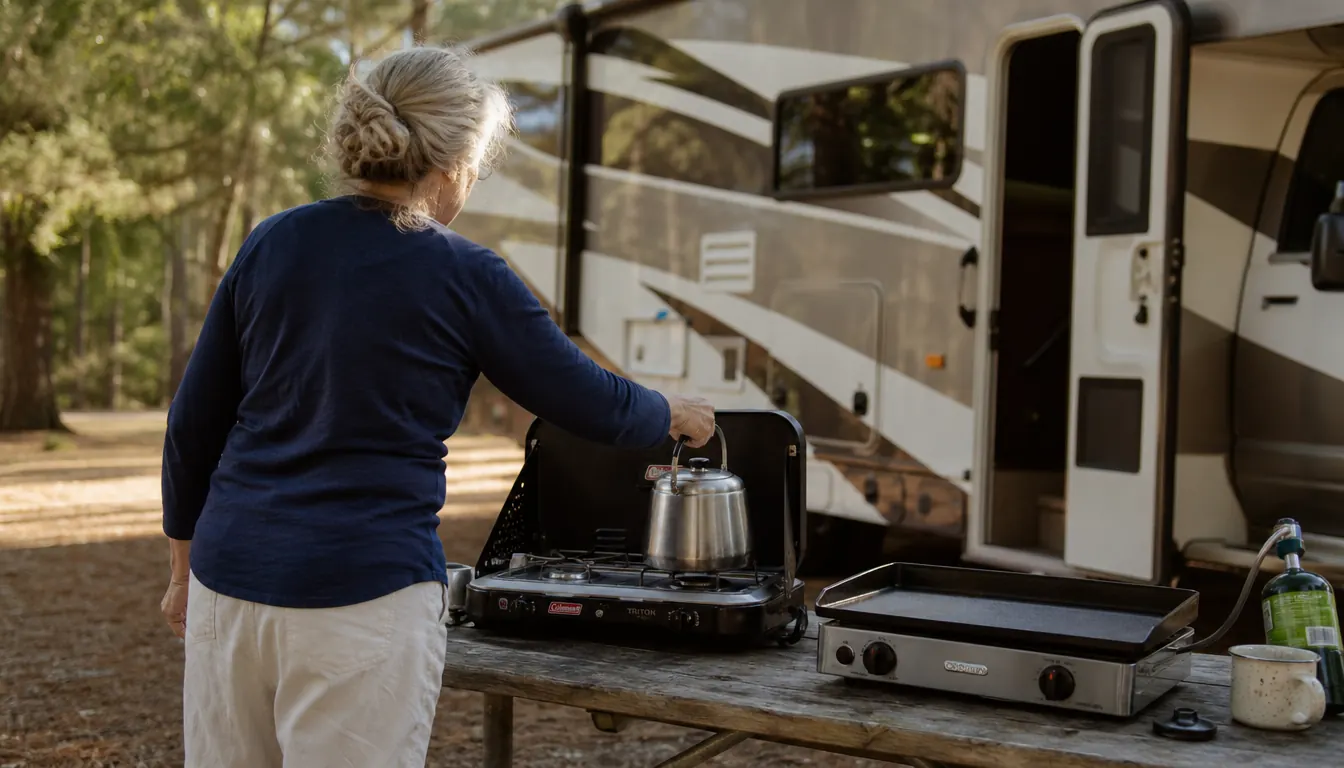
Two burners beat one griddle when the meal is built around pots. I can set a kettle on one burner for coffee and a saucepan of soup on the other, and both are going at once. The BLACKSTONE cannot do that. Its cooking surface is for food, not for a kettle or a pot, and its one heat zone means everything on the plate cooks at the same setting. If your camping dinner is pasta, rice, chili from a can or a pot of coffee, a two-burner camp stove is the more useful box.
The second win is wind and familiar control. Most two-burner camp stoves have folding side panels or a lid that acts as a windbreak, and the burners sit close under the pot. On a breezy evening at a state park, that matters more than a wide cooking surface. The knobs also give you two separate low flames for simmering, which is hard to do on a griddle that wants to run hot across the whole plate. A two-burner stove is also the tool most campers already know how to run, so there is no seasoning routine and no scraping.
The third win is versatility for one-pot meals. A two-burner camp stove can boil water for pasta, simmer a sauce, heat tortillas in a dry pan and make coffee, all without changing equipment. That is a lot of camp dinners for one box. The griddle is better at flat food, but it is not a replacement for a stove when the meal needs a pot. On a rainy night when I want chili and cornbread, I am not reaching for the griddle.
Where the two-burner stove also wins is control for two dishes at once. If I want to brown sausage in one pan and keep beans warm in another, I can do it without moving anything. The griddle can cook both on one surface, but they share the same heat. That is fine for bacon and pancakes. It is not fine for a sauce that needs a low simmer while the main dish sears. Two burners give me two decisions instead of one.
If camp breakfast is the meal that needs fixing, start with the 17 inch BLACKSTONE
It gives you 268 square inches of cooking surface, a built-in igniter and a 9 kg package that fits the outside bay. It is the tool we use for pancakes, eggs and burgers.
Amazon Check Today's Price on Amazon →Who Should Buy Which
Buy the BLACKSTONE 17 inch griddle if your outdoor cooking looks like ours: pancakes and eggs in the morning, smash burgers or sliced sausage at night, and food for two to four people who want to eat at the same time. Buy it if you have a place in the outside bay for a 9 kg cooker and you do not mind scraping and wiping the surface while it is still warm. The grease tray does need emptying, and the plate does need seasoning, so it is not a wipe-and-forget tool.
Buy a two-burner camp stove if coffee, soup, pasta, rice or one-pot meals are the center of your camp kitchen. Buy it if you cook with a kettle every morning, if you want two heat zones, or if you camp in wind and want a stove with folding panels. It is also the better choice if you have very little outside storage and want one box that can do a little of everything. It will not give you a wide griddle surface, and you will cook breakfast in batches.
In our rig we do not ask one cooker to do both jobs. The BLACKSTONE handles the flat food, and a single-burner Gas One handles coffee and boiling water. If I were starting from zero and had room for one outdoor cooker, I would ask which meal I make most often. For us, that is breakfast for two with leftovers for lunch, and the griddle wins. For a couple who makes soup and coffee outside every day, the two-burner camp stove is the honest answer. Either way, measure your storage bay before you buy. A cooker that does not fit is a cooker you will leave at home.
There is no rule that says you cannot own both. Plenty of RVers carry a griddle for breakfast and a camp stove for coffee. The reason we do not is space. Our outside bay already holds chairs, a hose, a toolbox and the cast iron. One more box means one less chair. If you have a larger bay, the pair can make sense. If you have a 25 foot Class C like ours, every box has to earn its shelf.
See the 17 inch griddle that fits a 25 foot Class C storage bay
268 square inches of cooking surface, a built-in igniter and a 9 kg body. Measure your shelf, then decide if the flat cooking field is the one your camp kitchen is missing.
Amazon Check Today's Price on Amazon →