
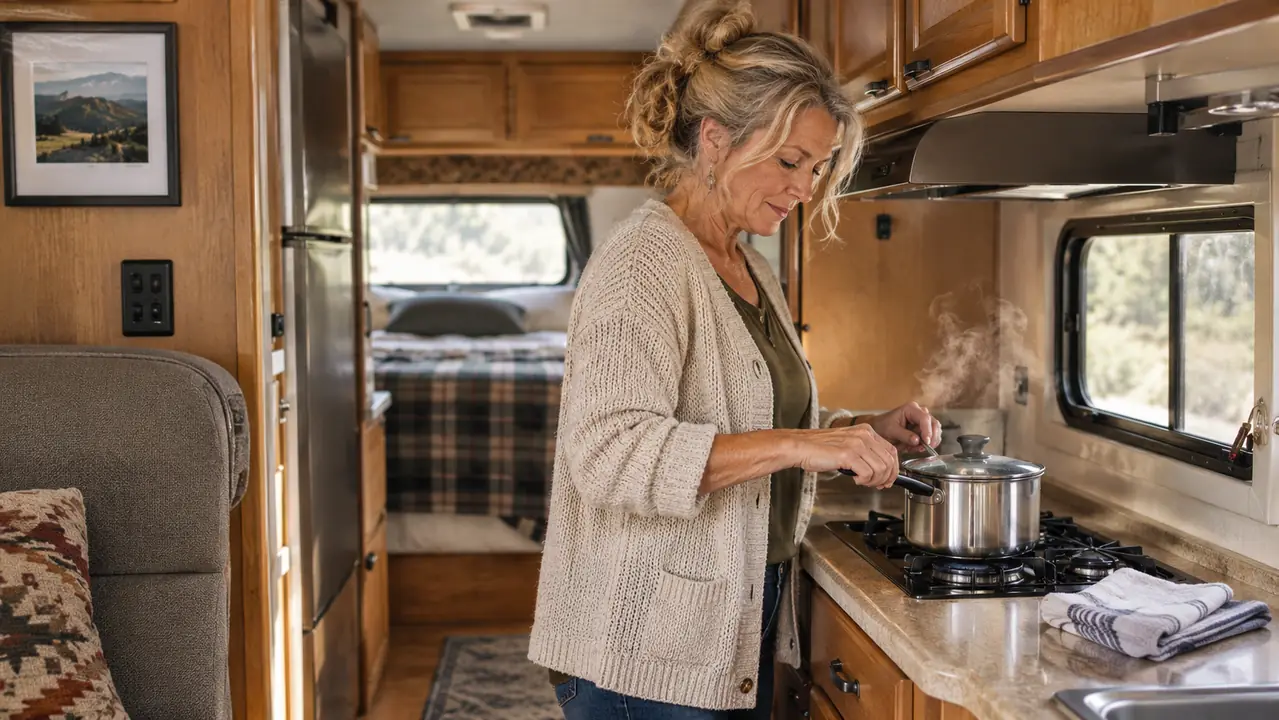
The galley in our 25 foot Class C is roughly the size of a coat closet, and for my first two seasons on the road I cooked in it like a woman trying to fit a whole kitchen into a lunchbox. The burners were never the problem. The handles were. Every pan I owned came with a long rigid arm attached to it, and those arms turned the one narrow drawer into a puzzle I lost every morning. I would reach for the 8 inch skillet, drag two lids and a saucepan out with it, and listen to the stack settle back into place like a bad hand of cards. Handled pots do not nest. They lean, they rattle on the road, and they eat the counter space you need while you are trying to plate a piece of chicken.
In spring 2025 I bought the CAROTE 19-piece detachable handle cookware set, and the drawer changed shape. The handles come off, which sounds like a small thing until you have spent a cold morning wrestling a stack of pans at a campground outside Bend. I will not tell you it made me a better cook. It made me a calmer one, and it handed back about six inches of counter, which in a 25 foot rig counts as real estate. Eighteen months of trips later, this is the routine I would hand to a friend, in the order I would hand it over.
The drawer fix that gave me back six inches of galley counter
Nineteen pieces, two detachable handles, tempered glass lids, nonstick aluminum that stacks flat once the handles come off. This is the set that lives in my one narrow drawer on every trip.
Amazon Check Today's Price on Amazon →Step 1: Measure the Drawer, Then Count What You Really Cook
Empty the drawer onto the dinette table and measure the inside with a tape before you buy anything. Mine runs 19 inches wide and 14 deep, with about 7 inches of usable height once the latch hardware is accounted for. Then be honest about a month of meals. I use the 1.5 quart saucepan for rice and oatmeal, the 3 quart for soup and pasta, the 8 inch frying pan for eggs, the 10 inch for chicken thighs and vegetables, and the 4 quart saute pan when I want one pot to carry the whole dinner. Five pieces do nearly all the work in a galley this size.
Here is what is actually in the box: those five pieces, two detachable handles, tempered glass lids, and utensils. I left a few of the 19 pieces at the house in Salem, including one lid set. A set this large sounds like more than a small galley can hold until you notice that most of the count is lids and handles, and the pieces that matter nest into each other. The whole thing weighs about 4 kilograms, just under nine pounds, which is worth knowing when you are watching how the storage bays load.
One more measurement, and this one is about the rig rather than the kitchen: put the heavy cookware low and slightly forward of the rear axle. Mine lives in the one narrow galley drawer, which happens to be low and centered by luck rather than planning. If you want the wear side of this, I kept [eighteen months of notes on the set](carote-detachable-cookware-review-long-term) with the scratches, the staining, and what still looks new.
Step 2: Nest It Handle-Free and Give the Handles Their Own Home
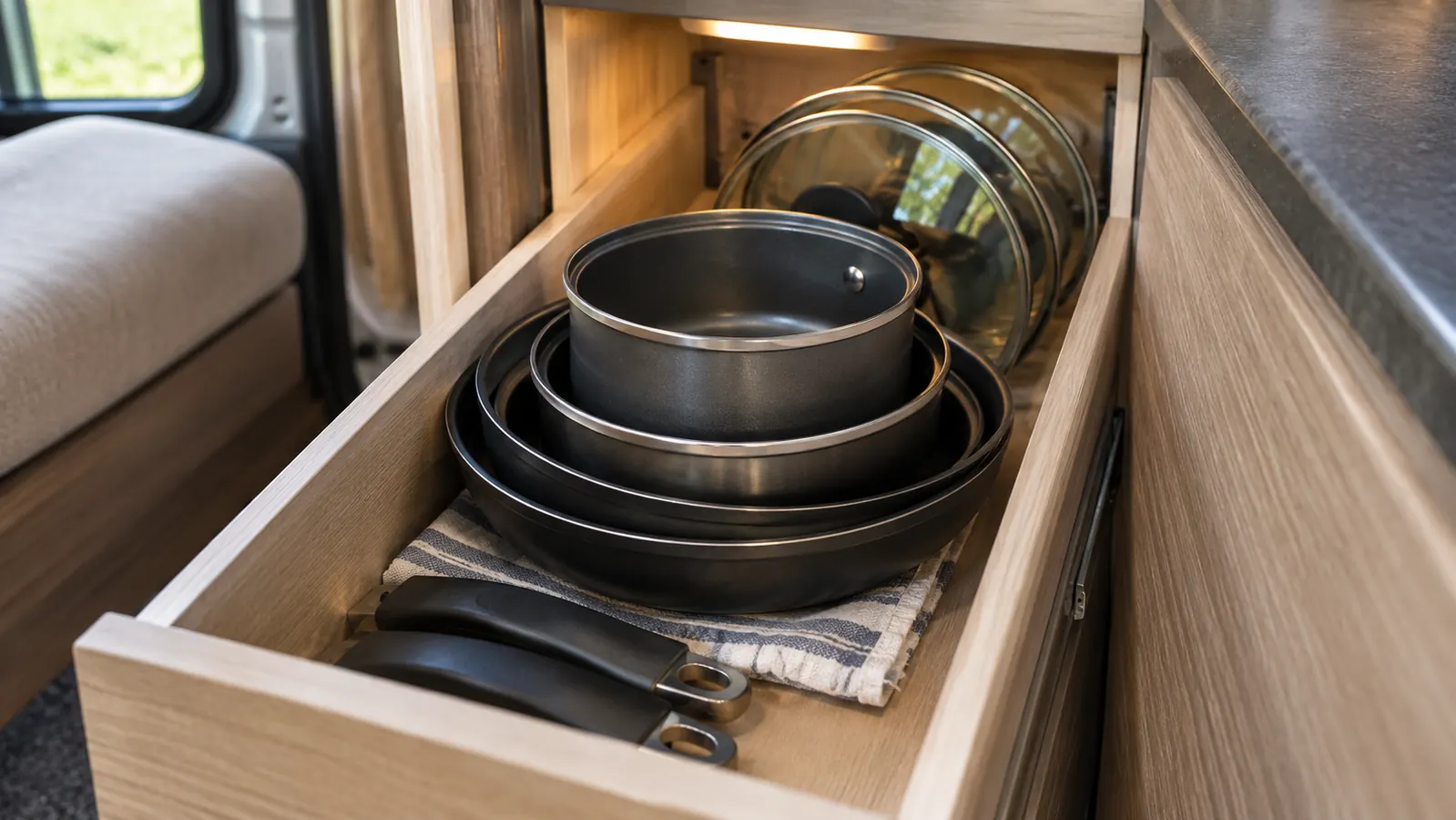
With the handles off, the pans drop into each other the way they were designed to. CAROTE puts the space savings at up to 70 percent against the same set left assembled, and my drawer backs that up. Five pieces plus lids fit where two handled pans used to sit. Stack by size, put the 1.5 quart saucepan inside the saute pan, set the frying pans on top, and stand the lids on edge against the back wall of the drawer so you can read them at a glance.
The handles need a home of their own, and that is the step people skip. Both of mine live in the front left corner of the drawer, where my hand lands first. In February I got lazy and left one attached to the saute pan overnight. Next morning the pan had rolled onto its side and a lid was wedged underneath it. The handles are the one part of this system that will wander off if you let them.
A word on the drawer itself. If yours is bare wood or slick plastic, cut a piece of non slip shelf liner to fit. Mine slid forward twice on mountain grades before I lined it, and stacked pans that shift in transit end up with rim marks that never come out. A few inches of liner fixed it for good, and it also quiets the rattle on washboard gravel roads.
Tempered glass lids are heavier than the thin aluminum ones on cheap camp sets, and I like that about them. They sit flat, they do not warp when a burner runs hot, and you can check rice without lifting the lid and losing the steam. Two of them cover the saucepans well enough, so I carry only the ones I use and leave the rest in Salem.
Step 3: Check the Handle Seat Before You Lift Anything
The honest downside of detachable handles: they can come off at a bad moment. Before lifting a full pot, I set the handle, then give the pan a small tug toward me with two fingers while it is still on the burner. If it holds there, it will hold across the galley. The habit takes two seconds and it has saved me a quart of soup, half a roll of paper towels, and one truly unpleasant afternoon.
For the 4 quart saute pan, use both handles. One hand on each side to carry it from the stove to the counter, then pull them off before you serve. That is where the set earns its place in a small rig: the pan becomes the serving dish. One dish to wash instead of two, which matters when your gray tank is at three quarters and the nearest dump station is not until Tuesday.
Two other handling notes. Silicone or wood utensils only, and no metal scrubbers, ever. The nonstick surface sits over aluminum and it will scratch if you treat it like cast iron. And I have not had a handle get uncomfortably hot on me, even moving fast off a burner, though I still set it down on a folded towel rather than straight onto the counter.
With the handles off, five pieces and their lids fit in the drawer that used to hold two handled pans.
Step 4: Cook a Full Meal in Sequence, Not All at Once
Two burners is the whole kitchen, so stop planning meals that want three pans at temperature at the same time. I cook in sequence now and dinner still lands hot at the table. Long thing first, quick thing second, protein last while the first two wait with their lids on. Once you get the order right, the two burner limit stops feeling like a limit and starts feeling like a plan.
A real example from a Wednesday outside Bend. Rice in the 1.5 quart saucepan with a lid on the back burner. Onions and zucchini in the 10 inch frying pan up front. When the vegetables were done I slid them into a bowl, pulled the rice off the heat to finish steaming, and used the front burner for chicken thighs in the 4 quart saute pan with both handles on for the lift. Thirty five minutes, two pans dirty at the end, and one of them went to the table as the serving dish.
The one pot version is worth learning too. Brown chicken thighs in the saute pan, add rice, stock and a handful of frozen peas, lid on, low burner for twenty five minutes. One pan, one lid, one serving spoon, and the handles come off so the whole thing goes to the table without a second dish. That meal is the reason I stopped carrying a separate serving bowl.
The set is oven compatible, so anything that needs finishing goes into the RV oven with the handle off. That is the other reason detachable matters. A handled skillet does not fit a small oven. This one does, and it comes back out with no long arm to catch on a rack.
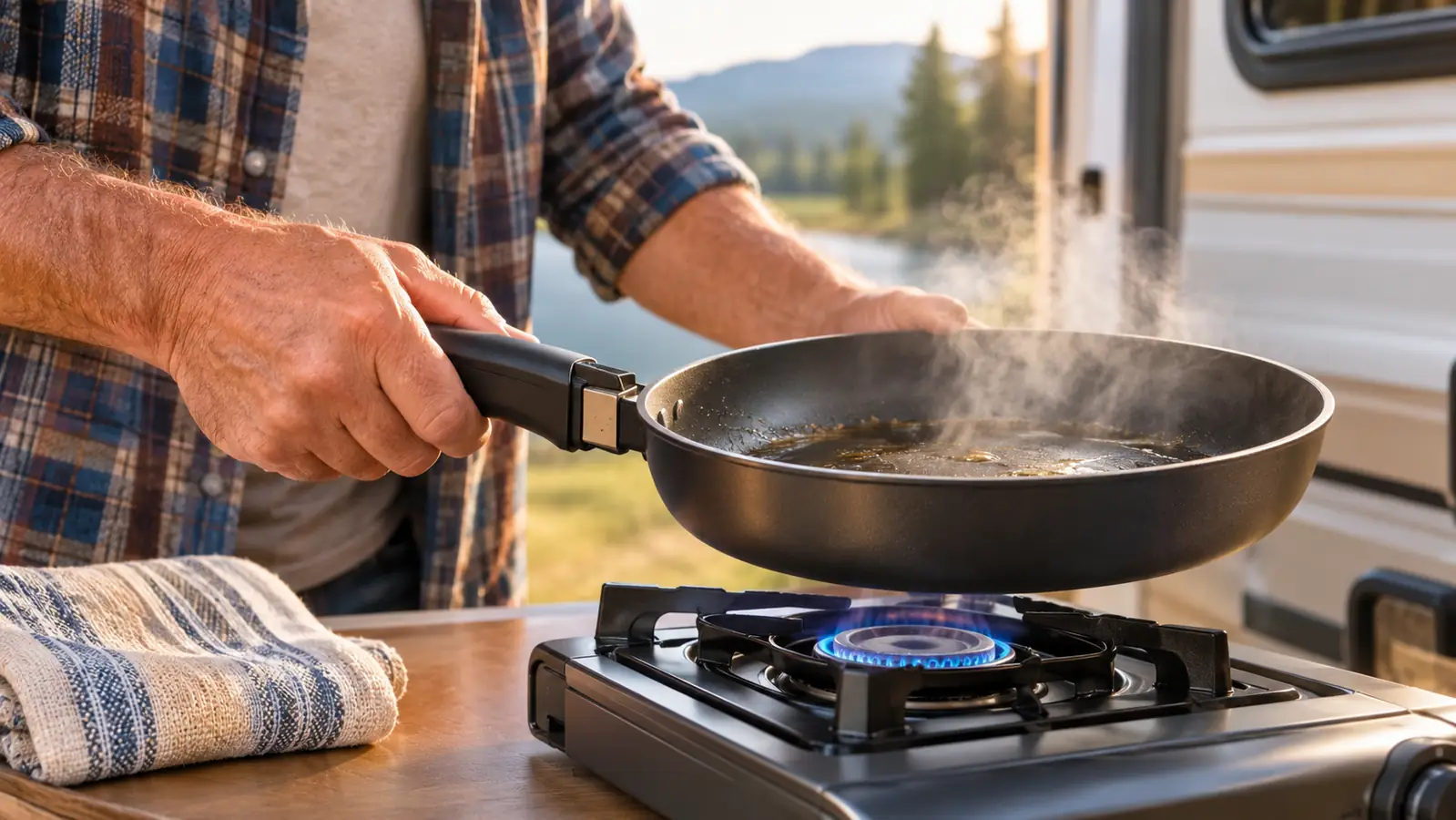
When it is hot out, the whole operation moves outside to the picnic table. Ray runs the griddle for breakfast and I take the single burner portable stove for anything that would smoke up the rig. If you are weighing a set like this against plain stainless camp pots, I laid out the [comparison against stainless camp cookware](carote-detachable-cookware-vs-stainless-camp-cookware) separately, including the pans I would still keep in stainless.
Step 5: Wash With the Water You Have, Then Stow Before You Drive
We carry about 40 gallons of fresh water and dishwashing is the biggest draw on it. Nonstick helps because it wipes out instead of soaking. I use a small basin of hot soapy water, wash from cleanest to greasiest, then rinse everything in one pass with the sprayer on low. Two pans and two lids take about a gallon and a half. The same meal in bare stainless takes twice that and a good deal more scrubbing.
Dry everything before it goes back in the drawer, lids included, and put a folded dish towel between the bottom pan and the drawer floor. Stacked wet nonstick spots, and the drawer starts to smell after a few days of that. Then stow it all before anyone turns the key. Anything left on the counter becomes a projectile. A lid will find the floor on the first hard right turn off a highway ramp, and it will do it in the worst place in the rig.
The last thing I do each night is a thirty second check: both handles in the front left corner, lids standing at the back, nothing loose on the counter, drawer latched. That check is the difference between cooking breakfast and cleaning up a mess before breakfast, and after eighteen months it is automatic.
What Else Helps
The CAROTE set is the core of the galley, not the whole of it. Three other things earn their storage. A single burner portable stove in the outside bay keeps the smell and the heat out of the rig in July and gives us a third burner when both inside ones are busy. A 5 quart cast iron Dutch oven, heavy enough that we keep it low and centered in the bay, does stews, chili, no knead bread and cobbler over Ray's campfire coals about once a week. A 17 inch tabletop griddle covers every breakfast plus a smash burger night that has become a small campground event.
For storage, the collapsible silicone containers that came home with the cookware the same spring do more work than I expected. Leftovers go flat in the 6 cubic foot fridge, chopped onions and peppers ride in the middle sizes, and the collapsed ones sit in the overhead cabinet taking up almost nothing. The lids need firm pressing and tomato sauce leaves a faint stain, but that is the trade and I would make it again.
A note on loading, since it took us a season to get right. Cookware goes low and forward in the outside bay, the griddle above it, the Dutch oven on the floor of the bay in a padded bag. Do not stack anything heavy on the lids or on the handle storage spot, and do not store the handles loose in a bin where they can bang against each other for a thousand miles.
Two small additions before your first trip. A collapsible dishpan, because the sink is the size of a shoebox and you will want to wash a pan without filling the basin. And a couple of thin cotton towels, one for drying and one folded in the drawer. That is the whole kit. It does not look like much in a photograph, but it cooks three meals a day for two people for months at a time.
Nineteen pieces, two handles, one narrow drawer
Nonstick aluminum, tempered glass lids, and a handles-off stack that frees up most of a galley drawer. It is the set I have cooked from on every trip since spring 2025, and the one I would buy again.
Amazon Check Today's Price on Amazon →