
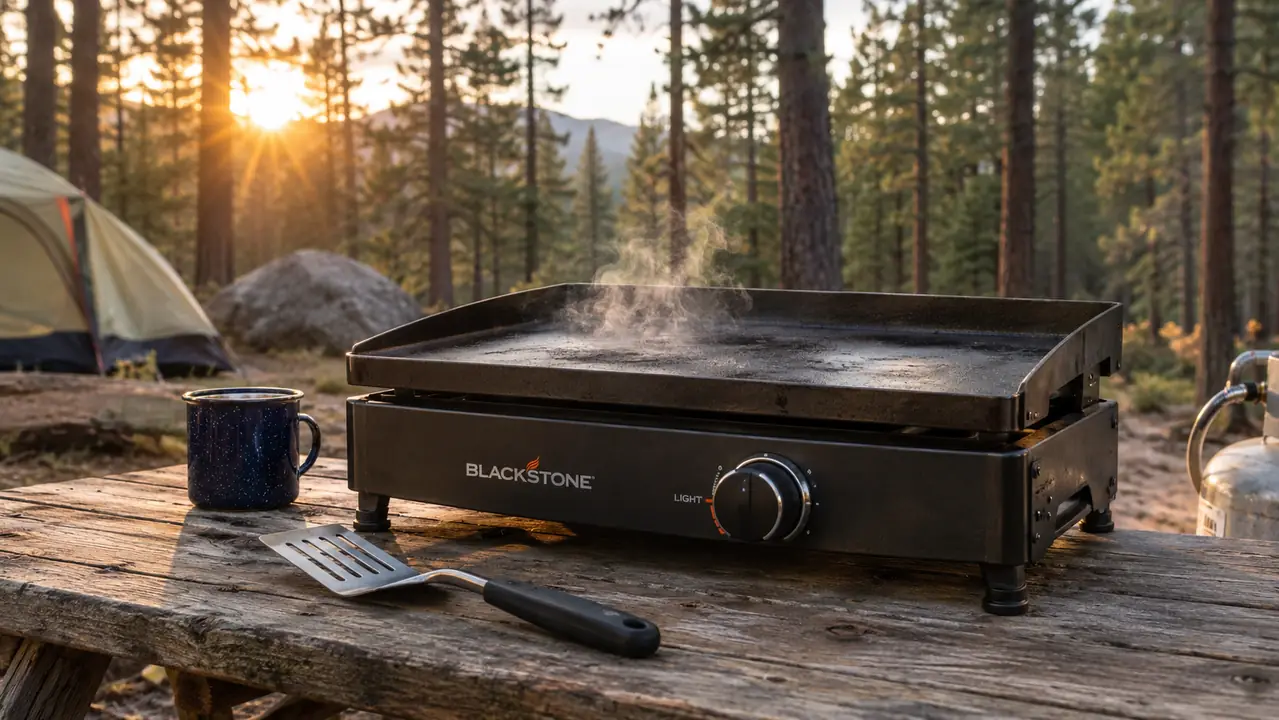
The first honest thing I can tell you about the Blackstone 17 inch griddle is that it made me a better breakfast cook and a worse dishwasher, and both of those things happened in the same week in April. We were at a state park outside Bend. Ray had it set up on the picnic table by seven, and by eight we had eaten pancakes and bacon and were looking at a stack of greasy plates with no good way to wash them in a 25 foot motorhome.
We bought the BLACKSTONE 1814 in spring 2026, so this is about seven months of ownership. That is long enough to be past the stage where everything about a new piece of gear seems wonderful. It rides in the outside storage bay in its own cover, it comes out most mornings when we are camped, and it goes back in the same way every time.
Here is the short answer for anyone who wants the short answer first. A tabletop griddle is not a grill. You will not get char, you will not get smoke, and you will not get the crust Ray gets on a steak over coals. What you get is a flat surface roughly the size of a small baking sheet that holds heat evenly, and for eggs, pancakes, hash browns, bacon, tortillas and smash burgers, that surface is genuinely useful.
The Quick Verdict
A real 268 square inch cooking surface that turns a campsite breakfast into a twenty minute job. It also adds grease handling and seasoning work to every single meal, and the listing photos never show that part.
Amazon Check Today's Price →If breakfast is the meal you actually cook outside, start here
This is the griddle we bought for our own rig and still use most mornings. Today's price and the full spec sheet are on the Amazon listing, including the cooking surface size and the weight, so you can check both against your own storage bay before you order.
Amazon Check Today's Price on Amazon →What Nobody Tells You Before You Buy
The cooking surface arrives grey, not the deep brown you see in the photos, and it needs a season before the first cook. That part is in the instructions. What is not in the instructions is that the season is never finished. It is something you maintain for as long as you own the griddle, and it takes about ten minutes at the start of a trip and another five at the end.
Nobody tells you that a flat top cooks in its own fat, either. Bacon renders. Burgers render. Sausage links leave a film of grease across 268 square inches, and all of it has to go somewhere. On the Blackstone it drains into a tray. The tray is bigger than I expected and it does not need emptying in the middle of a cook, which matches what the listing claims, but it is still a tray of hot fat at a campsite where you are not supposed to pour anything on the ground or into the fire ring.
And nobody tells you how much of the work happens after the food comes off. The scraping, the wipe down, the re-oil. On a two burner camp stove you turn off the gas and eat. On a griddle you turn off the gas, eat, and then spend eight minutes cleaning a hot surface before it cools and the residue sets up like varnish. That is the trade, and it is worth knowing before you buy rather than after.
Seven Months of Real Cooking on It
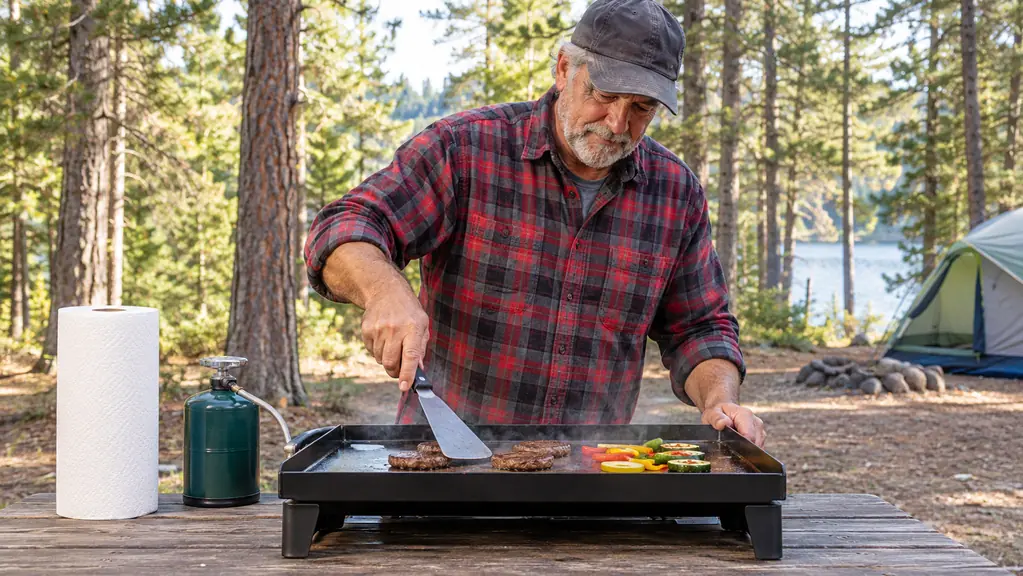
Ray runs the griddle. I run the inside galley, the two burner propane cooktop, the fridge and the sink, and we split it that way because the griddle is outside and the bacon smell stays outside with it. In July in eastern Washington that matters more than any line on the box. Cooking bacon indoors in a 25 foot rig means you smell it in the bedding for two days.
There is a rhythm to it that suits two retired people. Ray lights the griddle while I make the coffee and carry the plate of bacon out of the fridge. Twelve minutes later we are eating, and the surface is scraped and wiped down before the second cup goes cold. When we were both still working and camping on weekends, we never cooked like this. The griddle is a good part of why we do now.
One morning in September at a campground near Detroit Lake we cooked for six. Two other couples we had met that week, all of us in rigs of one size or another. I mixed batter in a collapsible bowl, Ray ran the griddle, and we fed six people in about thirty five minutes, including a second round because the first went faster than we expected. That was the day I stopped thinking of the griddle as a convenience. In a 25 foot motorhome with a two burner cooktop we cannot cook for six indoors. Outside, on one flat surface, we can.
The surface is 17 inches across, and the listing puts it at 268 square inches, which they say is nine burgers. I have not tried nine burgers. I have done six smash burgers at once with room to work a spatula between them, and I have done a full batch of pancakes, eight at a time, with the bacon on the back third staying warm. That is more simultaneous cooking area than any pan in my galley, and more than the two burner stove gives me when both burners are busy.
Heat is even across most of it. The listing mentions an H style burner and a built in igniter, and both of those show up in use. The igniter clicks on the first or second try, which is better than the wand lighter I used to keep in the drawer. The middle runs a little hotter than the outer edges, so I keep pancakes in the middle and things that need holding on the edges. That is a normal griddle habit, not a defect.
It runs off a 1 lb propane cylinder, and a cylinder gets us through roughly three breakfasts before it starts losing pressure. When it quits, it quits in the middle of a cook, which is why there is always a spare under the sink. Ray also carries an adapter hose for a larger tank, and on longer stays that is what we use.
The Seasoning Is a Commitment, Not a Step
If you take nothing else from this, take this one. The nonstick surface you are imagining does not exist here. A griddle surface is steel with layers of polymerized oil on it, and those layers come off if you scrub them hard, if you cook something acidic, or if you leave the surface wet.
I season ours with a thin coat of oil after every wash, wiped on with a paper towel while the surface is still warm. Twice this summer I got lazy and left it until morning, and both times I paid for it with a grey patch that took three coats to bring back. It has never rusted, because I have never once put it away wet.
Let me save you the experiment I ran. My first instinct was a nylon scraper and a no scratch sponge, the same things I use on the cookware set at home, and both left a film that built up in the corners and went tacky by the second day. What works is a stiff metal scraper and a folded towel, used while the surface is still hot enough to sizzle under the wipe. That first fortnight cost me two rounds of reseasoning. I have not lost a patch since.
The upside is that the seasoning is also why the eggs slide. By month three the surface had gone dark and glossy and I could cook an egg with barely any oil and lift it whole. That is a real pleasure, and it is earned, not bought.
By month three I could cook an egg with barely any oil and lift it whole. That is earned, not bought.
Grease, Wind, and the Cold Morning Problem
Wind is the thing I would warn a friend about. There is a hood over the surface when it is off, but when it is running the flame sits under an open plate, and moving air takes heat with it. On a still morning the surface is ready in about five minutes. On a morning with a steady wind off the lake it takes closer to twelve, and the windward edge runs cooler than the rest.
The worst of it came on a Tuesday in August at a campground on the Columbia, where the wind came up the river around nine and never let go. The bacon was fine. The pancakes on the windward edge came out pale underneath and raw in the middle, and I finished the batch cooking two at a time in the middle third instead of six across. Ray built a windbreak out of two folding chairs and a bath towel. It looked ridiculous and it worked. If you camp in the gorge in summer, plan on something like it.
Grease in wind is worse. The tray catches what drains, but a spatula flick at the wrong angle sends a spot of hot fat onto the picnic table, and in wind it goes further than you expect. I keep a folded towel and a spray bottle of vinegar water at the end of the table now. That is a campsite habit rather than a product flaw, but it is part of the real routine.
Cold is the other one. Under about forty degrees the cylinder pressure drops and the flame gets lazy. We cook inside on those mornings, on the two burner, and the griddle stays in the bay. Seven months in, that is the honest pattern. It is a three season tool in the Pacific Northwest, and a very good one in July.
Weight, Storage, and What I Would Change
The griddle weighs 9 kilograms, which is just under twenty pounds, and the listing gives it as 21.7 inches deep by 20.5 wide by 14.7 high. That is small enough for the outside storage bay of a 25 foot Class C, and it goes in beside the cast iron without a fight. It is not something I would carry down to a beach.
I measured our bay before we ordered, and I would do that first if I were you. The griddle is 21.7 inches deep and 20.5 wide, and it is the depth that decides whether it fits, because the hood adds height and the whole thing has to slide in without tipping. Ours goes in first and comes out first for that reason, and the BLACKSTONE has the front of the bay to itself. If your opening is shallow, measure the opening and not the floor. More than one camper has bought a tabletop appliance that fit the floor and not the door.
The hood and the stainless steel front plate are the two parts I did not expect to care about. The hood keeps dust and pine needles off the surface between meals, which at a forest campground is not nothing. The front plate adds enough rigidity that the whole thing does not flex when Ray lifts it off the table.
If I could change one thing it would be the cleanup order. The grease tray sits under the plate and comes out for washing, but it has to cool first, and by then I want to be in a camp chair with a book. A second tray would not fix that. Nothing would, really. That is the trade you make for cooking on a flat surface.
What It Does to Your Water Budget
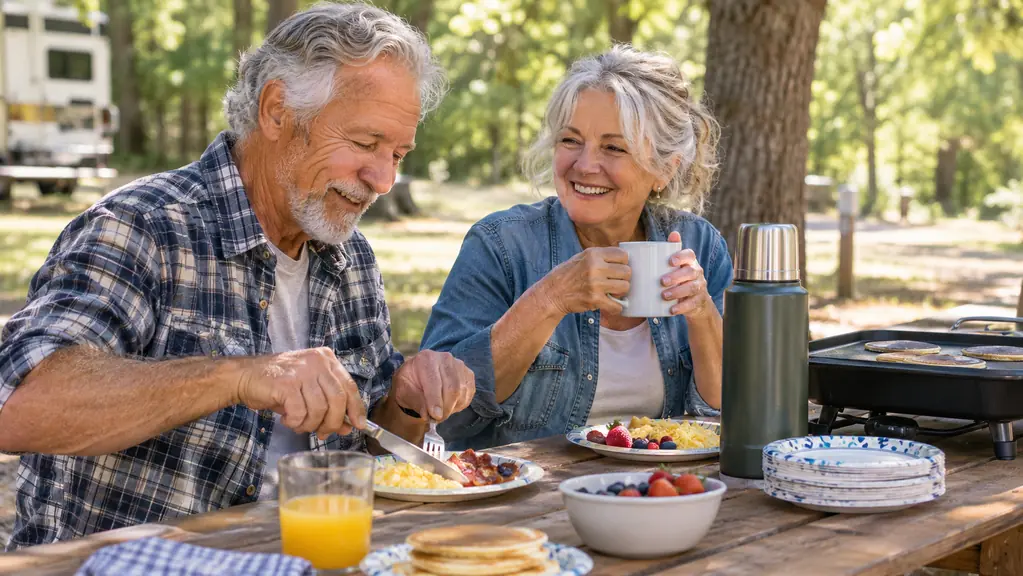
This is the part that surprised me most as an RVer. A flat top uses less water than four frying pans because there is only one surface to wash, and that surface gets scraped and wiped rather than scrubbed. On a morning when I used to dirty a pan for eggs, a pan for bacon and a pan for pancakes, I now use one griddle, one spatula and one plate per person.
The trade is that it uses more paper towels. I go through a roll every four or five days now, scraping into the grease tray and wiping the surface down while it is warm. In a rig with a small fresh tank and a small gray tank, fewer dishes is the bigger win, and I would make that trade again.
What I Liked
- 268 square inches of cooking surface, enough for six smash burgers or eight pancakes at once
- Even heat from the H style burner, with a built in igniter that lights on the first or second click
- Sets up and packs down in about two minutes and fits in the outside bay of a 25 foot rig
- The grease tray holds a full breakfast without needing to be emptied in the middle of a cook
- Once seasoned, the surface releases eggs and pancakes cleanly with very little oil
Where It Falls Short
- Every meal ends with scraping, wiping and re-oiling a hot surface
- Wind slows the heat up and makes the windward edge run cooler
- Grease has to be dealt with at the campsite, not poured out on the ground
- A 1 lb cylinder lasts about three breakfasts and quits without warning
- Just under twenty pounds, so it stays in the rig rather than going to the beach
How It Fits With the Rest of Our Kit
We did not replace anything with the griddle. It sits alongside the two burner stove, the cast iron Dutch oven and the detachable handle cookware, and each one has a job. The stove boils, the Dutch oven does stew and bread over coals, the cookware set handles anything with liquid in it, and the BLACKSTONE takes anything flat. On a long trip all of them earn their space, and none of them sits unused.
Who This Is For
This is for the person who cooks breakfast outside more often than dinner. If your campsite mornings involve a stove, a frying pan and a queue, the griddle replaces that with one surface and one cleanup. It suits a couple in a Class C or a travel trailer with an outside bay, and it suits anyone who is tired of cooking bacon in the same box they sleep in.
It also suits the person who likes the maintenance side of cast iron. If wiping oil onto a warm surface every morning sounds like a ritual rather than a chore, you will get along with this.
Who Should Skip It
Skip it if you want to turn a knob and eat. A two burner camp stove is simpler, lighter and needs no season. Skip it if you are cooking for two and mostly boiling water, because a griddle does nothing a kettle does.
Skip it if you camp where grease disposal is a real problem, or in bear country where every scrap of food and fat has to leave with you. And skip it if you are not going to clean it the same night. A griddle left dirty until morning is a griddle you will be reseasoning from scratch.
Seven months in, it still comes out most mornings
The BLACKSTONE 1814 has earned its space in the bay, seasoning work and all. If you want the current price, the cooking surface dimensions and the weight in one place, the Amazon listing has all three, and you can measure your own storage bay before you decide.
Amazon Check Today's Price on Amazon →