Nobody tells you that the hard part of buying a camp stove is not the stove. It is the fuel. I bought the Gas One GS-3400P in the summer of 2024 for one reason: it runs on butane canisters or on a one pound propane cylinder, and I did not want to be the woman in a campground forty miles from the nearest store holding a stove that only eats the canister nobody has in stock. That was two summers ago. I still think it was the right call. I also think most of what gets written about this stove skips the five or six small details that decide whether you will actually like it.
I am June Halvorsen, sixty seven, a retired school librarian from Salem, Oregon. Ray and I travel in a 25 foot Class C motorhome, mostly the Pacific Northwest in summer and the Southwest when the rain comes back. When I say this stove was tested, I mean it cooked breakfast at a picnic table outside Bend, dinner in a state park with the wind coming sideways off a lake, and a pot of coffee in a hurry before a storm chased us indoors. Here is the honest accounting, including the parts that annoyed me.
The Quick Verdict
A genuinely useful second burner that costs you three pounds of payload and a little patience in the wind. Buy it as a picnic table stove and a backup, not as your only way to cook.
Amazon Check Today's Price →Three pounds, one burner, and no match to lose on a windy morning
The GS-3400P lives in its carry case in the outside storage bay and lights with a push of the igniter. The only thing that changes week to week is today's price.
Amazon Check Today's Price on Amazon →How This Stove Earns Its Place in a 25 Foot Rig
Our motorhome has a two burner propane cooktop built in. It works fine. But in July, cooking inside means the whole rig smells like bacon until bedtime and the ceiling fan has to run for an hour afterward. So the Gas One goes outside on the picnic table, and I cook there while Ray tends the campfire and pretends he is not watching me. That is the main job, and it does it without complaint, morning after morning.
The second job is the one I did not expect to value. When both inside burners are busy, which happens more than you would think when there is chili in one pot and cornbread in the oven, the GS-3400P becomes a third burner without asking anyone to move. I have set it on a picnic table, on a level concrete pad at a full hookup site, and once on a flat rock I checked twice before trusting it with a full pot of soup.
That is the whole relationship. It is not plumbed in, it is not bolted down, and it does not pretend to be either. It comes out of the carry case, it sits on something flat, it gets lit, and it goes back in when it has cooled. If you want a stove built into the side of your rig, this is not that, and no amount of wishing will make it so.
The Dual Fuel Question, Explained by Someone Who Has Run Out
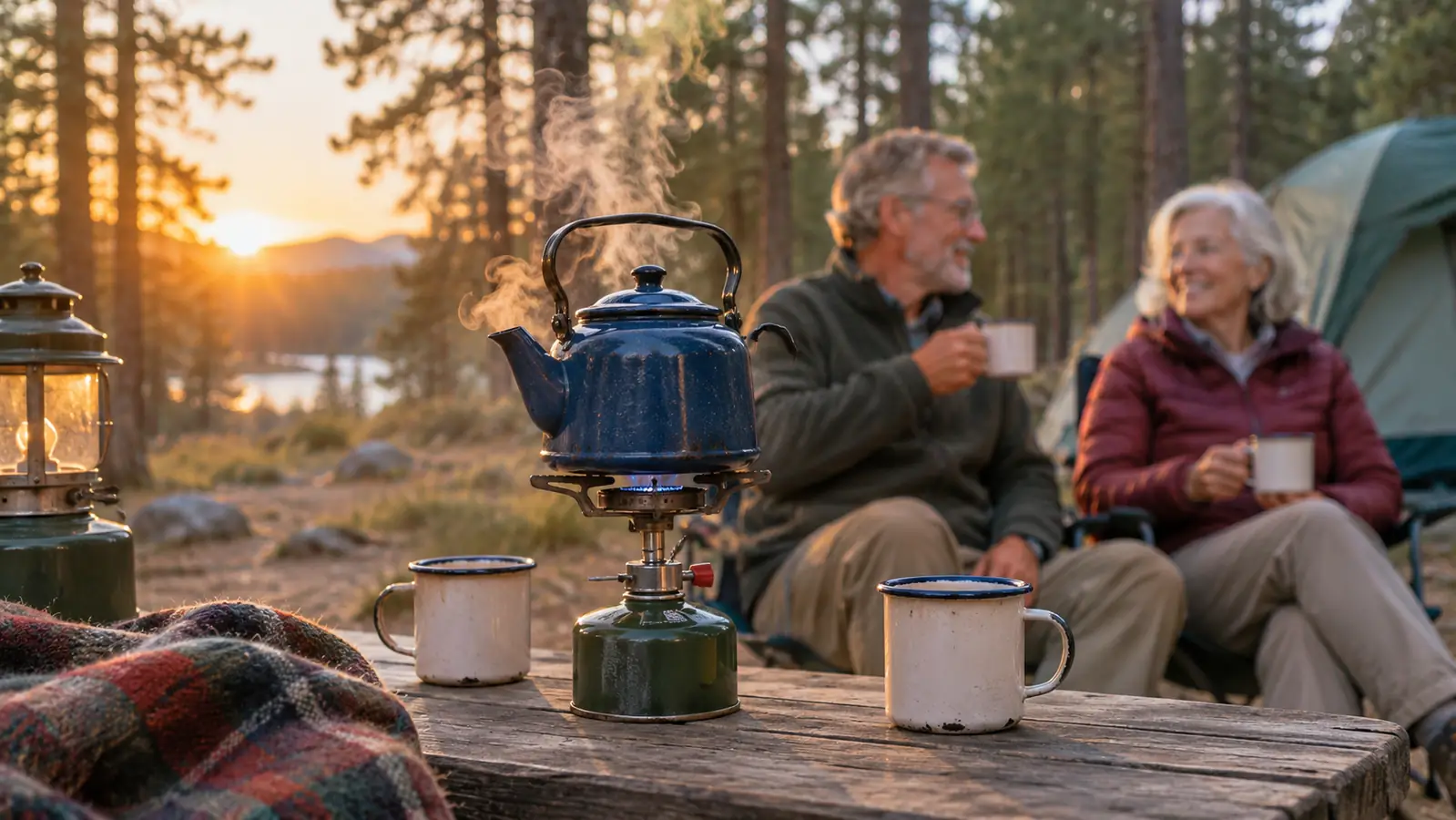
Butane canisters are wonderful and they are also a fair weather fuel. In the Southwest in January they are everywhere and they behave beautifully. Leave one in the storage bay overnight when the temperature drops to forty degrees and it will still light, but the flame goes soft and sulky and your coffee takes three times as long as it should. I learned to bring the canister inside the night before if I wanted an early start, and that one habit fixed most of my complaints.
A one pound propane cylinder is more forgiving in cold. That is the honest trade. Butane is easier to find in some towns, and propane keeps its manners when the mercury drops. The Gas One takes either one, and the adapter for the propane cylinder makes the swap quick enough that I do not think about it anymore.
What nobody says out loud is that dual fuel means dual fuel to store. You end up with a canister or two in one bin and a propane cylinder in another, and you have to remember which is which when you are tired and it is getting dark and the matches are somewhere. That is a small tax and I pay it happily, because the alternative is the bad morning where the shelf is empty and breakfast is cancelled.
The Igniter, the Dial, and What I Keep in the Carry Case
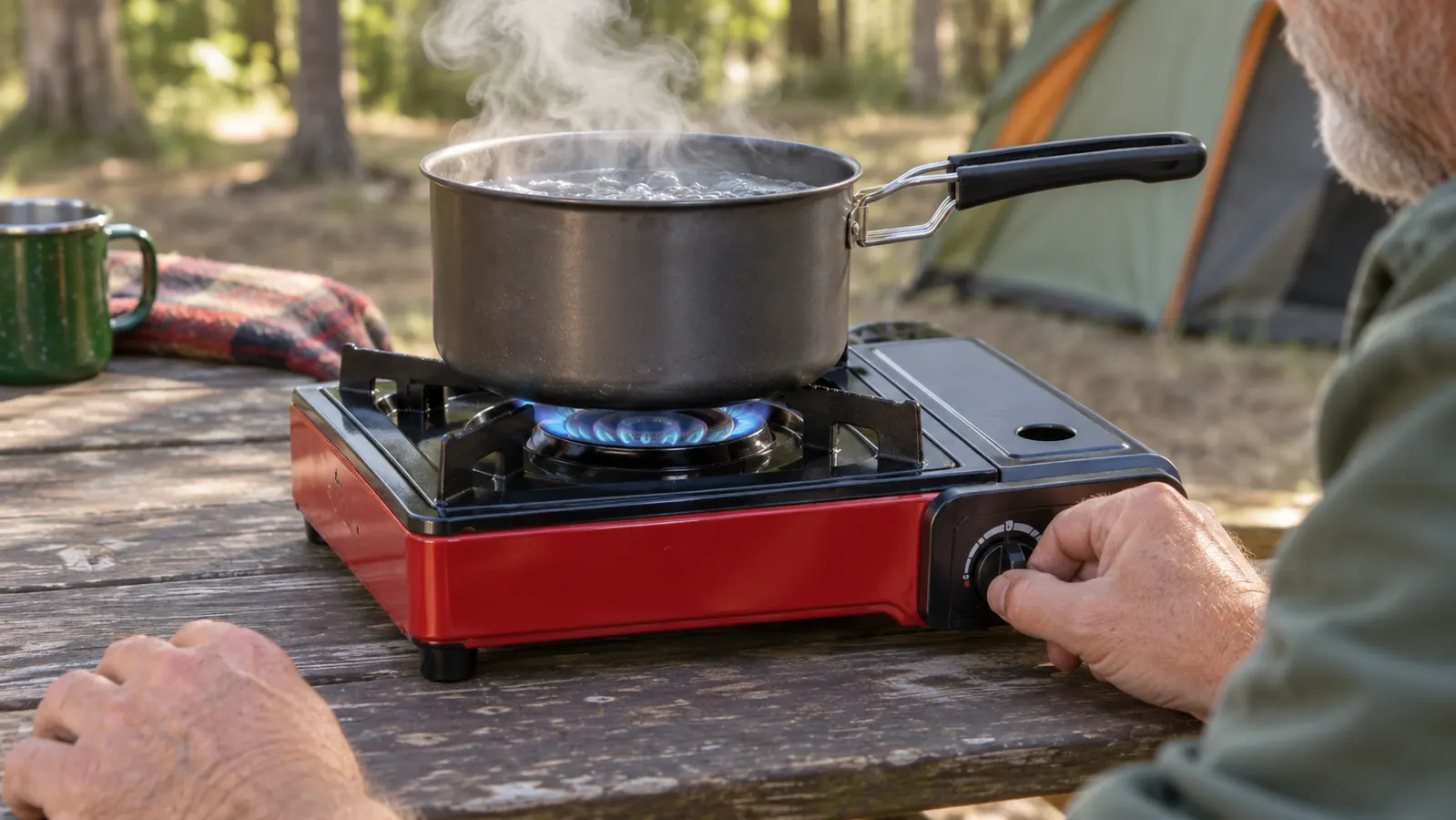
The stove lights with a piezo electric igniter, which is a fancy way of saying a button. Push it, get a spark, get a flame from the adjustable dial. Mine has caught on the first or second push nearly every time, including damp mornings when I did not expect it to. It is still a mechanical part, and mechanical parts quit on their own schedule, usually the worst one. There is a long grill lighter in the carry case beside the stove, and it weighs almost nothing.
The heat dial is a genuine dial and not a decoration. It runs from a low simmer that will hold a pot of soup without scorching the bottom up to a hard roll, and 8,000 BTU is enough to get a quart of water to a boil in a reasonable time on a calm day. It is not a restaurant burner. You will not be searing anything on it, and the griddle handles that work anyway.
Cleanup is a rag and a little water. Nothing on this stove needs seasoning, nothing needs scraping, and nothing needs to be dried and oiled after you wash it. After a season of owning a cast iron Dutch oven and a tabletop griddle, both of which demand attention after every single use, I have come to think of that as the quiet luxury of the whole thing.
Wind Is the Real Enemy, and It Is Not a Small One
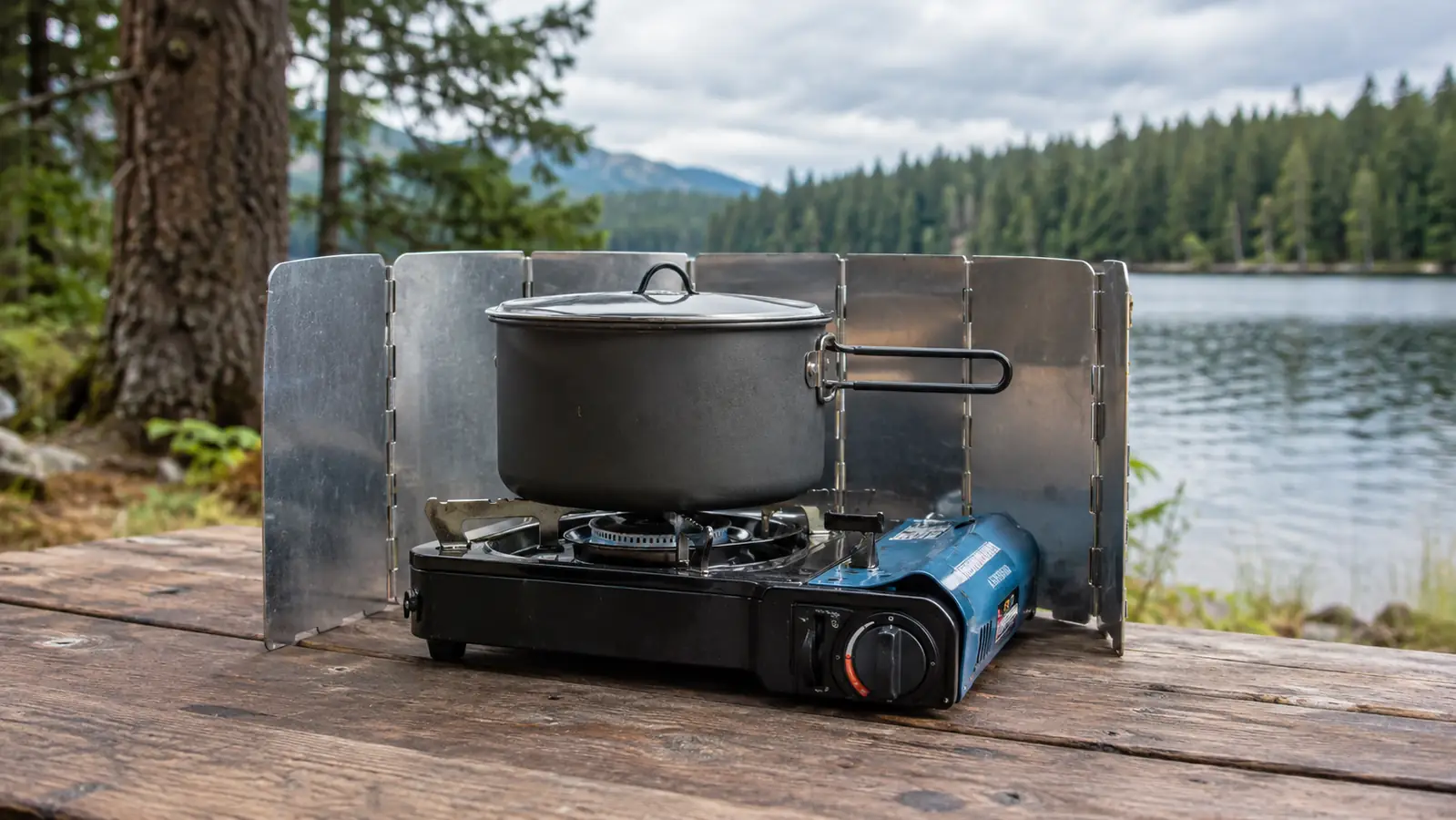
Every portable stove review waves at the word wind and then moves on. Here is what it looks like in practice. At a campground outside Bend, the stove sat on the picnic table with a breeze coming off the lake. Same fuel, same dial setting, same pot. The water took roughly twice as long to boil, because the flame leaned sideways and half the heat went somewhere other than the bottom of the pot.
I carry a simple folding windscreen now, and it changed the stove from unreliable to dependable in about four seconds of setup. The stove does not include one. Buy one, or learn to tuck the stove behind the cooler, which works right up until the day it does not.
The lesson is simple and it applies to every 8,000 BTU single burner on the market. That number is a fair estimate on a still morning and an optimistic one in weather. If you cook outside in the Pacific Northwest in spring, plan for wind the way you plan for rain, and you will not spend a morning annoyed at a stove that was doing its best.
Three Pounds, Thirteen and a Half Inches, and Why That Matters
The stove measures 13.5 inches long, 11 inches wide, and 4.45 inches tall, and it weighs 3.1 pounds. In a small motorhome those are not trivia. Our Dutch oven weighs 13 pounds and lives on the floor of the storage bay so the weight stays low and centered. A 3.1 pound stove can sit on a shelf and never once enter the conversation about payload.
It lives in its carry case in the outside storage bay, next to the griddle and the padded bag with the cast iron inside. It does not fit in the one narrow galley drawer and I would not want it there. Fuel and cooking smells belong outside, not two inches from the bread.
The carry case earns its keep in a way the product photo does not convey. The stove goes in, the case closes, and the bay does not fill up with soot and pine needles. It is not going to survive being thrown in a truck bed. It is a case that keeps the worst of the road dust off the burner, and after two summers it has done exactly that.
Setting It Up and Taking It Down, Which Is Most of the Work
The stove itself takes about a minute. What takes the time is everything around it: finding a flat spot, wiping the table, setting the windscreen, checking the fuel, and then reversing all of it when the food is gone and the stove has cooled enough to pack. I mention this because the product description makes it sound like a flick of the wrist, and it is not. It is a small ritual, morning and evening, and rituals take minutes even when you know them by heart.
Ray and I have a routine now. He wipes the table and sets out the camp chairs. I get the stove and the fuel out of the bay and angle the windscreen. If we are having eggs and bacon, the griddle goes on the far end of the table and Ray runs that, and we have a standing rule that nobody walks between the two cooking surfaces while either one is lit.
The one part I would change if I could is the cooling wait. A stove that has been running for twenty minutes is hot, and it has to sit before it goes back in the case. That is not a defect, it is physics. But it does mean the last thing you do before leaving a campsite is stand there waiting, which turns out to be a fine moment to look at the lake.
How It Has Held Up After Two Summers
I bought it in the summer of 2024 and it has gone out on every trip since. The body has no rust spots I can find. The dial still moves freely through its whole range. The igniter still sparks. The warranty is one year, and we are well past that, which is the point at which you find out whether a thing was built honestly. So far this one was.
What wears on a stove like this is not usually the metal. It is the small decisions, the fitting, the thread on the fuel connection, the little habits of the person using it. I check the connection every time I put a canister on, the same way I check the handle clicks on my cookware before lifting a full pot. That habit is not a complaint about the Gas One. It is just what a careful person does with anything that carries fuel.
If You Were Wondering About a Two Burner Instead
The obvious question is whether a two burner stove would have been the smarter buy. For some people, yes. Two burners mean you cook a whole meal at once instead of sequencing it, and if this were going to be your only stove, that difference would wear on you by the second dinner. But two burners also mean a bigger footprint on the picnic table, more fuel burning at once, and more weight sitting in the bay.
My advice is to count how many things you actually cook at the same time. If the honest answer is two and you have no indoor cooktop, buy the two burner and be done. If the answer is one, because the rest of the meal is happening inside or on a griddle, the Gas One is the lighter and simpler choice, and it takes up roughly the space of a shoebox in the storage bay.
The Honest Downsides, in Plain Terms
It is one burner. One. If you are making soup and grilled cheese at the same time, one of them waits, and it waits with the lid off so it does not overcook. In our rig that is fine because the inside cooktop covers the second pot. If this were going to be your only stove, you would feel that limitation before the first weekend was over.
Fuel is not included, which surprises people. You will make a stop before your first breakfast, and if you are pulling out on a Sunday evening in a small town, that stop may be the only thing open. Buy fuel before you leave home. The other downside is the one I keep coming back to: wind. A stove with an open flame on a picnic table is at the mercy of the weather, and no feature on the box fixes that.
What I Liked
- Lights with a push of the piezo igniter, no hunting for matches on a damp morning
- Takes butane canisters or a one pound propane cylinder, so one empty shelf does not cancel breakfast
- 3.1 pounds and 13.5 by 11 by 4.45 inches, which slides into the outside storage bay without rearranging anything
- Cleans with a rag and a little water, with nothing to season or scrape
- The adjustable dial gives a real simmer, not just hot and hotter
Where It Falls Short
- Wind pushes the flame sideways and roughly doubles cooking time
- Butane canisters go soft when stored in a cold bay overnight
- One burner means one pot at a time, always
- Fuel is not included, so you will make a stop before the first meal
- You need a flat, level surface and a backup lighter for the day the igniter quits
Same fuel, same dial setting, same pot. Twice the time, because the wind came off the lake.
Who This Is For
This is for the person whose kitchen is a vehicle and who wants a second burner outside it. It suits retirees on a fixed schedule who cook real food rather than boiling water for a pouch, and it suits anyone who wants the backup fuel option because running out in a strange town is a bad way to start a morning. If you have a cooktop inside, a picnic table outside, and three pounds of payload to spare, this fills the gap between them and asks nothing else of you.
Who Should Skip It
Skip it if you need two burners at once, if you cook in serious wind most days, or if you want something that stays set up rather than coming out of a case every morning. Skip it too if you are not willing to learn how butane behaves in cold, because that single piece of knowledge is the difference between a stove you trust and a stove you curse at. It is a good tool with a narrow job, and to its credit it is honest about the job.
A second burner that fits on a shelf and lights without a match
Two summers of picnic table breakfasts, one small case in the storage bay, and the same 3.1 pounds it started with. Check today's price on Amazon before your next trip out.
Amazon Check Today's Price on Amazon →