
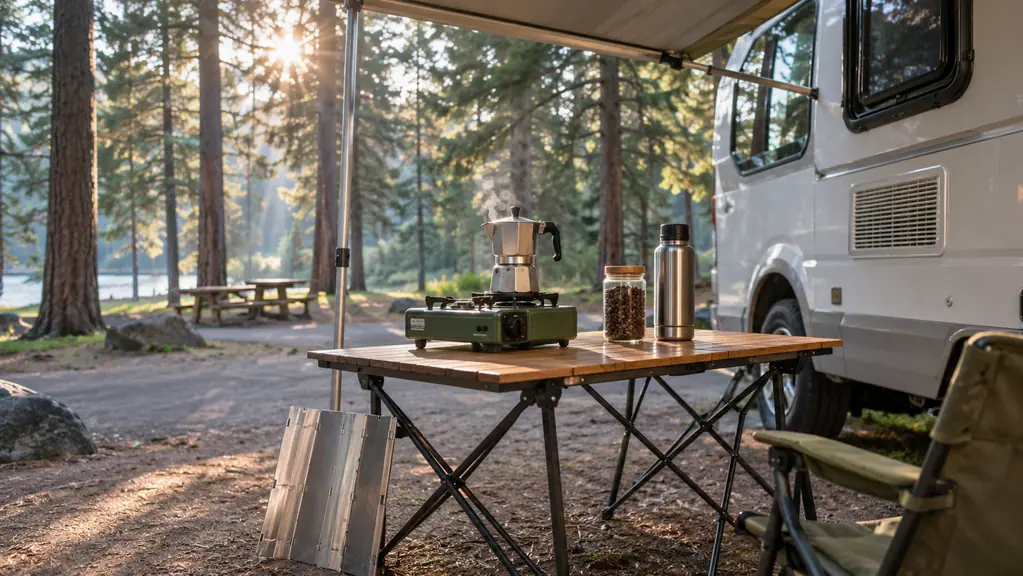
Short answer first, because that is the thing I wanted most when I was trying to picture either stove on our picnic table. For the way Ray and I actually cook in a 25 foot Class C motorhome, the Gas One GS-3400P is the stove that earns the space in the storage bay. The Coleman two burner is the better stove for a family that sets up at one campsite for a week and cooks a real breakfast every single morning. Those are two different jobs, and I have watched people buy the wrong one and then leave it home.
Here is why. Our rig already has a two-burner propane cooktop bolted to the counter inside. What it does not have is a way to fry bacon at eight in the morning without the whole coach smelling like breakfast until Thursday, or a spare flame when both inside burners are busy with a pot of chili and a saucepan of rice. The Gas One sits in its plastic case behind the camp chairs and comes out for both of those jobs. It weighs 3.1 pounds, it lights with a button, and it goes back in the bay ten minutes after we eat. The Coleman does the same work and then asks you to find a shelf to keep it on.
| Gas One GS-3400P | Coleman Two Burner | |
|---|---|---|
| Burners | One, on a single grate | Two, side by side on a wide body |
| Fuel | Butane canisters, or a 1 lb propane cylinder with the included adapter | 1 lb propane cylinders |
| Weight | 3.1 pounds, in a plastic carrying case with a handle | A good deal heavier, and it stores as a box |
| Footprint on the table | 13.5 by 11 inches, leaves room for a cutting board | Takes up most of one end of a standard picnic table |
| Total cooking capacity | 8,000 BTU on one burner | Two burners sharing the work, so a whole breakfast goes at once |
| Low heat | Adjustable heat dial holds a low flame under a pot of rice | The low end is coarser, and anything that scorches needs watching |
| Ignition | Automatic piezo-electric, no matches | Push-button ignition on the current models |
| Wind | Open burner, so a folding windscreen goes up first | Side panels fold up and shield the burners |
| Cleaning | One small grate and a shallow drip area, a rag and half a cup of water | Two grates and a wide grease tray to scrub |
| Warranty | 1 year | A limited warranty, so read the current terms before you buy |
| Best for | One or two people cooking outside, plus a spare burner when the galley is full | A family at a fixed campsite with room to store it |
Where the Gas One GS-3400P Wins
The first advantage is weight, and it is not close. The GS-3400P is 3.1 pounds and it comes in a plastic carrying case with a handle. I can lift it out of the bay with one hand while holding a coffee pot in the other. Ray is 70 and had his shoulder worked on a few years back, and the difference between 3.1 pounds on a handle and dragging a box the size of a briefcase out from under the folding chairs is the difference between a stove we use twice a day and a stove we leave home. Packed, it measures 13.5 inches long, 11 inches wide and 4.45 inches tall. It slides in behind the chairs and I forget it until I want it.
The second advantage is fuel. The GS-3400P runs on butane canisters, or on a 1 lb propane cylinder with the adapter that comes in the box. That reads like a brochure line until you spend a January morning in Arizona waiting on a butane canister to wake up. Butane gets lazy in cold weather, so I run propane in the winter and butane in the summer, when the canisters burn clean and I can buy them anywhere. The automatic piezo-electric ignition means no digging for matches in the drawer with the dish soap. Push the button, turn the adjustable heat dial, and it catches. I did not expect a stove that folds into a case to hold a low flame under a pot of rice without scorching it, and it does.
One morning outside Quartzsite last January it was 34 degrees at seven. The butane canister I had left in the bay overnight lit and then sulked, with a flame that barely covered the bottom of the kettle. I shut it off, swapped to a 1 lb propane cylinder, turned the dial, and had coffee in about six minutes. Since then I carry two cylinders from November through March and I check the date stamp on any butane I load. The swap takes a minute, and it is the whole reason this stove works in a cold month when a butane-only stove sits in the case and pouts.
Third is the size of it on the table and the water it takes to clean. At 13.5 by 11 inches it leaves room for a cutting board, a bowl of beaten eggs and the coffee pot, which a two-burner body does not. Cleaning is one small grate, a shallow drip area, a rag and about half a cup of hot water from the kettle. In a rig with a 6 cubic foot fridge, one narrow drawer and a gray tank that fills faster than I would like, that half cup is a real number. I am not spending my dishwater on a stove.
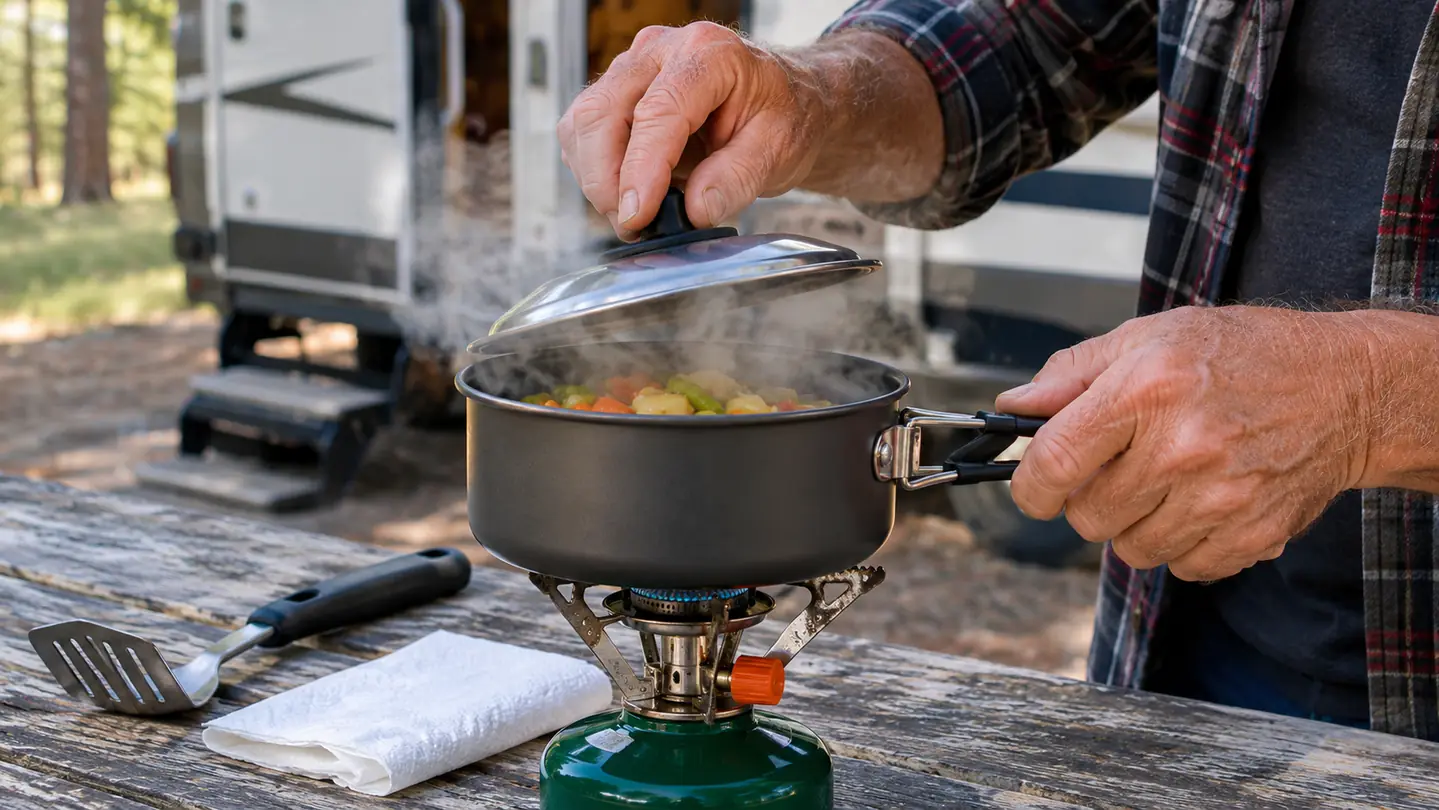
Where the Coleman Two Burner Wins
The Coleman does the one thing the Gas One cannot, and if that one thing is your whole morning then none of the rest of this matters. It has two burners, wide enough apart that two pans fit without a fight. Bacon in one, pancakes in the other, both hot at once, both within reach. When friends from our Salem campground circle pull in for a long weekend, the Coleman gets breakfast out for six people before the coffee goes cold. The Gas One gets one pan at a time, so I cook in an order instead of in parallel. On a slow morning that is fine. On a hungry morning it is not.
Better here means better for a group, and I want to be plain about that. I have cooked on a friend's Coleman at a lake campsite in eastern Oregon and it did everything it claimed. The pans sat flat, the side panels did their job against a crosswind coming off the water, and I never once thought about the flame while I was talking to somebody. That is what a good stove buys you: attention you do not have to spend.
Two, the Coleman handles wind and heavy iron without any help from me. The side panels fold up and shield the burners, so a breeze coming off the lake at seven in the morning does not push the flame sideways. My GS-3400P is an open single burner and a gust will lay the flame over, so I set up a folding windscreen before I light it. That is a thirty second habit and I do not resent it, but it is a habit the Coleman does not require. The Coleman also has the wider body and the bigger grates. Our 5 quart cast iron Dutch oven goes on the Gas One about once a week for chili and no-knead bread, and it works, but I set it down dead center and I do not walk away from it. The same pot on a two-burner body would not need the ceremony.
3.1 pounds, 13.5 inches long, and it lives in a plastic case behind the folding chairs. Everything else in this comparison is a detail next to that.
What Two Seasons in the Storage Bay Taught Me
We bought the GS-3400P in the summer of 2024, so it has been through two camping seasons and change, including a wet stretch on the Oregon coast and a dusty month outside Tucson. The case has a scuff on one corner from a concrete pad. The grate has darkened the way grates do. The body has no rust that I can find, which surprised me given how much time it spends in an unheated bay. The piezo ignition still catches on the first push, and that is the part I expected to fail. The dial still moves from off to a low flame without a dead spot in between.
One thing that did not occur to me until it happened: the case is not waterproof. On that wet stretch on the coast in October, water pooled in the bottom of the outside bay and the stove sat in about an eighth of an inch of it overnight. The case kept the burner itself dry, but I pulled everything out the next morning and dried it on a towel in a break between showers. Now the case rides on a rubber mat at the back of the bay and I have not had a repeat. That is not a flaw in the stove. It is a thing you learn about bays.
Two things I do differently now than I did in 2024. I carry a folding windscreen on every trip, even a still morning, because the open burner is the one honest weakness of this design. And I stopped fighting to cook two things at once on one flame. The pot of chili or the coffee goes on the Gas One, and if I want pancakes with it, Ray has the griddle going at the other end of the picnic table. Two small things that each do one job beat one big thing that does two jobs and then has to be found a home.
What I have not had to do is repair anything. No clogged jet, no cracked hose, no flame that refused to come down to a simmer. At 8,000 BTU it is not a rocket and it is not meant to be. It boils a kettle in about the time it takes me to set out the mugs, and it holds a low flame under a pot for an hour without a fuss. That is the whole job description for a camp stove as far as I am concerned.
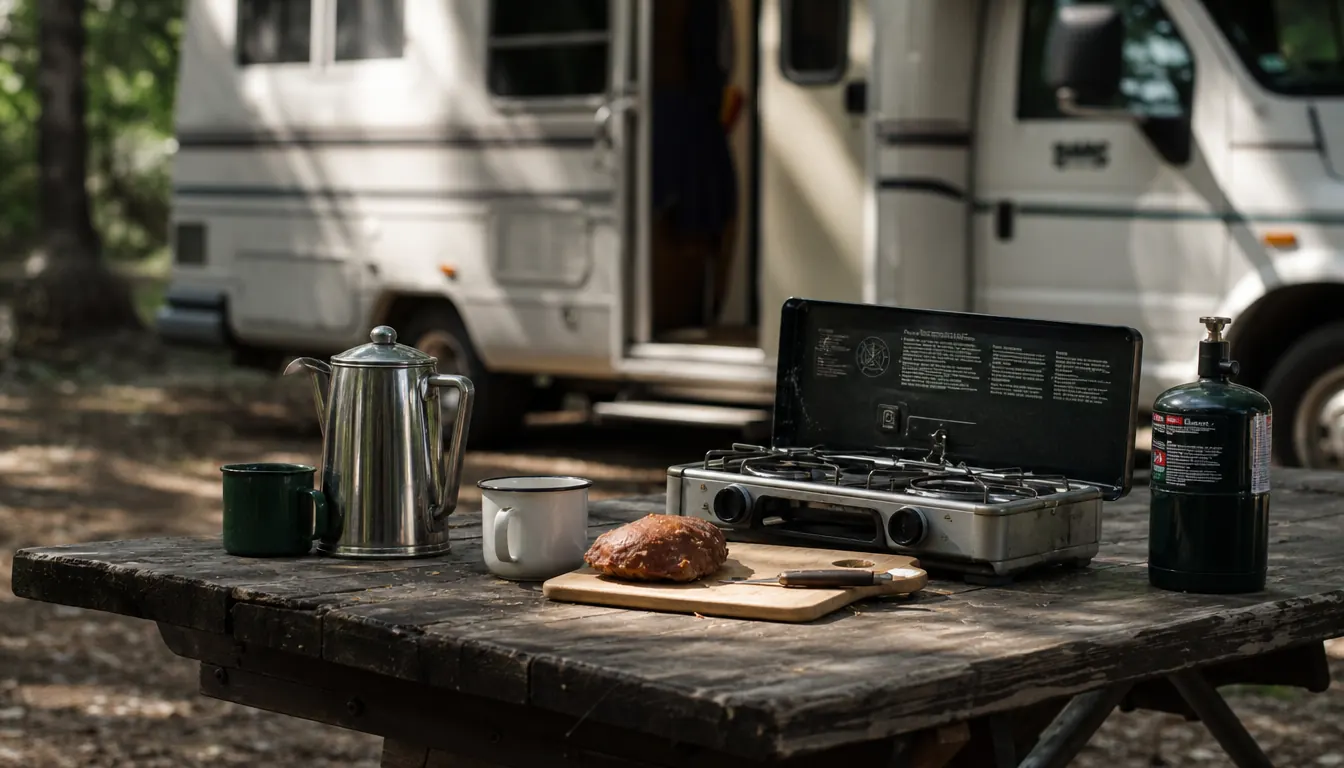
The Two-Burner Question
Whether you need two burners outside comes down to what is inside. If your rig has a working cooktop, you already own two burners, and they are out of the wind and out of the rain. What you do not have is a way to cook without heating up 25 feet of motorhome in July or filling it with the smell of onions. A single portable burner solves that, and the Gas One solves it at 3.1 pounds. If your rig has no cooktop, a tent trailer or a van or a truck camper where the galley is a cooler and a jug, then a two-burner stove outside is not a luxury, it is your kitchen. The Coleman is the better kitchen.
I measured once, out of curiosity, on the pad outside the rig. The Gas One's case takes a rectangle about the size of two folded camp chairs laid flat, and I can stack the kettle and the windscreen on top of it. A two-burner box would take that spot plus the space the chairs used to have, which pushes the chairs into the aisle, which means Ray steps over them on his way to the water pump at night. That is the real arithmetic in 25 feet, and it is why the smaller stove stayed.
There is also the weight and space budget, which nobody talks about until they are loading the bay. Our Class C has a limit like every other one, and cooking gear adds up. 3.1 pounds in a flat case fits into that budget without a conversation. A two-burner box is not heavy in absolute terms, but it takes a rectangle of floor space that something else wanted, and it has to be lifted onto a table that is often not level. None of that is a dealbreaker. It is the tax you pay for the second burner.
What I Liked
- 3.1 pounds, in a case with a handle, so it actually gets carried out
- Runs on butane canisters or a 1 lb propane cylinder with the included adapter
- Automatic piezo-electric ignition, no matches to hunt for
- Adjustable heat dial holds a low flame for rice and stews
- Cleans with a rag and about half a cup of water
- 13.5 by 11 inches leaves room on a crowded picnic table
Where It Falls Short
- One burner only, so you cook in an order instead of in parallel
- The open burner needs a windscreen in any kind of breeze
- A heavy cast iron pot has to be set dead center and watched
- Butane is unreliable on cold mornings, so winter means propane
- The carrying case is not waterproof if water gets into the storage bay
One burner, 3.1 pounds, and it fits behind the folding chairs
If your galley already has two burners, this is the one that does the work outside. Butane or a 1 lb propane cylinder, piezo ignition, a case with a handle, and a grate that wipes clean with half a cup of water.
Amazon Check Today's Price on Amazon →Who Should Buy Which
Buy the Gas One GS-3400P if your rig already has a cooktop inside and you want a burner outside that you will actually carry out, use, and put away before it rains. Buy it if you cook for one or two and would rather have a stove that fits on a crowded picnic table than one that owns it. Buy it if you want a backup burner for a power outage at home, since it runs on two kinds of fuel and lights without a match.
Buy the Coleman two burner if you cook for four or more at a campsite, if you have a shelf or a bay corner where a box can live, and if wind and heavy pots are part of your mornings. Buy it if the stove stays set up on the table from June to September, because at that point portability stops mattering and capacity starts.
And if you are where we were in 2024, with a small galley and no wish to rearrange the storage bay, the smaller stove is the one that gets used. A stove that lives behind the camp chairs and comes out in ten seconds beats a better stove that stays in the bay because it is a nuisance. That is not a knock on the Coleman. It is a comment on how much room 25 feet gives you.
The stove that gets used is the one that fits
Two seasons on, ours is still in the case behind the chairs and still catching on the first push. If that sounds like the way you cook, start here.
Amazon See the Gas One GS-3400P on Amazon →