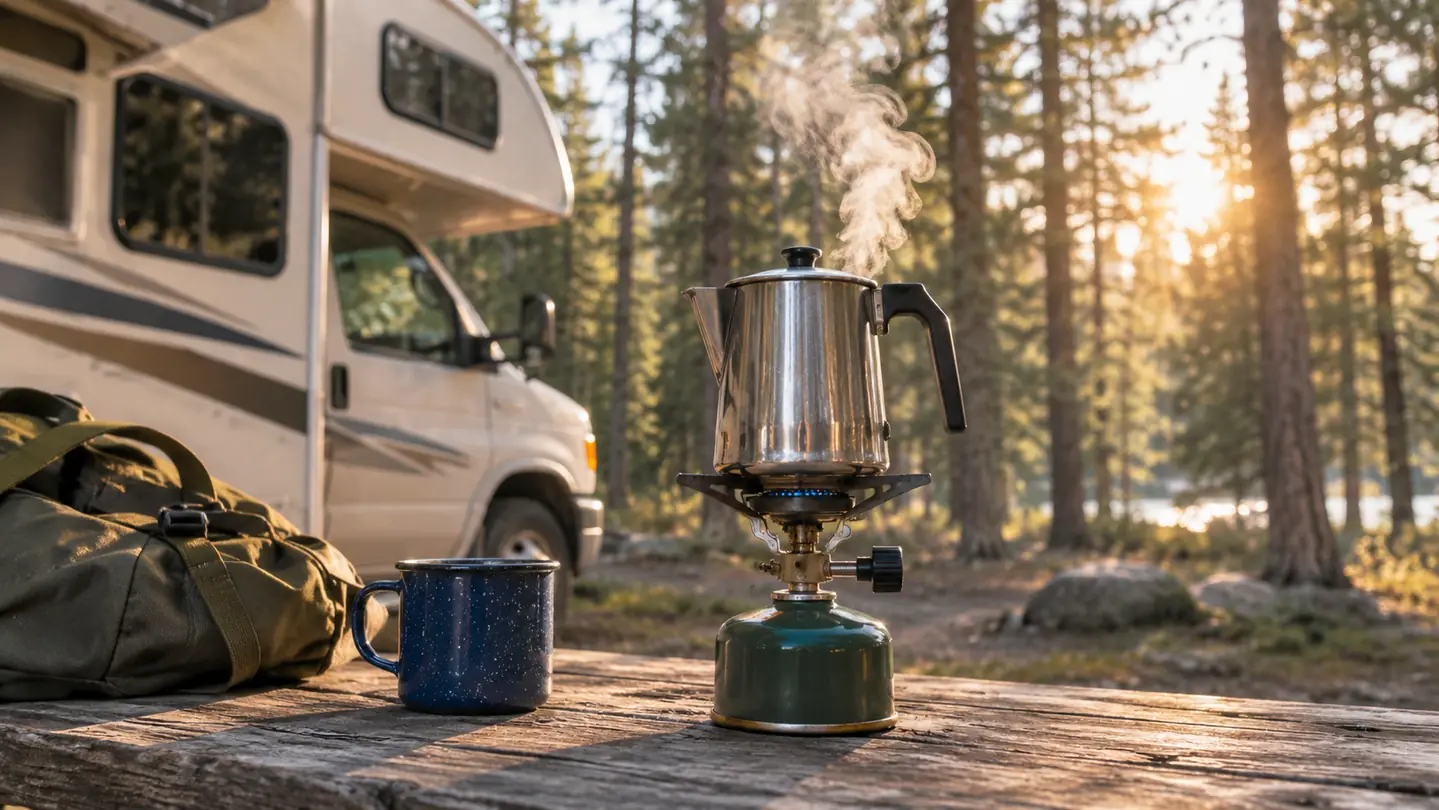
By the third summer in the motorhome I knew exactly what a 25 foot Class C does when you fry bacon inside it. The smell settles into the curtains. The heat climbs to the ceiling and stays there until the outside air finally drops at ten at night. And a fine grease film finds the cabinet fronts no matter how carefully you hold a lid over the pan.
Ray and I fixed it the way a lot of couples on the road do, by moving most of the cooking outdoors. The piece that made it practical was small. A Gas One GS-3400P single burner, bought in the summer of 2024, still the oldest cooking item we carry. It lives in its carrying case in the outside storage bay and comes out most nights from May through October. Dinner happens at the picnic table now, and the rig smells like a rig instead of like onions. What follows is the routine, in the order I actually do it, including the parts that went wrong before I learned better.
The three pound burner that keeps bacon smell out of the curtains
One burner, 8,000 BTUs, 3.1 pounds, and a carrying case that fits in the storage bay with room to spare. This is the stove that moved most of our cooking outside.
Amazon Check Today's Price on Amazon →Five Steps, in the Order I Actually Do Them
Step 1: Pick the Site Before You Unpack the Stove
The first thing I do is not unpack the stove. It is read the campground rules on the board by the office door. Plenty of state parks want cooking on the provided grate or on a table, not on the grass, and some ban open flame entirely during a dry stretch. Finding that out after you have hauled everything out is a waste of a good evening.
Then I look for a flat surface. The stove is 13.5 inches long, 11 inches wide and 4.45 inches tall, so it needs a tabletop bigger than that with no rock in it. Half the picnic tables in the older parks are warped, and a rocking stove means a sliding pot. I keep a square of half inch plywood in the bay, cut to about 16 by 14, and set the stove on that when the table is uneven.
One evening last September, at a park outside Bend, the table was so far out of level that a mug of coffee slid toward the edge on its own. I folded a dish towel under the plywood board and made up the difference, and the stove sat still for the whole meal. The towel lives in the bay with the board now, and it has saved three dinners since. That is the kind of thing nobody tells you and every experienced camper eventually figures out.
Location matters more than people think. I set up downwind of the door so smoke and grease drift away from the rig, and I keep clear of the awning fabric. The stove never goes inside the motorhome, never inside the screen room, and never in a tent, no matter how cold or rainy it gets. Those are the rules I do not bend, because carbon monoxide does not care how experienced you are.
Step 2: Match the Fuel to the Morning You Expect
The Gas One GS-3400P is a dual fuel stove. It runs on butane canisters, or on a 1 lb propane cylinder with the adapter that comes with it. That matters more than the spec sheet suggests, because the two fuels behave differently in the cold.
Butane is the easier canister to find and it burns clean and hot, and it is what I use from roughly May through September. Below about 40 degrees it gets sluggish, the flame shrinks, and a pot of water that boiled in six minutes takes fifteen. So on a cold shoulder season morning I switch to the 1 lb propane cylinder and the adapter, and the stove behaves like it does in July. Same burner, same dial, different fuel.
Fuel lives in the outside storage bay, upright, out of direct sun, never in the living space and never on the dashboard. I carry one spare canister and one spare propane cylinder, which is more than enough for a week of two meals a day. The stove's maximum output is 8,000 BTUs, so it is not a rocket, but it is honest heat for one pot at a time.
Step 3: Block the Wind, Then Light It
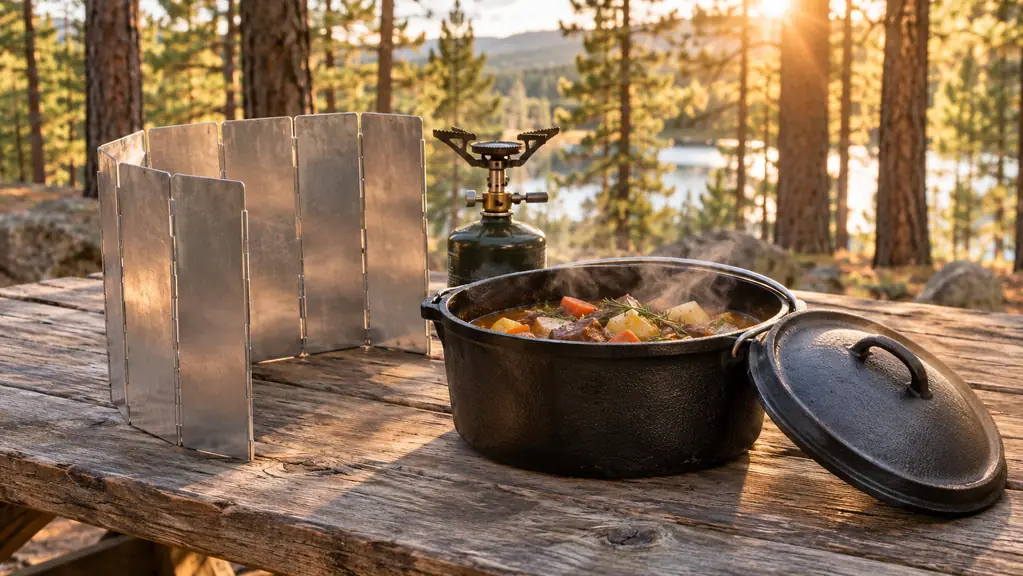
The one real weakness of a single burner this light is wind. On an open table with a breeze off the lake, the flame leans and the pot never gets the heat you are paying for. I solved it with three panels of folded aluminum flashing, hinged with the folds so it stands on its own. It goes on the upwind side, a couple of inches from the burner body, with the back left open. Never wrap it around all four sides, because you will trap heat under the pot and cook the stove instead of the food.
Wind is the thing I underestimated longest. On a bright afternoon at a lake in eastern Oregon the flame on the Gas One leaned so hard the water never broke a simmer, and I blamed the fuel for a solid hour before I thought to look at the flame itself. Three panels of flashing later, the same pot boiled in seven minutes. Now the windscreen comes out before the stove does, even on a calm looking day, because the breeze off water tends to arrive around four in the afternoon.
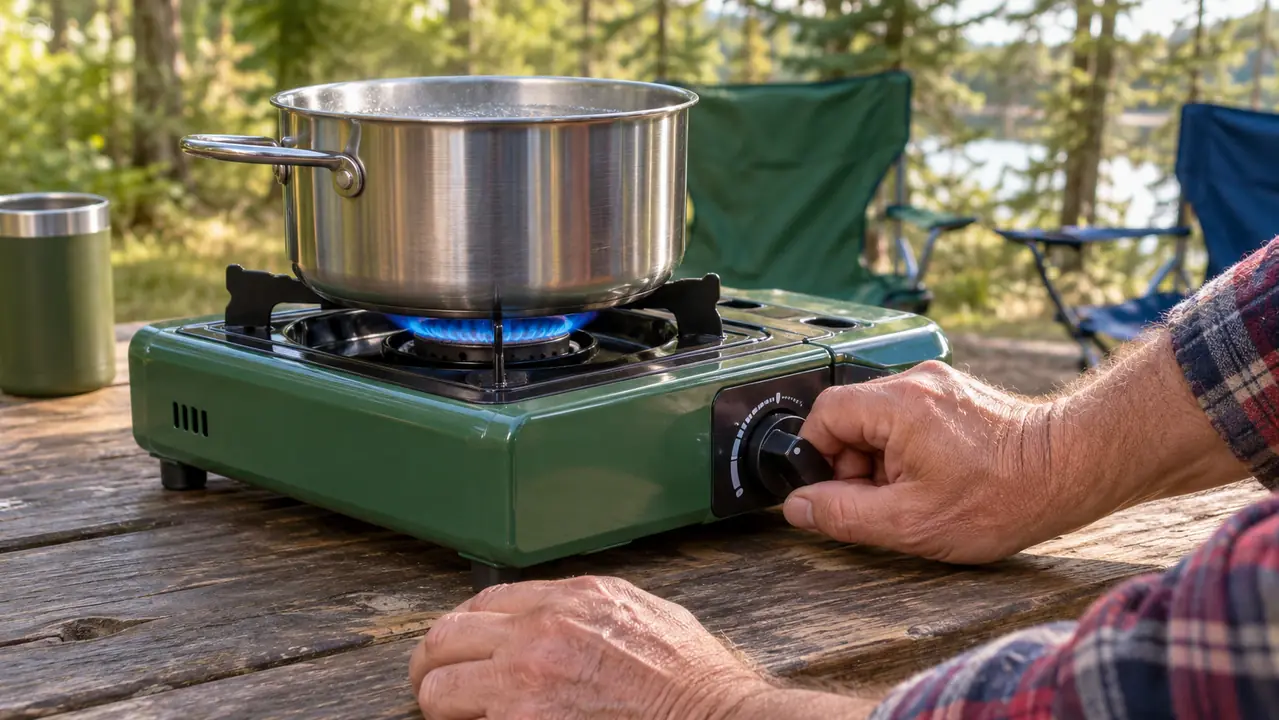
Lighting is simple once you have done it twice. Turn the heat dial to the closed position. Attach the fuel. Open the dial about a quarter turn, push the piezo electric ignition, and the burner catches with a click instead of a match. If it does not light after two or three tries, close the dial all the way, wait a minute for the gas to clear, and start again. Do not stand there clicking at a burner that is already hissing.
Once it is lit, I set the flame with the dial and leave it. A good flame is blue with a steady ring and just a hint of yellow at the tips. If the whole flame is yellow and lazy, the burner is getting too much fuel or the air holes are dirty. And I never move a lit stove, not even an inch, no matter how the wind shifts.
It weighs 3.1 pounds and it lives in a carrying case in the storage bay. That is the entire reason it comes out every single night and the two burner inside the rig does not.
Step 4: Cook in Sequence, Because You Have One Burner
One burner means you plan a meal backward from the pot count. On a typical Tuesday that means the coffee pot goes on first while I am still in my camp chair, then the 5 quart cast iron Dutch oven for a stew or a chili, and everything that needs a hot pan happens last so it goes to the table hot. When I forget the order and try to do three things at once, we eat in shifts.
Timing is worth writing down. A pot of water for pasta takes about eight minutes on this burner with the wind blocked, a Dutch oven of chili takes forty minutes to come up and another thirty to cook down, and the coffee pot is five. If I start the chili at five in the afternoon, we eat at seven. If I start it at six, we eat crackers and complain about it, which we have done twice.
The Dutch oven is the workhorse for this setup. It is 13 pounds, which is the heaviest cooking item we carry, so it rides low and centered on the bay floor in a padded bag. On a cool evening it goes on the campfire grate and Ray tends the coals. On a fire ban or a wet night it sits on the stove instead, and I do not walk away from it, because a pot that size on a burner that small wants a little attention.
Breakfast is where the two surface trick pays off. Ray runs the 17 inch griddle on the far end of the table for pancakes and bacon, and I keep the single burner for coffee and a pan of eggs. Two cooking surfaces, no crowding, no one reaching across a hot grate. It also keeps the grease outside, which was the whole point to begin with.
Step 5: Shut It Down and Wash With a Cup of Water
Shutdown order matters. I turn the fuel off at the cylinder or canister first and let the flame burn down and die on its own, which clears the line. Then I close the heat dial. Doing it the other way leaves gas sitting in the hose, and you can smell it the next time you open the case.
Then I wait. The metal body gets genuinely hot and the grate holds heat for several minutes. I wipe the grate with a paper towel while it is still warm and the residue comes off easily, then let everything cool completely before it goes back in the carrying case. A stove packed warm stays sticky and picks up grit from the bay floor.
Washing up is where a small rig teaches you discipline. I scrape the plates into the trash, wipe them with a paper towel, then wash in a small basin with about a cup of hot water and a drop of soap. The Dutch oven gets dried on the burner for a minute and wiped with a thin film of oil so it does not rust. Two pots and two plates, done in ten minutes, and the gray tank does not know we ate.
What Else Helps
A few things around the stove earn their space. The collapsible silicone containers get used more than anything else in the galley. I prep onions, peppers and sliced meat at the rig, collapse the empties flat in the overhead cabinet, and carry one trip to the table instead of four. Leftovers go back in the same containers and into the 6 cubic foot fridge, which is small enough that square containers beat round ones every time.
The containers earn their space on day trips too. We pack lunch for the lake in two of them, collapsed flat in the day bag, and they hold sandwiches and a sliced apple without crushing either one. The lids need a firm press to seat properly, and a leftover tomato pasta will leave a faint stain in the silicone that washing does not fully lift. Neither of those bothers me anymore, and I have stopped apologizing for the stain when friends ask about them.
Cast iron is the other half of the system. One deep pot with a lid that doubles as a skillet covers stew, chili, no knead bread and a cobbler in the coals, and it does it without a stack of pans. The tradeoff is weight and the drying and oiling after every wash, and I would not pretend otherwise. It rides on the floor of the bay, not in the galley drawer.
Two small habits make the whole routine hold together. First, a folding side table, because the picnic table is sometimes taken and sometimes six feet from the rig. Second, a headlamp, because the last of the cleanup happens after dark more often than you would guess. Neither takes up much space, and both mean the stove gets used instead of skipped on the nights you are tired.
One honest note about the stove itself. It is a single burner with an adjustable heat dial and a one year warranty, and it is not going to simmer a delicate sauce the way a home range will. Low is a little higher than low should be. For soups, stews, coffee, eggs and a pot of pasta it is completely fine, and after two years of nightly use our Gas One still lights on the first click.
If the inside of your rig still smells like last night's dinner, this is the simplest fix I know
Set it on the picnic table, block the wind, and cook the whole meal outdoors. Ours has been in the storage bay since 2024 and still comes out every night.
Amazon Check Today's Price on Amazon →