The first morning at a new campsite tells me whether I packed right. Coffee is easy. Breakfast is the hard one. In a 25 foot Class C, the two burner cooktop inside can turn out eggs and toast without much trouble, but bacon, pancakes and hash browns for two people in that galley means steam on the ceiling, grease on the backsplash behind the stove, and me turning sideways every time Ray needs to get past me to the sink.
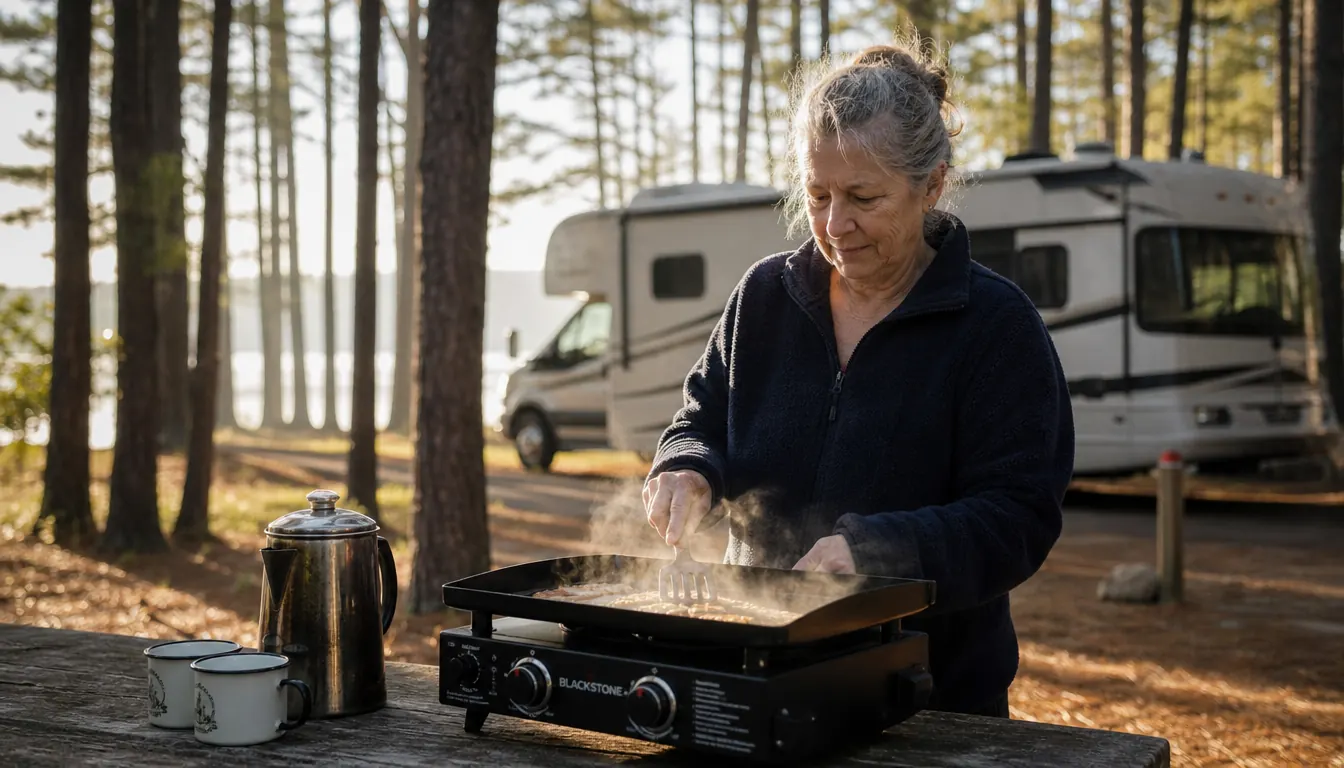
So we moved breakfast outside. The BLACKSTONE 1814 17 inch propane griddle came with us in spring 2026 and has ridden in the outside storage bay ever since, seven months of trips now. It sits on a picnic table, runs off a 1 lb cylinder or an adapter hose, and cooks the whole meal on one surface instead of one pan at a time. What I did not expect was how much of the job is not cooking. Setup, seasoning, heat and the scraping afterward decide whether the thing is a pleasure or a chore. Here is the routine we settled into, in the order we actually do it.
The whole breakfast goes on at once, twenty feet from the galley
The BLACKSTONE 1814 is a 17 inch tabletop griddle with 268 square inches of cooking surface and a built in igniter. It goes from the storage bay to the picnic table in one trip and runs on a 1 lb propane cylinder or an adapter hose.
Amazon Check Today's Price on Amazon →The Morning Routine, Start to Finish
Step 1: Get the griddle level and the gas checked before the food comes out
The order matters more than people think. I used to carry the egg carton and the batter bowl out first and then set up, and by the time the surface was hot the batter had warmed and the butter had gone soft in the sun. Now the griddle goes out first and the food stays in the fridge until everything is ready to receive it.
Level first, always. A picnic table at a state park is rarely level, and a griddle that tips sends every drop of bacon fat into one corner, which is exactly where the hash browns are sitting. I set the unit down and press on opposite corners of the table. If it rocks, I move to another table or Ray slides a thin split of firewood under the short leg. The feet on a tabletop unit sit flat, but the table has to meet it halfway.
Then gas. We screw a 1 lb cylinder onto the regulator, hand tight, and check the joint with a drop of dishwater. Bubbles mean back it off and start again. When we are staying in one place for a week, Ray runs the adapter hose to a larger tank so we are not buying cylinders every few days. Wind is the other piece of setup. If it is blowing across the table, the flame suffers and the cooking slows down. I turn the griddle so the wind hits the back of it, and on a rough morning Ray puts a folding table on its side behind the rig as a break. Five minutes of setup saves a whole breakfast.
Step 2: Season it at home, then keep it seasoned on the road
A new griddle is not ready to cook on. The cooktop arrives with a factory coating that has to come off before anything touches it, and then the surface wants thin layers of oil heated on until it darkens and turns slick. I did ours at the house in Salem over an afternoon, four rounds, a teaspoon of oil wiped across and left to smoke off each time, before it ever went into the rig. Do that work at camp and you will be standing there at seven in the morning with an empty stomach and a surface that is not ready.
At camp, seasoning is maintenance, not a project. After every breakfast I scrape the surface while it is still warm, wipe it down with a paper towel, and rub on a thin film of oil with a second paper towel. That is the whole job. Twice a season I do a fuller round at home between trips. A dry cooking surface will rust and stick, and a sticky surface will fight you on eggs for the rest of the week.
The one thing I would tell anyone buying their first one: do not soap it and do not leave it wet. I use a stiff scraper and a flat spatula, and I skip the scouring pad entirely. Water is for lifting residue off a warm surface, not for washing it like a frying pan. The stainless front plate and the hood wipe down with a damp cloth and that is enough for them.
Step 3: Heat it slow and learn where the hot spot is
The built in igniter means no hunting for matches on a windy morning. Turn the knob, press the button, and you have flame. The burner underneath is an H style design, and what that means in practice is that the middle of the surface runs hotter than the outer edges. I treat the griddle as three zones now. A hot middle for bacon and a hard sear, the shoulders for eggs and pancakes, and the far corners for anything that needs to sit and hold while the rest finishes.
Give the BLACKSTONE five to eight minutes with the hood closed before the first thing goes on. If you start cooking on a cold surface the food steams instead of browning and you will blame the griddle for it. Butter should sizzle the second it touches down, not sit and slowly melt.
Ray runs ours and I have watched him enough to know his two rules. Never walk away in the first two minutes, and never turn it past medium just because you are in a hurry. High heat on a cooking surface this size means scorched butter and a pancaked burned black on one side, and it takes longer to clean than the cooking took in the first place.
Step 4: Cook in an order that does not need a second plate
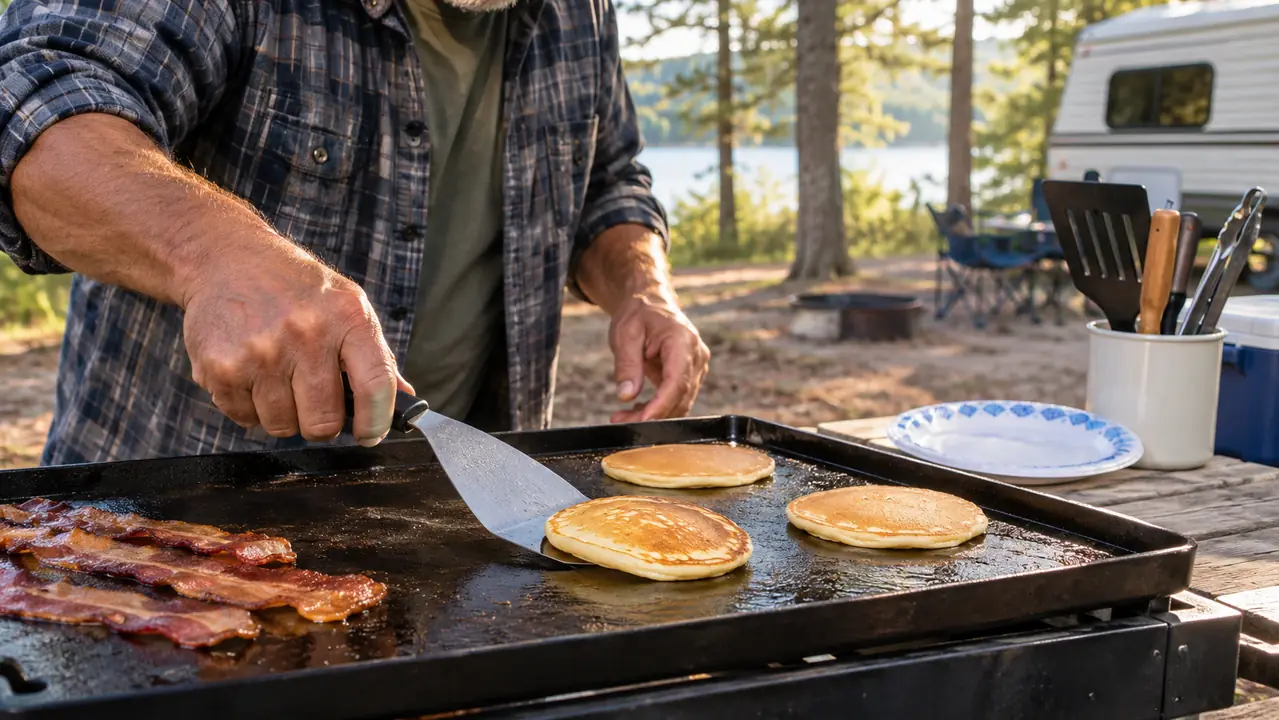
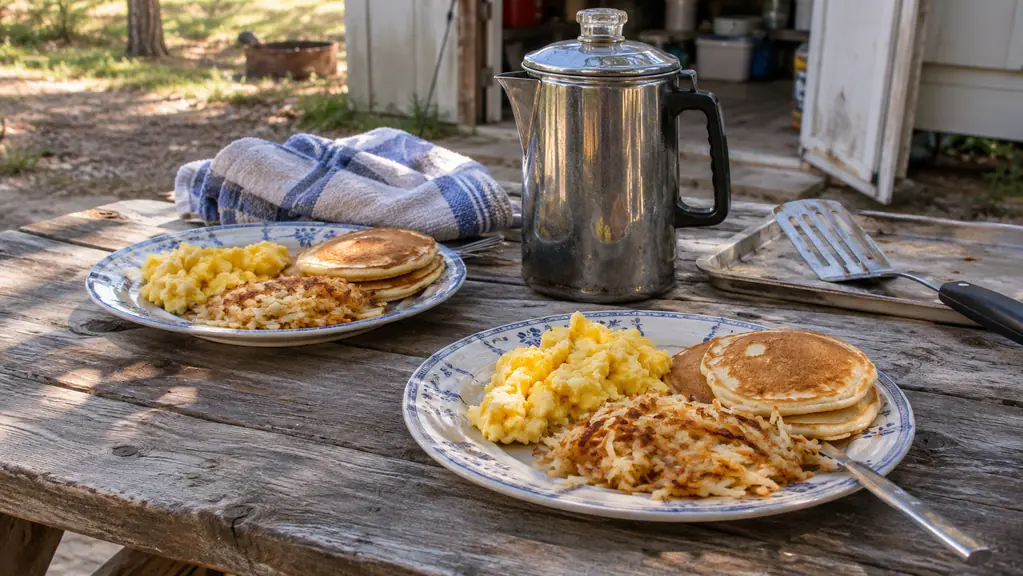
The whole advantage of a griddle is that breakfast cooks at once. Getting that to work means putting things on in the right order, not all at the same time. Hash browns go down first. They take the longest and they do not care what the surface looks like. Spread them thin, press them flat with the spatula, and leave them alone for four minutes before you touch them.
Bacon next, along one side. It renders fat that seasons the surface for everything after it, and it holds fine on a paper towel while the rest cooks. Then eggs, in the cooler shoulder of the griddle, and I crack them into a cup first because a shell in the middle of a hot surface costs you two minutes and some language. Pancakes last, because batter wants the cleanest surface of the morning, and by then the bacon has come off and the plate is sitting under a folded towel.
The surface is 268 square inches, which is more room than it sounds if you are used to a skillet. The listing says it will hold nine burgers, and I have no reason to doubt it. For breakfast I can have six strips of bacon, four hash brown patties and four eggs going at once with space left over. That is the entire reason we bought it: one cook, one surface, one trip back inside with a full plate.
Twenty five minutes at the picnic table instead of forty fighting a two burner cooktop indoors. The galley stove never gets lit, the ceiling never gets steamed up, and the bacon smell stays outside the box we sleep in.
Step 5: Shut it down, scrape it, and deal with the grease before you drive
The grease tray is the part people forget, and it is the part that makes a mess of a storage bay. Ours is generous, and one breakfast for two does not come close to filling it. But it does not empty itself. Before the griddle goes back in the bay, I let it cool, pull the tray, and scrape the fat into a zip bag that goes in the campground trash. Never down the RV sink. That is how you end up with a gray tank that smells like a diner.
Cleaning the cooktop at the campsite takes a scraper, two paper towels and maybe half a cup of hot water. Water is precious in a 25 foot rig with a small gray tank, so I do not run the tap to clean a cooking surface. While it is still warm but not hot, I pour a little water across it, let it lift the residue, scrape it into the tray, then wipe and oil. If it has gone cold, the scraper alone works fine.
Turn the gas off at the cylinder first, not just at the knob. Then the hood goes down and the cover goes on, the griddle goes back in the bay, and the cylinder rides upright in its own corner where it cannot roll. Nine kilos of griddle shifting around in a storage bay is a sound you only want to hear once.
What Else Helps
A few small things have made more difference than I expected. A dedicated flat spatula and a stiff scraper live in a tub with the griddle, so I am never hunting through the galley drawer while the bacon burns. A folded towel under the tub stops it rattling in the bay. A small squeeze bottle of oil means I am not carrying a jug out to the table and back twice a morning. None of it costs much and all of it saves time.
The rest of breakfast does not have to come off the griddle. Coffee and hot water come off the Gas One stove at the other end of the picnic table, which keeps the griddle free for food. On a cold morning, or when we want something that will hold for an hour, the Dutch oven does the work over coals while Ray tends it. Oatmeal, a pan of biscuits, a pot of beans. Two heat sources and one person on each means nobody is waiting on anybody.
Weather decides a lot of this. In February we cook fast and eat inside with the door shut. In July the griddle is the reason we are outside at all, since it keeps the heat and the smell of bacon out of a small box we have to sleep in. If rain is coming in sideways, we skip it and use the two burner inside, and breakfast is simply less good. That is the honest version.
One last thing, and it is the thing I would say to any friend who asked. Learn the routine once, at home, on a dry afternoon, before you take the griddle on a trip. Season it, cook one breakfast on it, scrape it, and put it away. The first morning at a campsite is not the morning to be reading instructions on the back of an oil bottle.
One surface, one trip inside, and the galley stays clean
The BLACKSTONE 1814 tabletop griddle measures 17.5 by 18 by 8.5 inches, fits in an outside storage bay, and runs on a 1 lb cylinder or an adapter hose. Ours has cooked seven months of camp breakfasts, and the routine above is what made it easy.
Amazon Check Today's Price on Amazon →