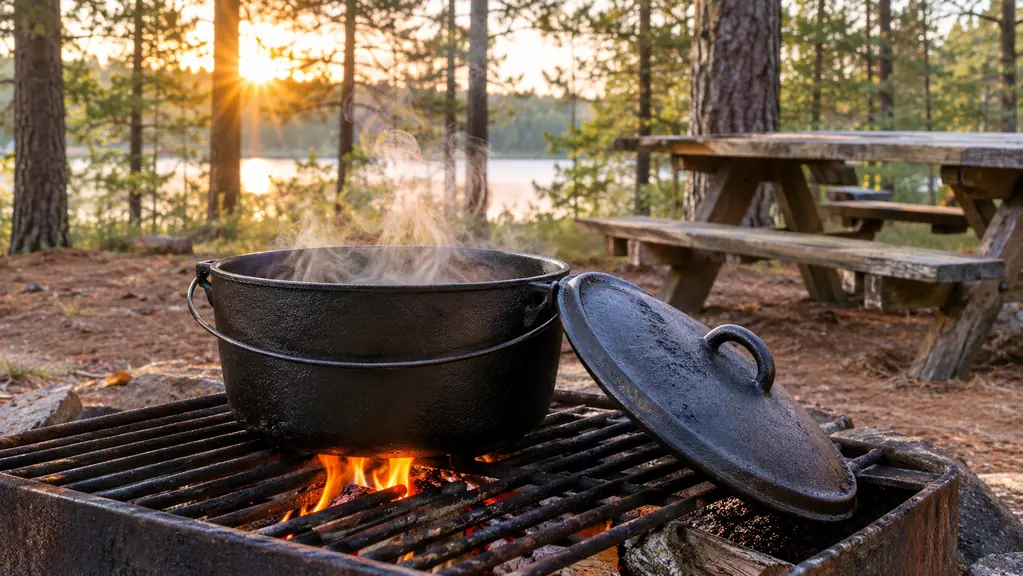
The first meal I cooked in the Lodge double Dutch oven was a pot of chili for four at a wet picnic table outside Bend, and Ray still brings it up. Not the chili. The pot. It came off the coals, sat on the table for half an hour, and the last bowl was still steaming. The onions had gone soft in the lid while the beans simmered underneath.
We bought it in the fall of 2024, at the end of a season of me complaining about our galley. Twenty five feet of motorhome does not leave much room for cookware. I have one narrow drawer and one overhead cabinet, and both were already spoken for. What I did not have was a piece that could go from a burner to a campfire to the table without me carrying three pans and then washing three pans in a sink the size of a cereal bowl.
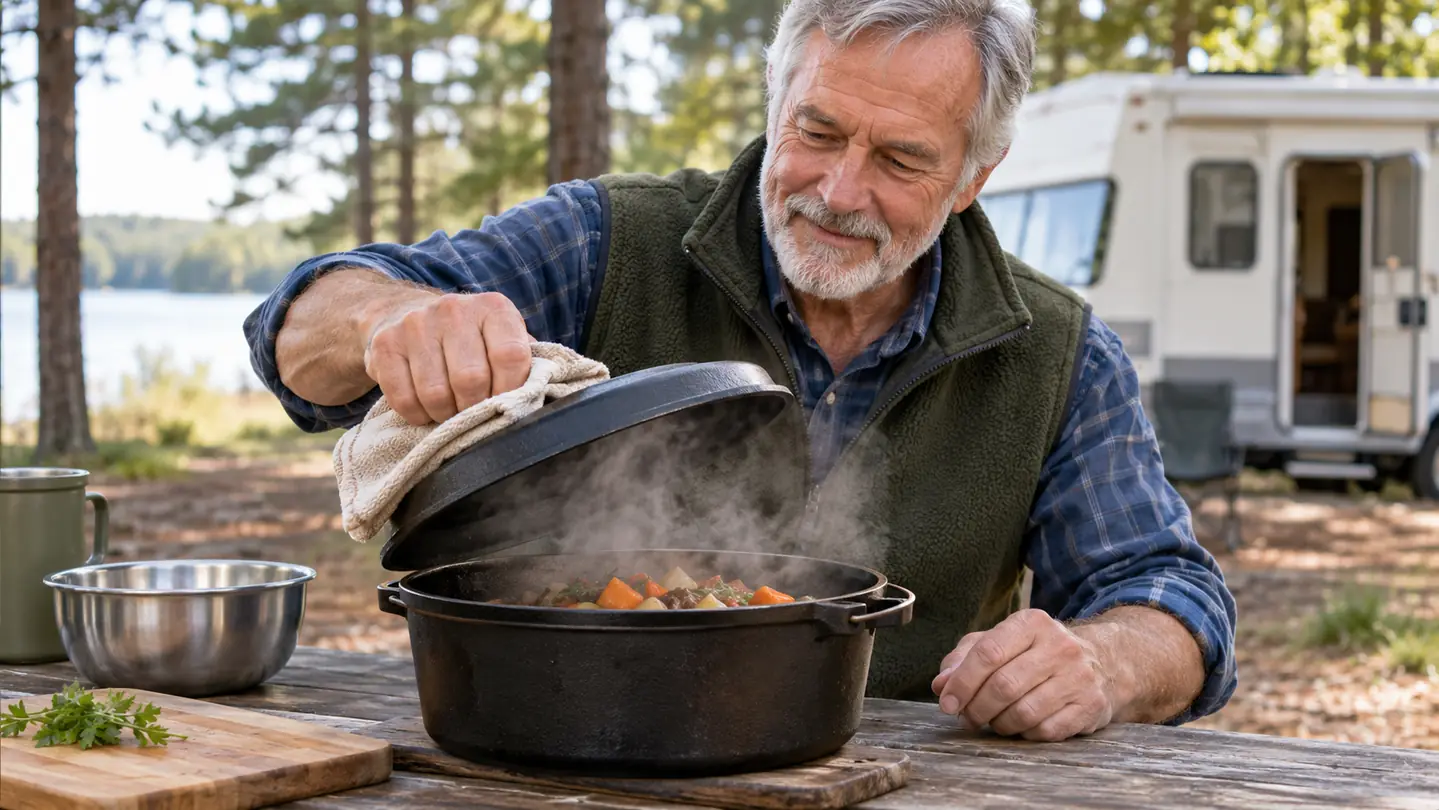
The Lodge double Dutch oven is a 5 quart cast iron pot, 11.15 inches across and 5.55 inches tall, 13.1 pounds with the lid on. The lid is the part I did not expect to lean on so hard. It has two handles of its own, so flipped over it is a skillet, which means one piece of iron does the work of a pot and a frying pan. The listing calls it a 2-in-1 pot and skillet combo. That is exactly what it is.
It lives in a padded bag on the floor of the outside storage bay. That placement is deliberate. At 13.1 pounds it is the heaviest thing we carry for cooking, and in a rig this size the heavy items ride low and centered, never up in a cabinet where a rough road turns them into a missile.
Thirteen point one pounds is the whole argument for this pot and the whole argument against it. I keep it low in the bay and I have never once begrudged the space.
One pot, one skillet, one square of storage bay floor
The 5 quart Lodge double Dutch oven does the job of the pot and the pan I used to carry separately, and it is the first thing I would buy again if it ever walked off.
Amazon Check Today's Price on Amazon →Cast iron is slow and forgiving in a way thin pans are not. I brown the beef right in the pot, add the tomatoes and the beans, put the lid on, and let the coals do the rest. No hot spot in the middle scorching the bottom while the edges stay cool. When the wind picks up I move the whole thing onto the Gas One stove and finish it there. The pot does not care which heat source it is sitting on.
The no-knead bread is what won Ray over. I heat the pot on the grate, drop the dough in, set the lid on, and shovel coals onto the lid. The rim holds them. Twenty five minutes later there is a loaf with a crust that cracks when you cut it, baked at a picnic table, and the pot wipes out with a cloth.

We carry five cooking pieces now and each one earns its space. Ray runs the griddle for breakfast, the single burner handles the smelly cooking outside in summer, the nonstick set stays in the drawer for quick lunches, and the Lodge handles anything that wants a lid and a long, quiet simmer. Nothing overlaps much. That is the only way a small galley works.
Cleaning takes less water than people assume, which matters when the fresh tank is the fresh tank. Hand wash only, a little hot water and a nylon brush, dry it on the burner, then a thin wipe of oil while it is still warm. If I skip the oil I can see it the next morning. The whole routine is about two minutes and it has kept ours in good shape through two winters on the road.
Here is the honest part. It is heavy, and thirteen pounds is real weight in a rig with a limit. The lid gets hot enough that you want a dry cloth and a glove, not a damp towel. It does not go in the dishwasher and it will rust if you put it away wet. If you want cookware you can toss in a bin and forget about, this is not that piece.
What it does better than anything else we own is hold heat. A stew that comes off the fire at six is still warm at eight. Peach cobbler made in it in September, with coals under and coals on the lid, is why we now keep a bag of peaches in the fridge on purpose. It is also rated oven safe to 315 °C and carries a lifetime limited manufacturer's warranty, so it goes into the real oven at the house in Salem between trips without a second thought.
What I'd Tell You If We Were Sitting at My Kitchen Table
If you are standing in a camp store wondering whether one heavy pot is worth the floor space, ask yourself what you actually cook. If chili, stew, soup, bread or a cobbler shows up at your table more than twice a month, this pot pays you back in fewer pans and far fewer dishes. If you are a one-skillet cook who wants everything light and quick, buy something lighter and be happy with it. And either way, put the iron in a bag or wrap it in an old bath towel, because a bare pot rolling around a storage bay will chip its lid rim on the first bumpy road. Mine has a small nick to prove it.
The pot I would buy again tomorrow, and the one I would tell a friend to buy
5 quarts, 13.1 pounds, a lid that works as a skillet, and a lifetime limited warranty. Ours has been on the fire about once a week since the fall of 2024 and it is still the piece I reach for first.
Amazon Check Today's Price on Amazon →