
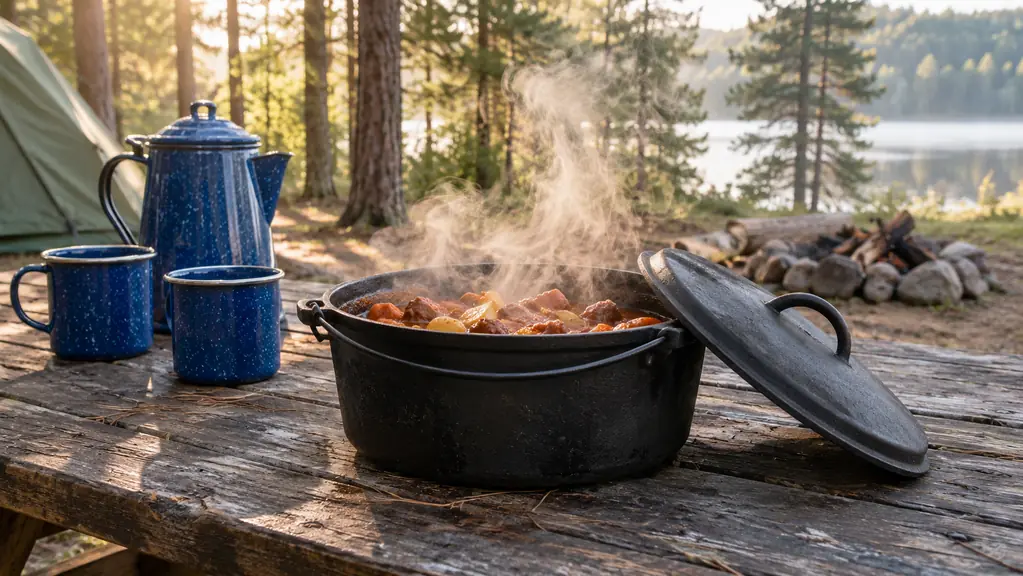
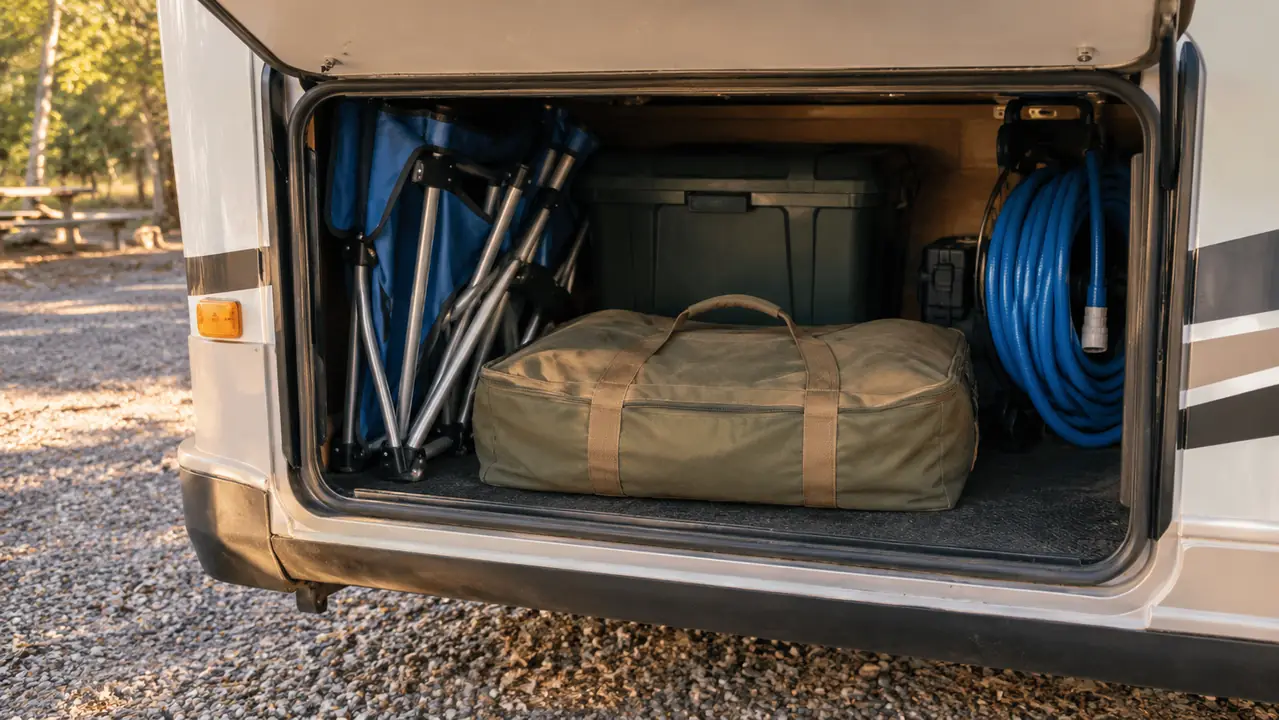
The Lodge Cast Iron Double Dutch Oven came into our rig in the fall of 2024 and it has lived in the outside storage bay ever since, in a padded bag, on the floor, because it weighs 13.1 pounds and I am not lifting that out of an overhead cabinet at seven in the morning. Every camper who sees it on the picnic table asks the same question. Why not an enameled Dutch oven? They clean up easier, they do not need oiling, and they look nice enough to leave out on the table. All of that is true.
My short answer, after two years of cooking in a 25 foot Class C with one narrow galley drawer and one overhead cabinet: for the way we travel, the Lodge is the better fit. The lid is a second pan. The whole thing goes into campfire coals and comes out whole. And on a cold night when I want bread with dinner, there is no other pot in this rig that will do it. An enameled oven still wins on a few things, and I will be honest about which ones, because I have cooked beside plenty of them at campgrounds and I have envied the cleanup more than once.
The Two Ovens Side by Side
| Lodge Cast Iron Double Dutch Oven | Enameled Dutch Oven | |
|---|---|---|
| Pans it replaces | Two. The lid is a dual-handle skillet and cooks on its own | One. The lid only covers |
| Heat it will take | Oven safe, rated to 315 C, and it sits in campfire coals | Rated lower, and direct coals followed by a cold night can craze the glaze |
| Footprint and stow | 11.15 inches across, 5.55 inches tall, 13.1 pounds | About the same footprint, and it wants the same low spot in the bay |
| Cleaning | Hand wash, dry it completely, wipe it with oil | Wash, dry, put it away |
| Tomato and acid | Fine on a built-up seasoning, hard on a thin one | Enamel is inert, acid does not touch it |
| Capacity | 5 quart, 4.75 liters | Six quart ovens hold more, which matters for a whole chicken or a crowd |
| Seeing the fond | Dark iron hides it unless you tilt the pot into the light | A light interior shows the color the moment it takes |
| A drop onto gravel | Dents at worst | A chip is permanent |
| What it costs to buy | Less than the enameled ovens I have priced | More |
The row that matters most to me is the first one. A pot that is also a skillet saves a whole piece of equipment, and in this rig a piece of equipment is a drawer, a cabinet shelf, and about four pounds of payload. The rows where the enameled oven wins are real wins too. I am not going to pretend that washing a pot with a sponge and putting it straight away beats washing, drying, and oiling iron. It does not, and anyone who tells you otherwise has never done dishes in a half inch of water because the gray tank was nearly full.
Where the Lodge Wins
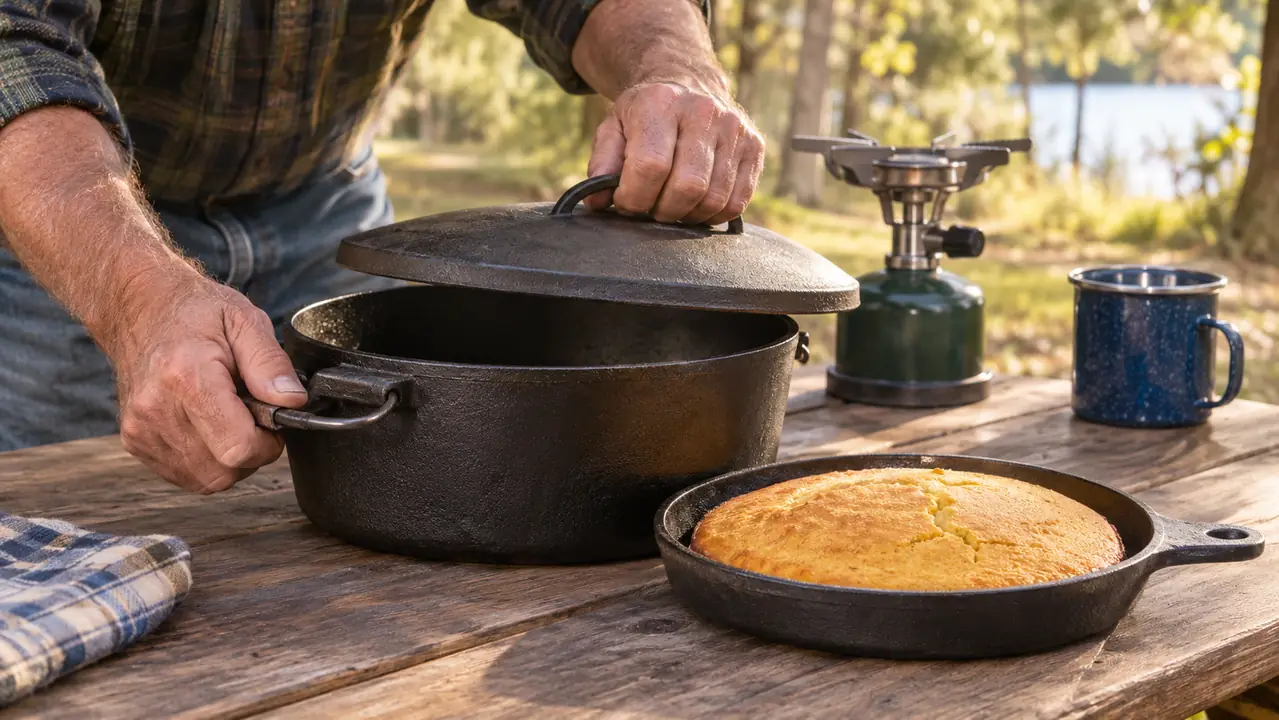
The lid is a dual-handle skillet, and that sounds like a line off the box until you are standing at a picnic table with one pot and two jobs. I brown the onions and the beef in the deep pot, then I set the lid down over a burner and make cornbread in it while the chili simmers. Two dishes, one bag, one wash. At home in Salem I have a cupboard full of pans and I never think about this. In the rig I think about it every single meal, because there is exactly one narrow drawer and one overhead cabinet and both of them are already full.
Then there is heat. The Lodge is oven safe, it is hand wash only, and it is rated to 315 C, which is close to 600 F. I do not carry a number like that around in my head for most pots, but I do know this one has sat in the coals at the edge of Ray's campfire with a pork shoulder in it for four hours and come out fine, and it has gone into the propane oven in the rig for bread more times than I can count. Enamel does not want that treatment. Direct coals, then a cold night, then a hot fire again is exactly the cycle that crazes a glazed surface, and a crazed surface is the beginning of the end.
And it survives a bad morning. Round, 11.15 inches across, 5.55 inches tall, and it dents at worst. Ray knocked it off the picnic table at a state park near Bend and it landed on gravel and the only damage was to my nerves. A chip in enamel is permanent. I watched a camper at a lake near Coulee Dam retire a perfectly good oven because the rim had chipped and she did not trust it anymore, and I understood her reasoning completely.
Where an Enameled Dutch Oven Wins
The enameled oven I am comparing against here is the six quart round type, the shape you see from brands like Tramontina and Le Creuset. What it does better than iron is the part of cooking I like least. Wash it, dry it with a towel, put it away. No oil, no ritual, no checking the seasoning in the morning to see whether last night's chili took a layer off it. When you are doing dishes in a small sink and watching the fresh water run, that difference is not a small one. It is the difference between a five minute job and a fifteen minute job, every night, for as long as you own the thing.
Acid is the other clear win. I make a lot of tomato sauce and a lot of chili with tomatoes in it, and on iron that is a fight with the seasoning whenever the pan is thin. Enamel does not care. Neither does enamel care that the inside of the pot is dark, and a light interior shows you the fond the moment it forms, where iron hides it unless you tilt the pot into the light. I have scorched the bottom of a stew in the Lodge because I could not see what was happening down there. That is a real cost and it belongs in the honest column, not swept under the rug.
Six quarts against five is a small difference on paper and a large one on a holiday weekend. A whole chicken, a batch of chili for eight, a double recipe of cobbler for the potluck at the campground pavilion. The Lodge will do all of those, but it will do them full to the rim, and I have had to ladle some out into a storage container before it boiled over onto a clean burner. If you regularly cook for a crowd, that extra quart earns its keep and then some.
One pot in the bay, two pans at the table
5 quart deep oven with a dual-handle lid that works as a skillet of its own. Oven safe, rated to 315 C, and at home in campfire coals. For a galley with room for one pot, this is the one I kept.
Amazon Check Today's Price on Amazon →How the Lodge Actually Gets Used in Our Rig
Chili is the weekly job. Two pounds of ground beef, onions, peppers, two cans of tomatoes, and it all goes in the deep pot on the Gas One stove outside at the picnic table, so the rig does not smell like onions for three days and the inside does not heat up in July. Ray runs the coals when we want it cooked over the fire instead. The pot goes in the coals with the lid on and coals heaped on the lid, and I check it every twenty minutes or so. That is not a technique I invented, it is just how a cast iron oven has been used for a hundred years.
The bread is the reason I would not give this pot up. A no-knead loaf, mixed the night before, goes into the hot deep pot with the lid on and comes out with a crust I cannot get any other way in a rig this size. I have baked it in the propane oven and I have baked it in coals, and both work. An enameled oven will bake bread too and it will do a fine job. But a hot empty enamel pot preheating at high heat is a thing I would handle carefully, and a hot empty cast iron pot is a thing I have dropped onto a picnic table without a second thought.
Cobbler for the potluck is the third job, and the lid is the fourth. The lid is a dual-handle skillet, so on a morning when Ray is doing pancakes on the griddle, I can have the lid over the other burner with eggs in it and we are not waiting on each other. Two people cooking in a small galley, one pot and one lid, and nobody is standing in the doorway holding a cold plate. That is worth more to me than any feature on a spec sheet.
Living With Thirteen Pounds in a 25 Foot Rig
The weight is the price of admission and I will not pretend otherwise. At 13.1 pounds, it is the heaviest single piece of cooking gear we carry. It rides on the floor of the outside storage bay in a padded bag, low and centered, and Ray carries it out to the table in the morning and back in at night. I do not store it overhead, I do not store it in the narrow drawer, and I do not carry it up a ladder. If you have a bad shoulder or a bad back, this is the part of the decision that should decide it for you.
What I will say in its favor is that it replaces two pans and a baking dish. When I add up what it does, the 13.1 pounds is not 13.1 pounds of extra cookware, it is more like 13.1 pounds standing in for maybe seven or eight pounds of other things, and the things it stands in for are the ones that rattle. That math is why it stays and the extra skillet went home to Salem. Your payload and your back are your own business, but do the math before you buy, not after.
Washing Up With Half a Sink of Water
The care instructions are hand wash only and oven safe, and that is the whole routine. Hot water, a stiff brush, no soap needed on a well seasoned pot, and no soaking, ever. If something sticks, I put a little water in it and set it back on the burner to loosen, then scrape with a flat wooden spatula. I do not leave it in the sink overnight. Not once, not ever, because rust is the one thing that will take a cast iron pot out of service faster than a drop off a picnic table.
Drying is the part people skip. A towel is not enough on a damp morning near the coast. I set the empty pot on a burner for two or three minutes until every bit of water is gone, then wipe the inside with a thin film of oil while it is still warm, then it goes back into the padded bag and down into the bay. It takes about four minutes. An enameled oven takes about thirty seconds. That is the trade, and it is a real one, and it is why I tell people to be honest with themselves about whether they will actually do it.
Thirteen point one pounds, 11.15 inches across, and the lid is a second pan. In a 25 foot rig with one drawer and one cabinet, that math is the whole argument.
Who Should Buy Which
Buy the Lodge if you cook over a campfire, if you bake bread in camp, if you want one pot that turns into two at the table, and if you are willing to spend four minutes drying and oiling it after supper. Buy it if you have a place to stow it low and you are not hauling it up into an overhead cabinet. It is also the right answer if you are hard on equipment, because there is no finish to chip and nothing to baby. Ours has been in and out of the bay roughly once a week since the fall of 2024 and it still looks like a pot that works for a living.
Buy an enameled oven instead if you cook a lot of tomato and wine and citrus, if you want to see what you are browning, if you regularly feed more than four people, and if you know in your heart that you will not oil a pot at nine at night. Buy it if your shoulders are not what they were and you want the shorter cleanup. Buy it if you want something you can take straight to the table and not think about again until tomorrow. None of that is a knock on iron. It is just a different set of priorities, and a small galley forces you to name yours.
If you can only have one, and the rig is 25 feet and the drawer is narrow, my answer is still the Lodge. The two in one design is what does it for me, more than the durability and more than the heat rating. In a rig, the pot that does two jobs beats the pot that does one job better. That is the whole test I apply now, and this one has passed it every week for two years.
If you bake bread and make chili in the same small galley, this is the pot
5 quart deep oven, dual-handle lid that doubles as a skillet, oven safe to 315 C. Hand wash, dry it, oil it, and it goes back in the bay ready for next week.
Amazon See the Lodge Double Dutch Oven on Amazon →