
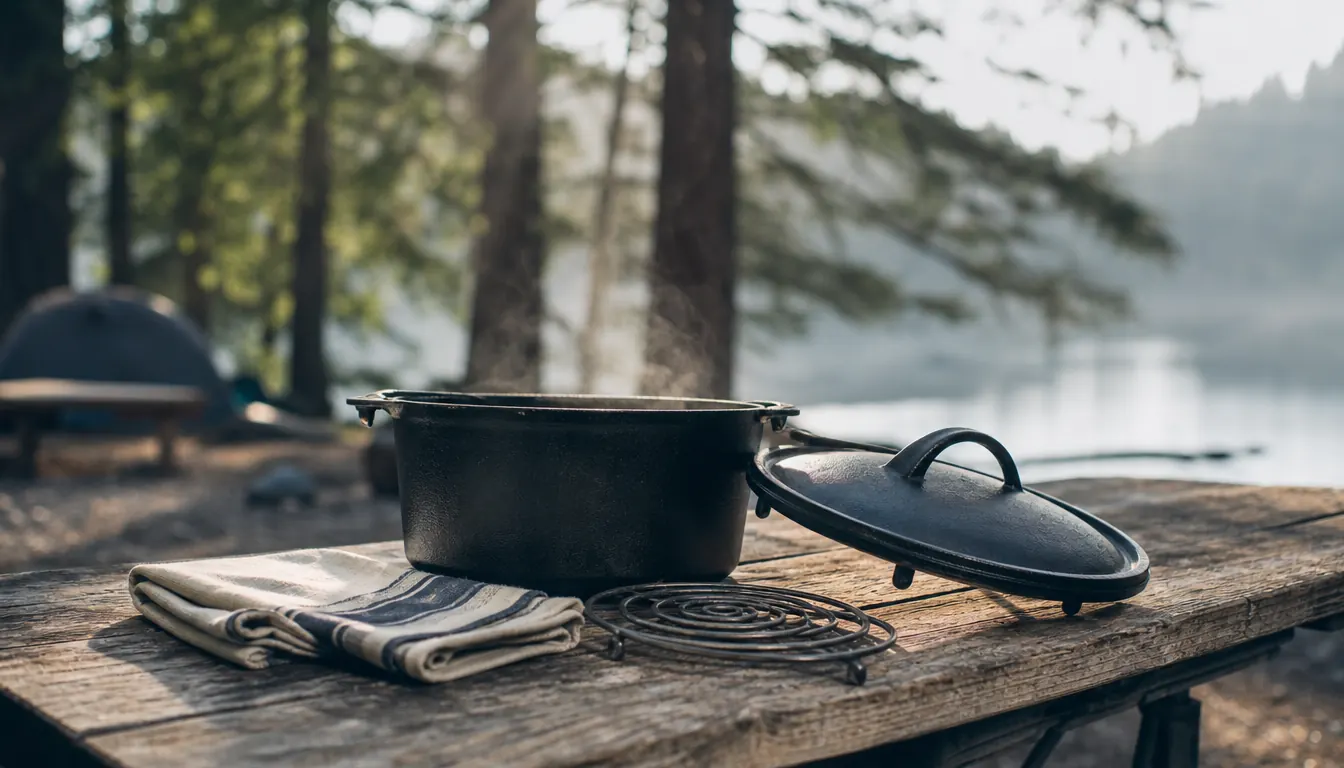
I bought the Lodge Cast Iron Double Dutch Oven in the fall of 2024 for one reason: I wanted one pot that could do the work of three in a galley the size of a coat closet. Eighteen months later I still use it about once a week, and I still have two complaints that almost no review mentions. This is the honest version, the one I would give a friend at the picnic table, about what the 5 quart pot actually does well in a 25 foot motorhome and what it asks of you every single time you lift it.
The short answer before the long one: the Lodge is a good piece of iron. It sears, it braises, it bakes bread, and the lid that turns into a skillet is not a marketing trick. That lid is the reason the thing earns its storage space. But it weighs 13.1 pounds, and in an RV that number is not a footnote. It is the whole conversation. Everything below comes back to those 13.1 pounds and to the water it takes to clean and dry the pot afterward.
The Quick Verdict
Buy it if you have a low outside storage bay, a campfire grate, and the patience to dry and oil iron after every wash. Skip it if lifting 13 pounds off a low shelf is hard on your hands, or if every cup of dishwater is planned.
Amazon Check Today's Price →One pot, two pieces, and a lid that will fry your eggs
The 5 quart Lodge works on a campfire grate, on a one-burner portable stove, and in the oven at home. Current pricing and the full spec sheet are on the listing.
Amazon Check Today's Price on Amazon →How I've Used It, and Why It Lives on the Floor
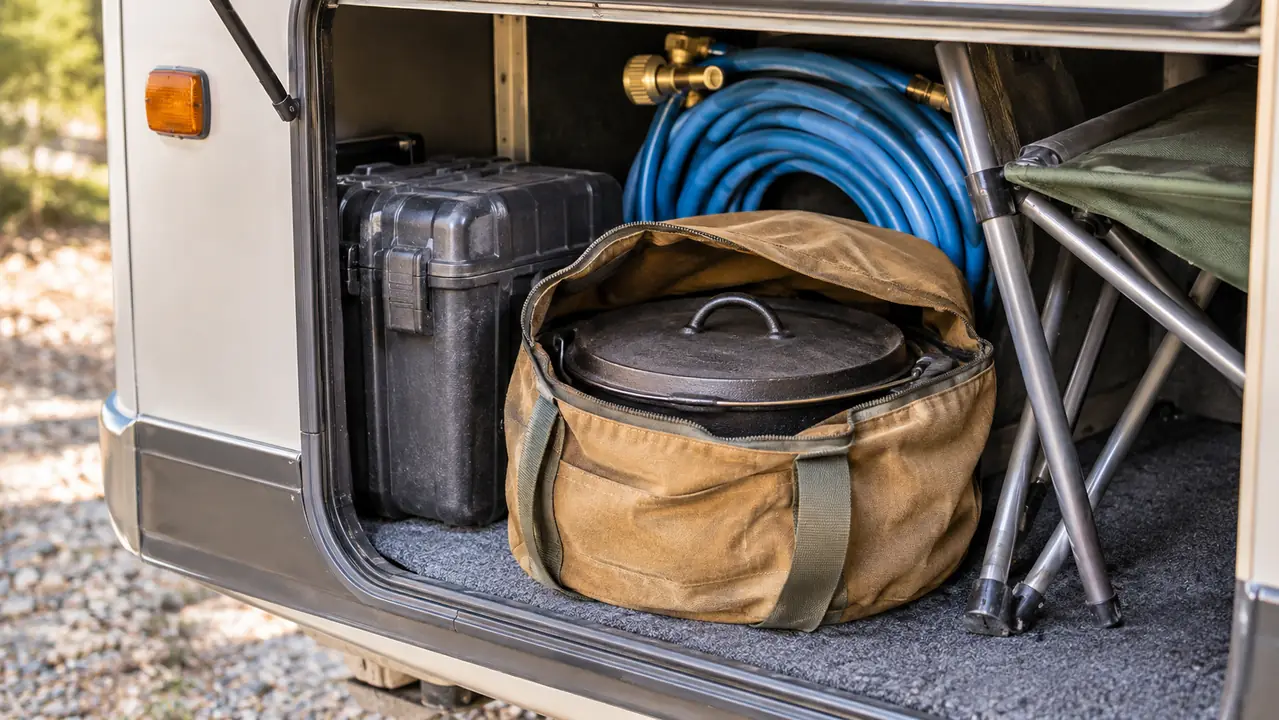
The pot lives in a padded bag on the floor of the outside storage bay, not in the galley cabinet. That was Ray's idea and it was the right one. At 13.1 pounds it is the heaviest thing we carry for cooking, and keeping it low and centered in the bay makes the rig ride better than hanging that much iron off a shelf. The overhead cabinet over the counter holds the collapsible containers and the light pieces. The iron stays down where a dropped pot lands on rubber instead of on my foot.
In the eighteen months since, I have used it about once a week, more in cold weather. Chili, beef stew, a chicken and rice thing I make when the evenings turn cool, no-knead bread, and a peach cobbler that has become a campground reputation. Ray handles the coals and I handle what goes in the pot. We cook it either on the campfire grate or on the portable stove at the picnic table, depending on whether a fire is allowed and how much wind is coming off the water.
What surprised me is how often the two pieces get used separately. On a travel day I will have stew going in the deep half while the lid sits on the second burner with onions in it. That is a two-pot meal out of one item, which matters when the drawer holds exactly one narrow row of cookware and the cabinet above is already full. The last time I did it we were parked at a state park outside Bend with a fire ban posted at the entrance, so the whole meal happened on the portable stove at the picnic table. Chops in the lid, potatoes and broth in the deep half, one burner going, and dishes done by seven. Before this pot that same dinner would have meant a skillet, a saucepan, and a third pan I did not own.
What Nobody Tells You About the Weight
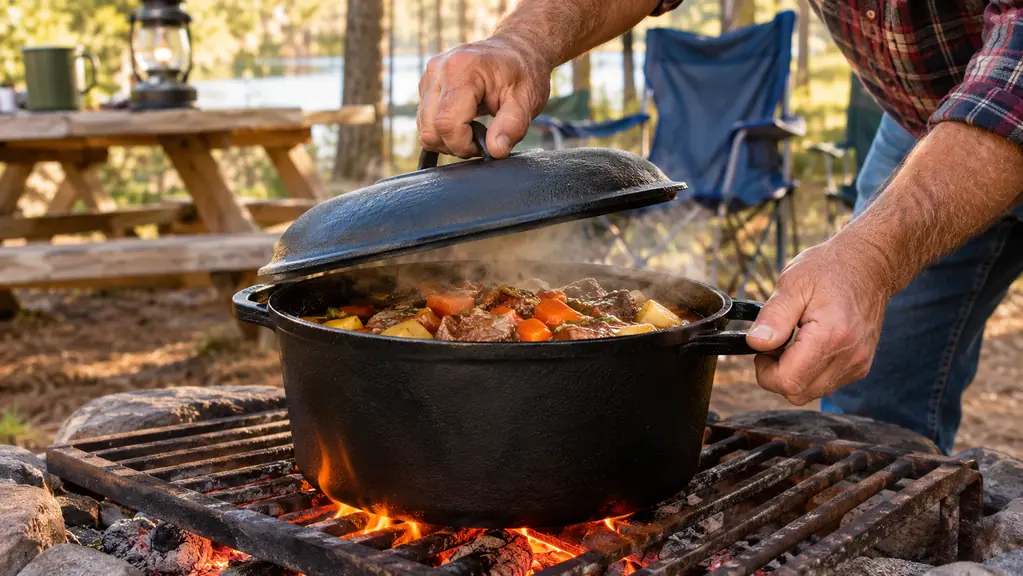
Every review mentions that cast iron is heavy. None of them tell you what heavy means at seven in the morning when you are pulling a cold pot out of a low storage bay with a sore shoulder. Thirteen pounds is roughly a gallon and a half of water, held out at arm's length, in the dark, before coffee. I am 67. Some mornings that is fine. Some mornings I ask Ray to get it, and I am not embarrassed about that.
It matters for the rig too. Cargo capacity in a 25 foot Class C is not generous, and every item gets weighed in my head before it earns a spot. The Lodge replaced nothing. I did not swap out another pot for it, because I did not own a Dutch oven before this one. That means it is 13.1 pounds of added weight, and I chose to spend that weight here rather than on a second cooler. If you are close to your limit, do that math honestly before you buy. I did it on paper at the kitchen table in Salem, with the bathroom scale, before we ever packed the thing. The pot I would otherwise have carried, a three quart with a lid, came in at four and a half pounds. So the real cost was closer to nine pounds of difference, and we paid for it by leaving one folding camp chair at home. I have not missed the chair. Ask me again after a long summer.
Thirteen pounds is nothing on the counter at home. Thirteen pounds at arm's length, out of a low bay, before coffee, is a decision you make every trip.
One more thing about the weight that nobody says out loud: the mass is the feature. You cannot get the even browning and the long slow simmer without it. So the trade is not really a flaw in the design. It is the design, and you should know you are making that trade before the box arrives at the house.
The Lid Is the Reason to Pick This Over a Plain Dutch Oven
A plain Dutch oven has a lid. This one has a lid with two handles that is also an 11.15 inch skillet, and it sits flat on a burner or on coals without wobbling. That detail is why I picked this instead of a deeper pot with a domed top. On our stove it means I can brown four pork chops in the lid while the deep half holds the potatoes and the broth. Nothing gets cold while I wait for a second pan.
The pot itself is 11.15 inches across and 5.55 inches tall, round, with a flat bottom that sits steady on a campfire grate. It is rated to 315 °C, hotter than any bed of coals I have ever set it on, so I do not baby it. The lid goes back on upside down when I want coals on top for bread, and right side up when I want the pot to simmer. Two positions, no extra part, nothing small to lose in the bottom of the bay.
The Chore Nobody Mentions: Drying and Oiling
Here is the part the listing does not dwell on and the five-star reviews skip. It is hand wash only, and after every wash it has to be dried completely and wiped with a thin film of oil. Not a lot of oil. A thin film, all over, inside and out, including the underside of the lid. Skip it and you get rust, and rust on a pot you waited a week for is a bad feeling.
In an RV that chore is bigger than it sounds. Water is limited. We wash in a small basin with as little as we can get away with, which means no long soak and no rinsing under a running tap. I wipe it out with a paper towel, scrub with a plastic scraper and a little hot water, dry it on the burner for a minute, and oil it while it is still warm. The whole thing takes four or five minutes. Done weekly it is nothing. Done at ten at night when you are tired, it is exactly why people leave cast iron at home.
I skipped the oil twice in the first month, both times on a travel day when we rolled in late and I wanted dinner and a shower, in that order. By the third morning there was a patch of orange on the underside of the lid about the size of a playing card. It came off with a green scrub pad and a re-season in the oven back at the house, but it cost me an afternoon and taught me the rule better than any instruction sheet could. Now I oil it before I sit down to eat, not after, because once I am in the chair I am not getting back up for a pot.
I will say the seasoning has held up well. Eighteen months of stews and bread and one cobbler that bubbled over have left it dark and slick enough that eggs slide in the lid. That did not happen in a week. It happened somewhere around the fourth month, and it happened because I kept oiling it on the nights I did not feel like it.
What I Liked
- Two pieces that work separately, and the lid is a real skillet rather than a lid with a handle bolted on
- Holds heat through a long simmer and browns meat without hot spots
- Flat 11.15 inch bottom sits steady on a campfire grate and on a portable stove
- Rated to 315 °C, so coals and a hot fire are not a problem
- Lifetime limited manufacturer's warranty, and cast iron can be repaired rather than thrown out
Where It Falls Short
- 13.1 pounds is a real load in a small rig and a real lift for older hands
- Hand wash, dry and oil after every use, or it rusts
- No long soak and no dishwasher, which is awkward when water is limited
- The deep half is too tall for a galley drawer and takes floor space in a storage bay
The honest summary of the care: it is not hard, it is constant. You cannot set this pot down wet and deal with it tomorrow. If that sentence makes you tired, buy enameled cast iron instead. An enameled Dutch oven does not need oiling, and I say that as somebody who chose bare iron on purpose.
How It Behaves on a Campfire and on a Two-Burner Stove
On the campfire it is at its best. Ray builds a bed of coals off to one side, I set the pot on the grate over the cooler end, and a stew that would scorch in a thin pan will sit there for an hour and come out even. The walls are thick enough that a gust of wind does not knock the temperature around the way it does with the portable stove. One evening in eastern Oregon the wind came off the lake hard enough that the stove flame kept blowing out, and the Lodge just sat there and kept simmering. That is the night I stopped thinking of the iron as the heavy option and started thinking of it as the reliable one. The one thing to watch is the handles. They get hot and they stay hot, and the pot holder in the galley drawer is not the same as the one actually next to you at the picnic table.
On the single burner portable stove it works, with a caveat. The burner is small and the pot is 11.15 inches across, so the outer edge hangs past the flame and the middle of the bottom takes the heat. That is fine for a simmer and for reheating, and I have made bread that way during a fire ban. It is not how I would brown a big batch of meat, because the ring of the pot that sits off the flame will not color. On the rig's two-burner propane cooktop inside, the pot is stable and the low flame is easy to control, but I do not run a long simmer indoors in July. It heats the whole box up.
The microwave is not in this conversation, and neither is the small fridge. This is a stovetop and fire pot, full stop. It is oven safe, which matters more at the house in Salem than it does on the road, and it is the reason I still reach for it between trips.
Where It Fights Back
Cleaning is the first fight. The deep half is 5.55 inches tall inside, which is deeper than my wash basin, so the bottom third of the pot does not get the same attention as the rest unless I tilt it and work at it. If you have ever tried to scrub a stew ring out of a deep pot in three inches of water, you know how that goes. It comes clean. It just takes longer than a flat pan does.
Storing is the second. In our rig it takes a padded bag on the floor of the outside storage bay, which is a whole chunk of floor space in a bay that also holds the portable stove case and the griddle cover. It fits. It simply does not share. If your bay is already tight, measure 11.15 inches across and 5.55 inches tall, add a bag, and see where that lands before you order.
The third fight is the one nobody warns you about: cast iron holds onto what you cook in it. After one fish dinner it took two rounds of washing and re-oiling before the next loaf of bread tasted like bread and not like the lake. I do not cook fish in it anymore. That is a small thing, and small things are what send people back to a nonstick skillet they can rinse and forget.
Who This Is For
This pot is for the camper who cooks real meals and not just coffee and a sandwich. If you make chili, stew, soup, bread or cobbler, and you have a fire ring or a grate you are allowed to use, the Lodge earns its weight. It suits a household with a spot to keep it low, because a heavy pot on a high shelf in a moving vehicle is a bad idea. Retirees who still have the grip and the shoulder for 13 pounds will get years out of it. Ours carries a lifetime limited manufacturer's warranty, and cast iron is one of the few things left that gets repaired instead of replaced.
Who Should Skip It
Skip it if lifting 13 pounds off a low shelf is hard on your hands, or if you would have to ask your partner every single time. Skip it if your fresh water tank is small and every cup of wash water is planned, because bare iron needs a proper dry and oil and that takes water and minutes you may not have. Skip it if you want to cook, eat, and deal with the pot in the morning. And skip it if you have never liked cast iron at home, because a small galley is a terrible place to find out you do not enjoy seasoning maintenance.
None of that is a reason to dislike the pot. It is a reason to buy it with your eyes open. Mine is in the bay right now, dark and slick from eighteen months of Sundays, and I would buy it again. I would just buy it in the fall, when the stews start, and not in the middle of July.
If you cook real meals at the campsite, this is the one piece worth the weight
5 quart capacity, a lid that doubles as an 11.15 inch skillet, hand wash only, 13.1 pounds. The full spec sheet and today's price are on the listing.
Amazon Check Today's Price on Amazon →